
exhalation
noun exhalation
ˌekshəˈleɪʃn
The process or action of breathing out.
He let out a long, weary exhalation as he relaxed his body.
exhalation
ˌekshəˈleɪʃn
読み込み中…
ˌekshəˈleɪʃn
The process or action of breathing out.
He let out a long, weary exhalation as he relaxed his body.
ˌekshəˈleɪʃn
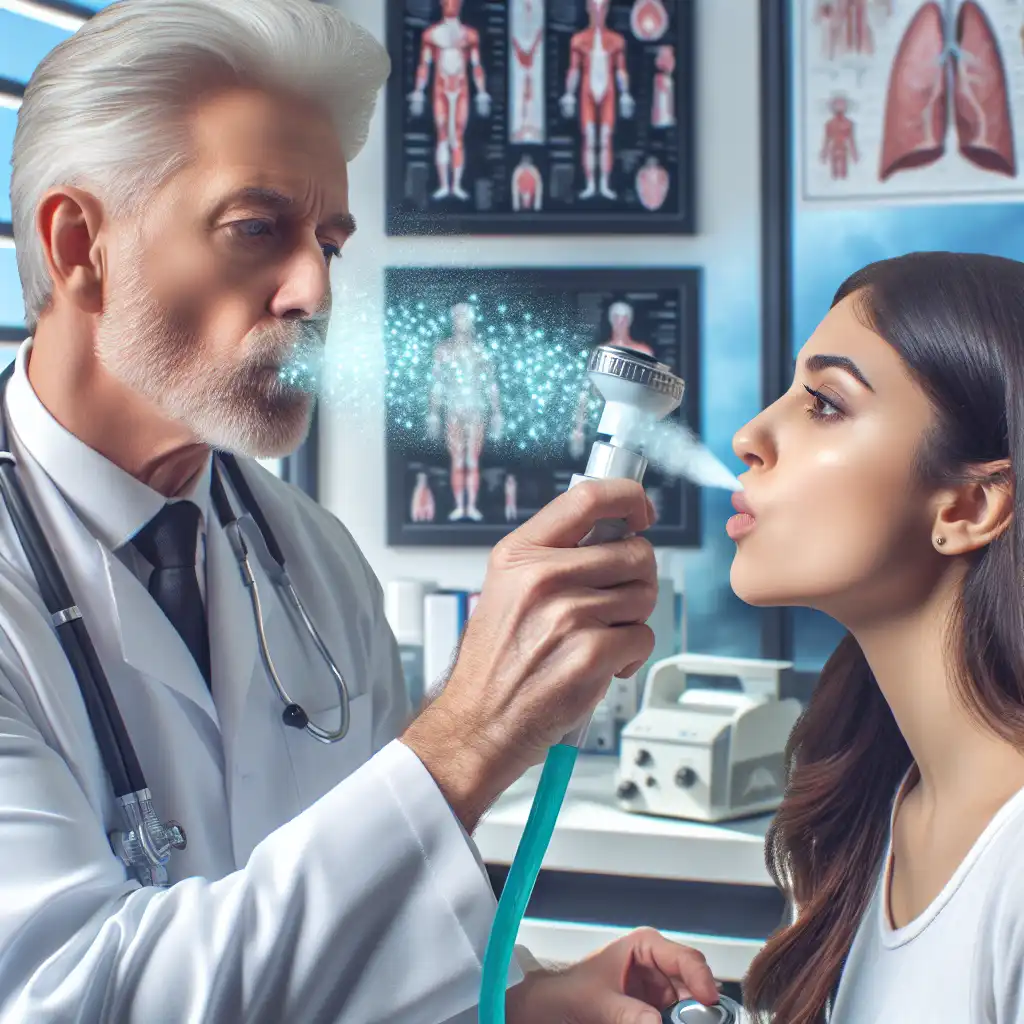
The substance that is breathed out during exhalation.
The doctor uses a device to measure the content of the patient's exhalation.

ˌekshəˈleɪʃn
A way to describe a faint or slight smell in the air.
The soft exhalation of flowers filled the air in the garden.
音声を読み込めませんでした。しばらくしてからもう一度お試しください。
The word 'exhalation' is commonly used when talking about breathing. It refers to the act of breathing out, or expelling air from the lungs. It is often used in medical or scientific contexts, but can also be used in everyday conversation when discussing things like breathing exercises or meditation. So, if you are talking about taking deep breaths and letting them out slowly, you might use the word 'exhalation' to describe the breathing out part of the process.
Both discharge and exhalation refer to the release of something from a confined space, but they are used in different contexts.
Discharge is typically used to describe the release of a substance or material, such as blood, waste, or a firearm, from a container or source.
The primary difference between the two is that discharge refers to the release of a substance or material, while exhalation specifically refers to the act of breathing out.
単語を開く: Discharge →Emission typically refers to the release of something, such as gas, energy or radiation from a source. In the context of environment, it is commonly used to describe the release of pollutants into the air or water by industries and vehicles.
Emission is applicable to the release of pollutants or other substances from a source or object, while exhalation describes the process of breathing out air by living organisms.
単語を開く: Emission →Evaporate refers to the process of a liquid turning into a gas. This occurs when the liquid is heated or exposed to air.
The resulting gas is called water vapor. Evaporation can happen to various liquids, such as water, alcohol, or gasoline.
It is applicable in various settings, such as a pool evaporating in the sun, or rubbing alcohol evaporating from your skin.
単語を開く: Evaporate →Exhaustion is a state of extreme tiredness or fatigue, both mentally and physically. It is a result of prolonged or intense activity that has drained the body's energy.
Exhaustion can also be mental or emotional, caused by stress or anxiety.
Exhalation is a natural body process of breathing out, while exhaustion is a state of extreme tiredness caused by physical or mental strain.
単語を開く: Exhaustion →Expulsion refers to the act of forcing something out, often by using physical or mechanical means.
Exhalation refers to breathing out air, while expulsion refers to the act of forcing something out.
単語を開く: Expulsion →Exhalation refers to the act of breathing out air from the lungs, while outflow refers to any movement or flow that moves outwards from a specific point.
Exhalation is a specific type of outflow, mainly used in relation to breathing. It is applicable in the context of respiratory processes, such as when we exhale air after inhaling.
Outflow has a broader meaning and can refer to a range of outwards movements. For example, it can describe the flow of water out of a tap or the flow of traffic out of a busy intersection.
Exhalation is a type of outflow that relates specifically to breathing, while outflow can refer to any outward movement or flow.
単語を開く: Outflow →Exhalation refers to the act of breathing out, while release refers to the act of letting go or freeing something. Exhalation is applicable in the context of breathing, while release can be used in a variety of contexts, such as in letting go of a ball, releasing a grip, or releasing a statement to the public.
Essentially, exhalation is more specifically related to breathing, while release is a more general term for letting go or freeing something.
単語を開く: Release →Exhalation is the act of breathing out air from the lungs, while ventilate is the act of providing fresh air to a closed space.
Exhalation is applicable to breathing, where a person exhales air from their lungs. Ventilate is applicable to closed spaces like rooms, where air needs to be circulated to avoid stuffiness and maintain air quality.
Exhalation is related to breathing, while ventilation is related to air circulation in closed spaces.
単語を開く: Ventilate →Letting Go With Lemurs -...
YouTube で見る ↗The universe began as an enormous breath being held. I am glad that it did... until this great exhalation is finished, my thoughts live on.
Award-winning teen-age...
YouTube で見る ↗In the inhalation and exhalation there is an energy and a lively divine spirit, since He, through his spirit supports the breath of life, giving courage to the people who are in the earth and spirit to those who walk on it.
How do ventilators work?...
YouTube で見る ↗Lungs 101 %\PIPE% National...
YouTube で見る ↗