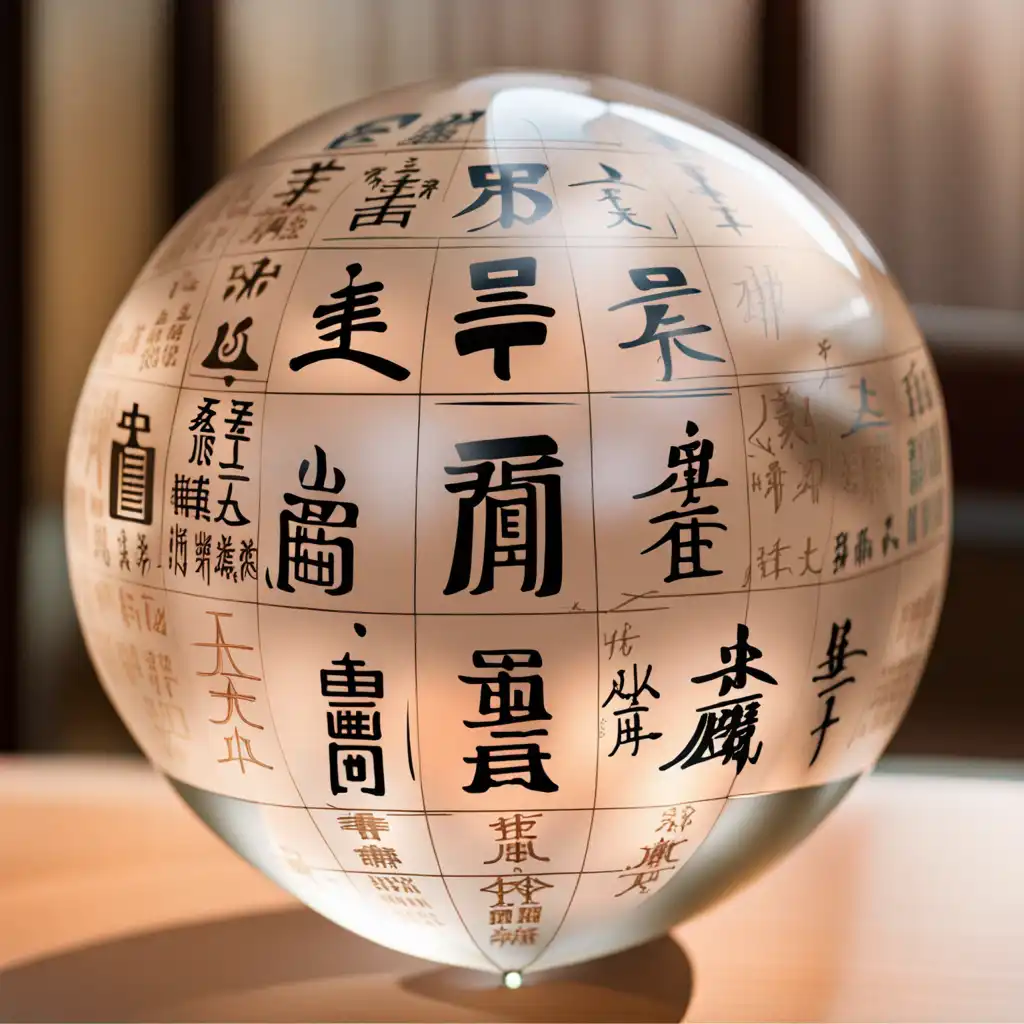
ideogram
noun ideogram
ˈɪdiəɡræm
A symbol or picture used to represent an idea or an object.
Chinese characters are ideograms, where each character represents an idea or concept.
ideogram
ˈɪdiəɡræm
Đang tải…
ˈɪdiəɡræm
A symbol or picture used to represent an idea or an object.
Chinese characters are ideograms, where each character represents an idea or concept.

ˈɪdiəɡræm
An instance of a portmanteau or blend, a word formed by the combination of two words.
In linguistics, ideogram is used to describe words like 'smog' (smoke + fog) or 'brunch' (breakfast + lunch).
Không tải được âm thanh. Vui lòng thử lại sau.
An ideogram is a symbol or picture that represents a certain idea or concept. It is commonly used in writing systems like Chinese and Japanese, where each ideogram represents a different word or object. Ideograms can also be used in other contexts, such as in mathematical notation or in graphic design. It is important to note that ideograms can have different meanings in different cultures or languages, and therefore one must be careful when using them in communication.
Character refers to a written or printed symbol that represents a sound or a word, often used in a specific alphabet or script, such as the Latin alphabet, Chinese script or Japanese script.
For example, the letter 'A' in the English alphabet is a character that represents a sound.
In summary, characters are used to represent sounds or words in written or printed form, while ideograms are used to represent ideas or concepts in visual languages.
Mở từ: Character →An emblem is a symbolic representation that represents an organization, group, or country. It could be a logo or a design that represents something that is important to the group.
Emblems are usually specific to a certain organization and represent something unique to them.
An emblem is more specific to an organization or group, while an ideogram is universal and represents a broader idea or concept.
Emblems are used in branding, while ideograms are used in writing systems.
Mở từ: Emblem →Glyph and ideogram are both symbols or characters with specific meanings, but there are differences between them.
A glyph is a symbol that represents a specific letter or sound in a writing system. For example, in English, the letter "A" is a glyph that represents the sound "a".
Glyphs can be combined to form words and sentences to communicate language.
The main difference is that a glyph represents a sound or letter in a writing system, while an ideogram represents a concept or idea.
Glyphs are applicable in languages that use an alphabet or writing system, while ideograms are applicable in pictographic writing systems.
Mở từ: Glyph →A hieroglyph is a symbol or character from ancient Egyptian writing that represents a word, sound or idea. Hieroglyphs were typically very intricate and often depicted people or animals.
An ideogram is a symbol or character that represents an idea, thought or concept. Ideograms are typically simpler in design than hieroglyphs and may be found in a variety of writing systems, including Chinese Hanzi and Japanese Kanji.
Both hieroglyphs and ideograms are used to convey meaning in written communication.
However, hieroglyphs were specific to the ancient Egyptian writing system, whereas ideograms can be found in a variety of languages and cultures.
Mở từ: Hieroglyph →An icon is a visual symbol that represents a person, idea, or concept. They are usually simple and recognizable, such as a heart for love or a star for fame.
Icons are commonly used in technology and graphic design to quickly communicate ideas.
They are more complex than icons and are used as a primary means of communication in some written languages.
In summary, icons are used as graphical representations of ideas or concepts, while ideograms are used to represent words or phrases in written language.
Icons tend to be more simple and recognizable, while ideograms are often more complex and require interpretation.
Mở từ: Icon →A mark is a simple symbol or sign that can have diverse meanings depending on the context in which it is used. A check mark, for example, can indicate completion, approval, or correctness, depending on the situation.
In summary, ideograms are symbols that represent concepts or ideas, while marks are simple symbols or signs that can have various meanings depending on context.
Mở từ: Mark →A sign is a symbol or gesture that communicates a specific message or meaning.
It can be used in various contexts, such as road signs, caution signs, or hand gestures.
In essence, an ideogram is more abstract and represents an idea or concept, while a sign is more concrete and communicates a specific message or meaning.
Mở từ: Sign →Both ideogram and symbol are visual representations of meaning.
An ideogram is a symbol that represents an idea or concept rather than a sound. Ideograms are often used in languages such as Chinese and Japanese, where a single character can represent an entire word or phrase.
A symbol is a visual representation that stands for an object, idea, or process. Symbols are often used in everyday life, such as traffic signs, logos, and emojis.
In summary, ideograms represent ideas or concepts, while symbols represent objects or processes. Ideograms are typically used in linguistics or technical fields, while symbols are used in everyday life and can have cultural significance.
Mở từ: Symbol →To put down an ideogram of a table so that people will recognize it as a table is not the work of a painter, but to sense it for a moment as a magic carpet with a leg hanging down at each corner is the beginning of a painter's imagination.