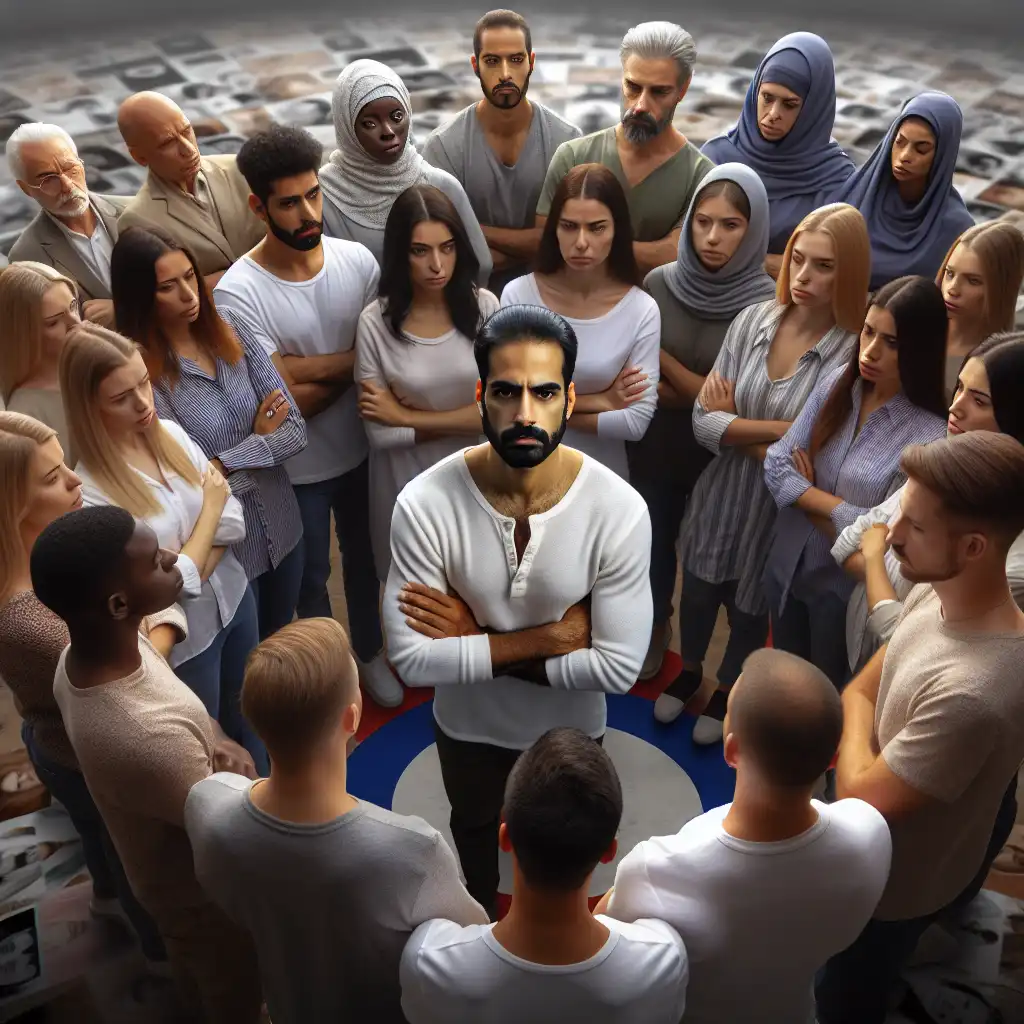
Related to or involving a religious or political group and the strong support of its interests, especially to the exclusion of other beliefs or interests.
Sectarian strife often leads to violence in society.
Audio could not be loaded. Please try again later.
How to use
The word "sectarian" is used to describe a situation where people strongly disagree or fight with each other because of their different religious or political beliefs. For example, if two groups of people who follow different religions argue and fight with each other, it can be described as a sectarian conflict. The word can also be used to describe someone who only supports or believes in their own group's ideas while ignoring or belittling the ideas of others. It is important to be respectful of others' beliefs and avoid causing sectarian division.
A bigot is someone who is intolerant of other people's beliefs or opinions, especially when they differ from their own.
Sectarianism is a type of bigotry that specifically relates to religious differences. It refers to the discrimination or hostility between different religious groups, often resulting from different beliefs or practices.
In simpler terms, a bigot is someone who is intolerant of anyone who is different from them, whereas sectarianism is the intolerance between different religions.
Dogmatic refers to someone who strictly follows a set of beliefs or principles without considering other viewpoints. It implies a rigid, inflexible adherence to a certain ideology or doctrine, without room for debate or discussion.
So, in short, dogmatic refers to a person who holds unwavering beliefs while sectarian refers to a person who shows favoritism towards a particular group.
Exclusive refers to something that is limited to a select group of people or things, and usually implies that others are barred from it.
For example, an exclusive club or a designer clothing brand that is only available to wealthy people.
So, while both words refer to things that are limited to certain groups, exclusive usually implies a sense of elitism, while sectarian often implies a sense of division or conflict between groups.
Fanatical describes someone who is extremely enthusiastic and obsessive about a particular thing, idea, or activity, often to a point where they have irrational beliefs or behavior.
For example, a fanatical fan of a sports team might be willing to do anything to support their team, even if it means breaking the law or hurting others.
So while both words refer to people with strong beliefs, fanatical is more about someone who is obsessively enthusiastic about something, while sectarian refers to someone who is intolerant or exclusionary towards those who don't share their beliefs.
Intolerant means a lack of acceptance or patience towards people who have different beliefs, opinions or lifestyles.
So, while intolerant implies an unwillingness to accept differences in general, sectarian implies an exclusive devotion to a particular group or set of beliefs.
Both words can be used in various contexts, such as politics, religion, or even personal relationships, but intolerant is more commonly used to describe behavior towards individuals and groups, while sectarian is more often used to describe attitudes towards ideologies or belief systems.
Partisan refers to someone who strongly supports a particular party or group, often without considering other viewpoints or opinions.
Overall, while both words refer to people who are fiercely loyal to a particular group or belief system, partisan typically applies more to politics, while sectarian generally relates more to religious or ideological beliefs.
Of course, violence will not end with our combat mission. Extremists will continue to set off bombs, attack Iraqi civilians and try to spark sectarian strife. But ultimately, these terrorists will fail to achieve their goals.
The good news from the U.S. military survey of focus groups is that Iraqis do accept the Nuremberg principles. They understand that sectarian violence and the other postwar horrors are contained within the supreme international crime committed by the invaders.
The role of the government is not to solve religious or sectarian or ethnic problems. These are age-old. I don't think any government of the day can solve all differences. But the government of the day can deliver to our citizens and show our citizens that they are equal in front of the law.