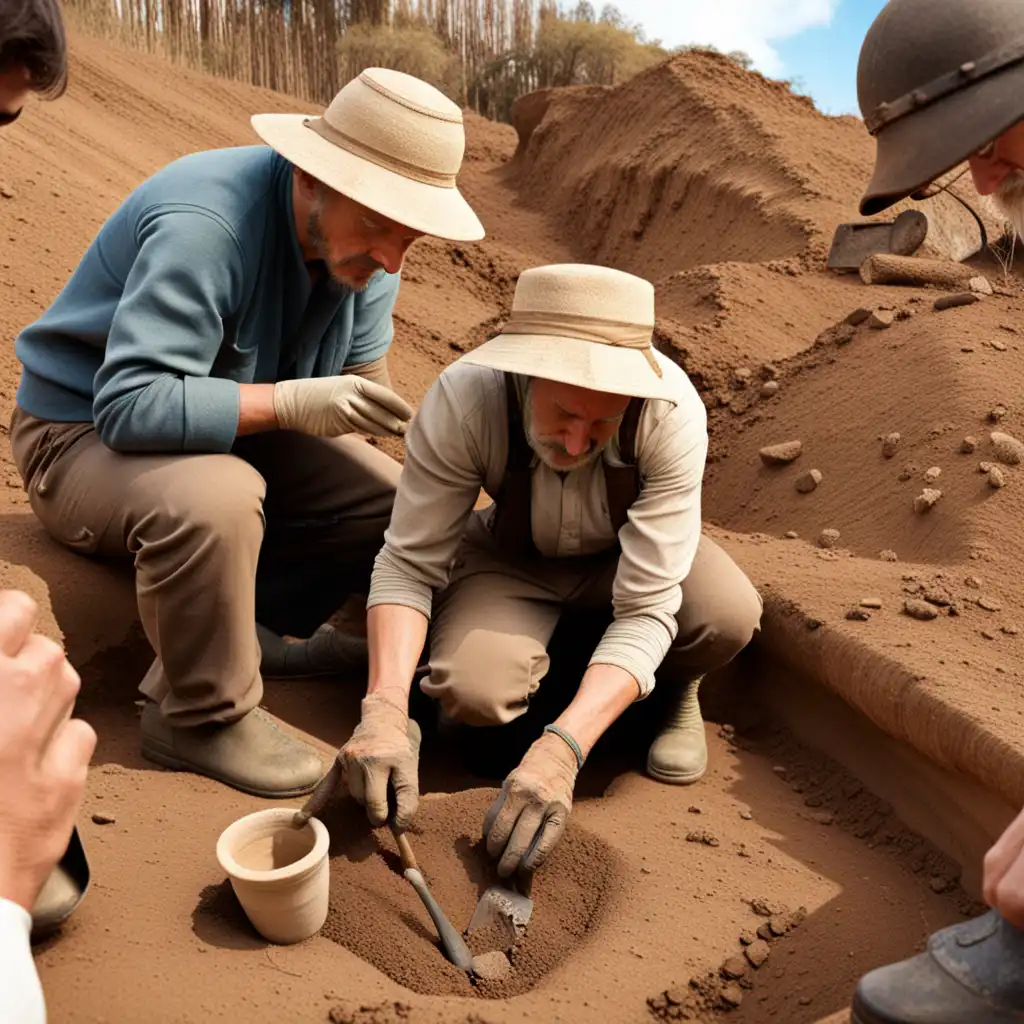
unearth
verb unearth
ʌnˈɜːrθ
To dig out or reveal something hidden or buried
Archaeologists unearthed an ancient artifact.
unearth
ʌnˈɜːrθ
Cargando…
ʌnˈɜːrθ
To dig out or reveal something hidden or buried
Archaeologists unearthed an ancient artifact.

ʌnˈɜːrθ
To find out or reveal a fact or information that was hidden or unknown
The investigation unearthed some interesting facts about the case.
No se pudo cargar el audio. Inténtalo de nuevo más tarde.
The word 'unearth' means to discover or dig up something that was previously hidden or unknown. It is often used to describe finding something that has been buried in the ground, such as an ancient artifact or treasure. You could also use it in a figurative sense, such as "unearthing" a new talent or discovering a piece of information that was previously unknown. It is a word that is commonly used in academic or scientific contexts when talking about uncovering new evidence or research.
Both dig up and unearth mean to unearth or uncover something from the ground, but dig up is more casual and can refer to any situation where something is dug from the ground.
For example, you dig up weeds in the garden, but archaeologists unearth ancient artifacts from a dig site.
Abrir palabra: Dig up →Discover means to find something that was previously unknown or hidden.
In essence, discover means finding something new, while unearth means finding something that was hidden or buried.
Abrir palabra: Discover →Both words expose and unearth refer to uncovering something, but they have slightly different connotations.
Expose usually refers to revealing something that was hidden or secret, often with the intention of causing shame or negative consequences.
For example, a news investigation might expose a corrupt politician, or a whistleblower might expose illegal activities within a company.
So, in simple terms, expose is used when something negative or shameful is revealed, while unearth is used when something valuable or interesting is discovered.
Abrir palabra: Expose →Extract means to obtain something from a source, usually by removing or pulling it out. It is commonly used when talking about getting a substance or information out of something else.
For example, we might extract juice from fruit or extract data from a database.
Extract is about taking something out, while unearth is about uncovering something that was hidden.
Extract is more commonly used when talking about substances or information, while unearth is used when talking about physical objects or secrets.
Abrir palabra: Extract →Both ferret out and unearth means to discover something, but ferret out implies finding something that is hidden, elusive or difficult to find, while unearth implies finding something that is buried or hidden underground.
For example, you might say "I had to ferret out the answer to that tricky question" which means you had to work hard to find the answer that was difficult to find.
Abrir palabra: Ferret out →Reveal means to make something known or visible that was previously hidden or secret.
For example, you could say that a detective revealed new evidence in a case, meaning that they shared information that was previously unknown.
Abrir palabra: Reveal →Both uncover and unearth mean to reveal or bring something hidden to light.
However, unearth usually implies that the object has been buried or hidden in the ground, while uncover can refer to something that is hidden but not necessarily in the ground.
For example, you can uncover a secret or uncover a painting that has been hidden behind a curtain. You can unearth a treasure or unearth a fossil from the ground.
Abrir palabra: Uncover →Unveil, on the other hand, means to reveal something that was previously hidden or secret, but it doesn't necessarily involve physically digging it up.
It can refer to unveiling a new product, revealing a surprise or secret, or even revealing a new piece of artwork or clothing.
Unearth is used when finding something physical that was previously hidden or buried, while unveil is used when revealing or making public something that was previously hidden or secret.
Abrir palabra: Unveil →The genius of Marie...
Ver en YouTube ↗Grown-ups and children are not readily encouraged to unearth the power of words. Adults are repeatedly assured a picture is worth a thousand of them, while the playground response to almost any verbal taunt is 'Sticks and stones may break my bones, but words will never hurt me.' I don't beg so much as command to differ.
Mohenjo Daro 101 %\PIPE%...
Ver en YouTube ↗Do what you love. Know your own bone; gnaw at it, bury it, unearth it, and gnaw it still.
You are fluent in this...
Ver en YouTube ↗Conscience, the power of conscience, can unearth all kinds of things.
Mapping wilderness %\PIPE%...
Ver en YouTube ↗The Khelo India University Games is a great way to unearth talent in this country.
Discovering Attenborough'...
Ver en YouTube ↗There seems to be more abiding interest in unearthing old memos abroad than there is here.
The World Machine %\PIPE%...
Ver en YouTube ↗Whenever you can bring your chops in as a reporter to unearth a cool story, that's always a good thing.
Digging up Paperwork %\PIPE%...
Ver en YouTube ↗I just care about what I get to unearth and what makes me uncomfortable and what makes me grow because, ultimately, I just don't want to ever play it safe.
Child Sacrifice in the...
Ver en YouTube ↗If you get back into the beginner mindset, you can unearth an energy and a fire that I didn't know I could even still possess.
The Train Heist %\PIPE% Think...
Ver en YouTube ↗With any new medium, the full power is only unearthed with experimentation.
Dan Berkenstock: The...
Ver en YouTube ↗I always keep myself open to different roles because I believe by taking up a variety of roles, one's true potential is unearthed.