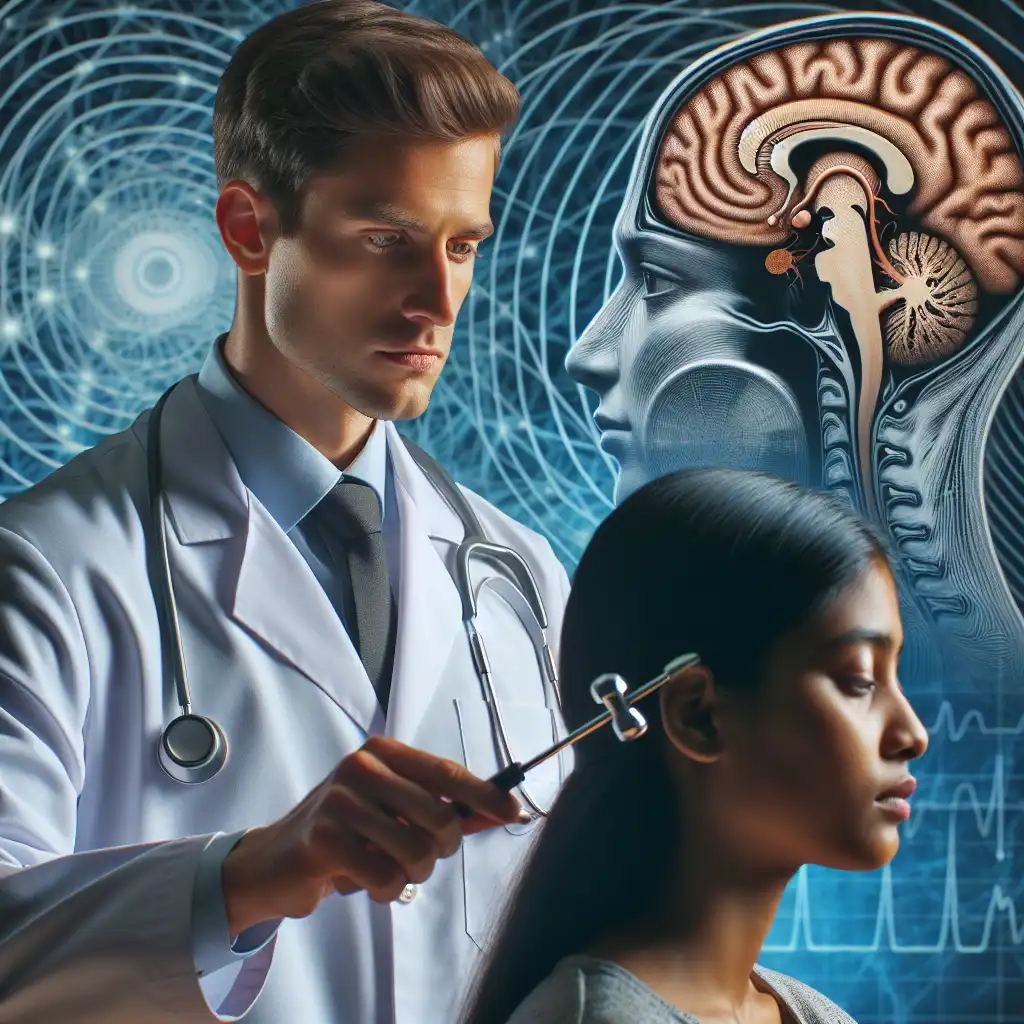
neurologist
noun neurologist
nʊˈrɑːlədʒɪst
A doctor who studies and treats diseases of the nervous system
After falling off his bike, he was advised to see a neurologist to check for any possible brain damage.
neurologist
nʊˈrɑːlədʒɪst
Đang tải…
nʊˈrɑːlədʒɪst
A doctor who studies and treats diseases of the nervous system
After falling off his bike, he was advised to see a neurologist to check for any possible brain damage.
Không tải được âm thanh. Vui lòng thử lại sau.
A neurologist is a doctor who specializes in the treatment of disorders related to the brain, spinal cord, and nervous system. They help diagnose and treat conditions like epilepsy, stroke, multiple sclerosis, Alzheimer's disease, and Parkinson's disease. If you have any problems related to your brain or nervous system, you may need to see a neurologist. They can help you understand your condition and suggest the best treatment for you.
A neuroscientist is a researcher who studies the nervous system, including its development, structure, and function. They explore different aspects of the nervous system, such as how it processes information, regulates behavior, and controls movement.
A neurologist is a doctor who treats patients with nervous system disorders, while a neuroscientist is a researcher who studies the nervous system to better understand how it works.
Mở từ: Neuroscientist →A neurosurgeon is also a medical doctor but specializes in treating conditions of the nervous system that require surgical intervention.
This can include things like brain tumors or spinal cord injuries. Neurosurgeons perform surgeries on the brain or spine to correct problems that cannot be fixed through other treatments like medications or therapy.
A neurologist diagnoses and treats neurological disorders with non-surgical methods, while a neurosurgeon performs surgeries on the brain or spine to correct more serious conditions that cannot be treated with non-surgical options.
Mở từ: Neurosurgeon →and of being the cause of things that happen in the world. And there are experiences of being a continuous and distinctive person over time, built from a rich set of memories and social interactions. Many experiments show, and psychiatrists and neurologists know very well,
Xem trên YouTube ↗Neurologists have a host of clinical tests that let them observe what a brain-damaged patient can and cannot do.
cold towel and pause stimulation at this early stage dog brain cells and neural connections between them strengthen and multiply some neurologists say these
Xem trên YouTube ↗I wanted to be a neurologist. That seemed to be the most difficult, most intriguing, and the most important aspect of medicine, which had links with psychology, aggression, behavior, and human affairs.
with the latest in machine learning which is very advanced by now we can now quantify exactly where somebody lies on a continuum between health and disease using voice signals alone so these voice based tests how do they stack up against expert clinical tests well they're both non-invasive the neurologists test is
Xem trên YouTube ↗Parkinson's is very hard to diagnose. So when I finally went to a neurologist, and he said, 'Oh, you have Parkinson's disease,' I was completely shocked.
So because of this, as your voice is the sound you hear the most in your life, you actually hear it less than other sounds. Finally we have a fourth filter. It's a neurological filter. Neurologists found out recently
Xem trên YouTube ↗As a practicing neurologist, I place central importance in applying current science to the notion of disease prevention.
sociologists neurologists and fertility specialists already that claiming your 20s is one of the simplest, yet most transformative things you can do for work for love for your happiness, maybe even for the world.
Xem trên YouTube ↗What I should have been, you see, is a neurologist.
But the journey itself was worthwhile taking. And at this point by this summer, everybody -- scientists sports scientists, endurance experts neurologists, my own team Bonnie -- said it's impossible.
Xem trên YouTube ↗We have a habit of turning to scientists when we want factual answers and artists when we want entertainment, but where are the facts about the nature of the self? Neurologists peering at PET scans and fMRIs know they aren't seeing the soul in there.
I even saw a psychiatrist. My psychiatrist said "It's clear you're really sick, but not with anything psychiatric. I hope they can find out what's wrong with you." The next day my neurologist diagnosed me with conversion disorder.
Xem trên YouTube ↗The first neurologist I saw just thought I was partying too much, and he stuck by that claim even after my family insisted that he was wrong.
and indeed that's what neurologists do. I mean you have patients that actually suffer pains, and you try to get an objective science of that. Okay I promised to refute all these guys, and I don't have an awful lot of time left, but let me refute a couple more of them. I said that behaviorism ought to be
Xem trên YouTube ↗I come from a pretty scientific family. My sister is a neurologist and my brother is an engineer.
And after spending all my life wanting to do art, I left art school and then I left art completely. But after a few years I just couldn't stay away from art, and I decided to go to a neurologist about the shake and discovered I had permanent nerve damage.
Xem trên YouTube ↗I started out as a neurologist. I then trained in neuropathology and was focused on neurodegeneration. So, for years, I studied Alzheimer's, aging, Parkinson's, that kind of thing.
But there's another rare syndrome so rare in fact, that very few physicians have heard about it not even neurologists. This is called the Capgras delusion, and that is a patient who's otherwise completely normal, has had a head injury comes out of coma,
Xem trên YouTube ↗The neurologist calls it 'Non-REM parasomnia'. For the sufferer, it might mean rising in the middle of the night, getting your motorbike out, going for a ride, and waking in the morning with no memory of the experience.