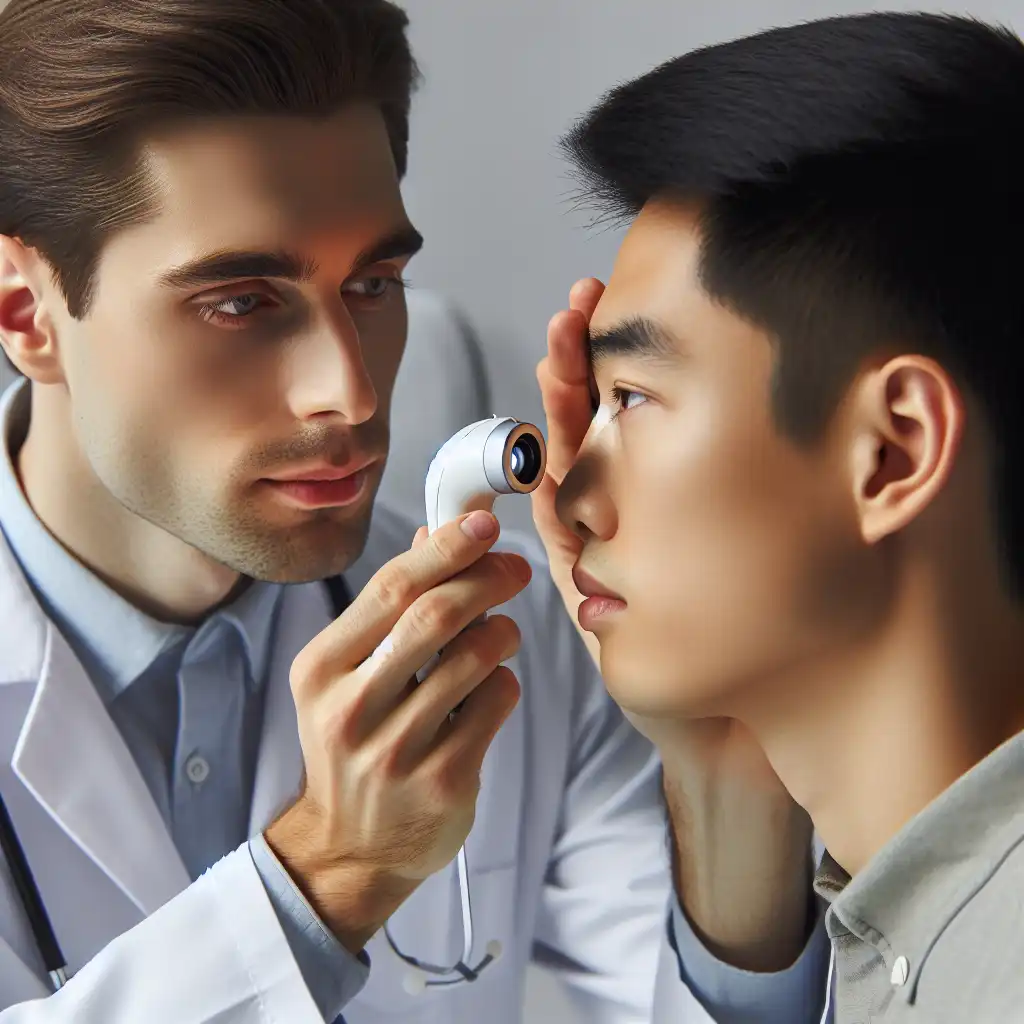
corneal
adjective corneal
ˈkɔːrniəl
Relating to the cornea, the clear front surface of the eye.
The doctor examined the patient's corneal reflex to determine the health of his eyes.
corneal
ˈkɔːrniəl
Chargement…
ˈkɔːrniəl
Relating to the cornea, the clear front surface of the eye.
The doctor examined the patient's corneal reflex to determine the health of his eyes.
Impossible de charger l’audio. Réessayez plus tard.
The word 'corneal' refers to something related to the cornea, which is the clear part of the eye that covers the iris and the pupil. It is typically used in medical contexts related to the eyes, such as corneal transplants or corneal infections.
Corneal refers specifically to the cornea, which is the clear, outer layer of the eye. It's used to describe something related solely to the cornea, such as corneal abrasion (a scratch on the cornea).
Eye is more general, encompassing the entire organ of sight.
It can refer to anything related to the eye, including the cornea, iris, lens, and retina.
Corneal refers only to the cornea while eye refers to the whole organ.
Ouvrir le mot: Eye →Cornea is the clear outer layer at the front of the eye, which covers the pupil and iris. The cornea is like a window through which light enters the eye.
The iris is the colored part of the eye, which surrounds the pupil. It is responsible for controlling the amount of light that enters the eye through the pupil, by changing the size of the pupil.
The iris contracts in bright light and expands in dim light.
The cornea is the clear outer layer that helps to focus the incoming light, while the iris is the colored part that controls how much light enters the eye.
Ouvrir le mot: Iris →Ocular refers to everything related to the eye as a whole, including the cornea, iris, pupil, lens, retina, etc.
So anything related to the eye in general, such as ocular diseases or ocular surgery, is described using this term.
Corneal is a more specific term that refers only to the cornea, while ocular is a more general term that refers to everything related to the eye.
Ouvrir le mot: Ocular →Corneal refers specifically to the cornea, which is the clear, front part of the eye covering the iris and the pupil. Ophthalmic, on the other hand, refers more broadly to things related to the eye as a whole, including the cornea but also the lens, retina, and other parts.
Ophthalmic would be used in a wider variety of contexts, such as ophthalmic surgery or ophthalmic medications.
Ouvrir le mot: Ophthalmic →Optic refers to the part of the eye called the optic nerve, which carries visual information from the eye to the brain.
Corneal is applied to the clear outer layer of the eye that helps to focus light, while optic is applied to the nerve that carries visual information from the eye to the brain.
Ouvrir le mot: Optic →The retina is a layer of tissue inside the eye that senses light and sends signals to the brain to form visual images. It contains specialized cells called photoreceptors that respond to light and help to create visual perceptions.
Simply put, the cornea is the part of the eye that light enters through, while the retina is the part of the eye that processes the light and helps us see.
The cornea is important for clear vision, while the retina is essential for seeing and interpreting images.
Ouvrir le mot: Retina →Corneal refers specifically to the cornea, which is a clear layer on the front of the eye that helps to focus light. Sight refers to the ability to see or perceive objects using the eyes.
Sight describes the overall ability to see and perceive visual information.
Ouvrir le mot: Sight →It plays a crucial role in focusing light into the eye. Visual refers to anything related to sight or vision.
It can refer to how we see or interpret visual information, such as colors, shapes, or patterns.
Visual would be used in a broader context to describe anything related to seeing or interpreting visual information, such as visual art or visual impairments.
Ouvrir le mot: Visual →The effects of...
Voir sur YouTube ↗I'm diligent about using eye drops and ointment before bed, which seems to minimize the frequency and severity of corneal abrasions. When I wake up now with an abrasion, I know I need to stay calm and effectively treat the pain. I can usually get back to sleep within a couple of hours.
I have control of my recurrent corneal erosion, as opposed to it having control of me.