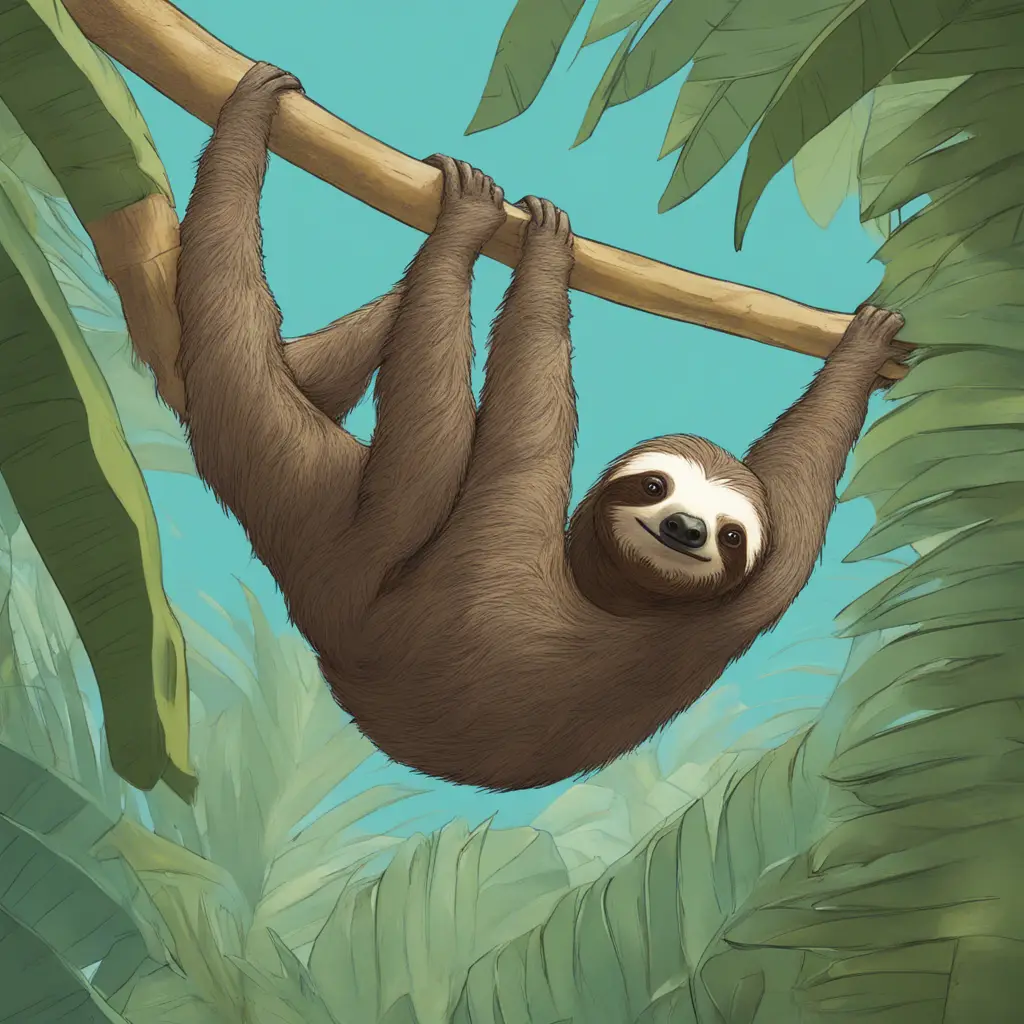
sloth
noun sloth
sləʊθ
A slow-moving tropical American mammal that hangs upside down from branches of trees using its long limbs and hooklike claws.
The sloth spends most of its time hanging in the trees.
sloth
sləʊθ
Loading…
sləʊθ
A slow-moving tropical American mammal that hangs upside down from branches of trees using its long limbs and hooklike claws.
The sloth spends most of its time hanging in the trees.

sləʊθ
Reluctance or laziness to work or make an effort; reluctance to move fast or physically exert oneself.
His sloth caused him to fail his classes.

sləʊθ
A deadly sin in Christianity, usually involving laziness or indifference in matters of God.
He confessed to the sin of sloth.
Audio could not be loaded. Please try again later.
"Sloth" is a word that describes a type of animal, but it is also often used to describe a human characteristic of being lazy or slow-moving. For example, if someone takes a long time to get things done or often procrastinates, you might say they have a "sloth-like" behavior. It's important to use this word with caution as it can have a negative connotation towards someone's work ethic if used in the wrong way.
Apathy refers to a lack of interest, emotion, or concern about something that someone used to care about.
It's a feeling of indifference or disinterest. For example, a student who used to love history might show apathy towards the subject after a while.
Apathy is about lacking feelings, while sloth is about lacking action. Both are negative, but apathy is a mental state, and sloth is a behavior.
Open word: Apathy →Idle means not doing anything productive, or not being actively engaged in any work or activity.
It's a descriptor of a person or a situation where there's nothing being done or achieved. For example, sitting on the couch watching TV can be called an idle activity.
Sloth refers to a state of laziness or inactivity that's more severe than idleness. Sloth implies a certain level of apathy or disinterest in doing anything productive or beneficial.
Idle refers to a lack of activity or productivity, while sloth suggests a willful and chronic state of laziness or inactivity.
Open word: Idle →Inactivity refers to a state of doing nothing or being idle.
Inactivity is a temporary state of doing nothing, while sloth is a personality trait of chronic laziness and disinterest.
Open word: Inactivity →Indolence and sloth both refer to a lack of motivation or inclination to do something.
However, indolence is more about being apathetic or lazy, while sloth implies a deeper sense of lethargy or even reluctance to do anything at all.
Indolence is applicable in situations where someone is simply choosing not to exert effort, while sloth is more commonly associated with a persistent unwillingness to engage in any activity.
Open word: Indolence →Inertia refers to the tendency of an object to remain at rest or in motion unless acted upon by an external force. It is a physical concept related to mechanics and movement.
Inertia is applicable in physics, engineering, and other technical fields where the behavior of objects in motion is studied.
Inertia is a physical concept related to the behavior of objects in motion, while sloth is a personal trait related to motivation and productivity in everyday life.
Open word: Inertia →Both laziness and sloth refer to a lack of motivation to do something.
However, sloth implies a more acute sense of apathy and indifference towards work or productivity, while laziness simply suggests a general lack of activity or energy.
Open word: Laziness →Both lethargy and sloth refer to a lack of energy or motivation, but they are not exactly the same.
Lethargy is a feeling of tiredness or sluggishness, often caused by physical or emotional stress.
Lethargy is a feeling of tiredness or disinterest, while sloth is a lack of motivation or action. Both can affect your productivity and well-being, but they each have slightly different meanings and uses.
Open word: Lethargy →Both sloth and torpor refer to a state of laziness or inactivity, but they are used in different contexts.
Torpor, on the other hand, usually refers to a physical or mental state of decreased activity or responsiveness. For example, during the winter months, some animals enter a state of torpor in which their metabolism slows down and they become less active to conserve energy.
Sloth describes a lack of motivation or effort, while torpor describes a state of reduced activity or responsiveness.
Open word: Torpor →And why does it nearly always choose to do so in exactly the same place? Whatever the reason it must be very important, for a sloth on the ground is almost helpless. Any predator could attack it and it doesn't have the speed to escape.
Watch on YouTube ↗Fiction is a kind of compassion-generating machine that saves us from sloth. Is life kind or cruel? Yes, Literature answers. Are people good or bad? You bet, says Literature. But unlike other systems of knowing, Literature declines to eradicate one truth in favor of another.
They descend from the canopy just once a week for a bathroom break. When sloths do move it's not very fast. It would take a sloth about five minutes to cross an average neighborhood street. This unhurried approach to life means that sloths don't need very much muscle.
Watch on YouTube ↗Oh yes, there's lots of great food in America. But the fast food is about as destructive and evil as it gets. It celebrates a mentality of sloth, convenience, and a cheerful embrace of food we know is hurting us.
was protection against smaller predators like the saber-tooth cat or dire wolf like today's elephants on the African plains the sloths massive size made it difficult to kill if a sloth was
Watch on YouTube ↗You must avoid sloth, that wicked siren.
in the fast-paced race for survival. Well I'm here to tell you that we've got this animal all wrong -- and how understanding the truth about the sloth may help save us and this planet we both call home.
Watch on YouTube ↗My background is degradation and sloth, mostly.
People don't quite realize how slow. Sloths are obviously renowned for being slow. But when your life and your work kind of revolves around them the slowness, it feels soul destroying. But in the loveliest way.
Watch on YouTube ↗Avoid sloth, the mother of all vices!
why does it come down to the ground to do it and why does it nearly always choose to do so in exactly the same place whatever the reason it must be very important for a sloth on the ground is
Watch on YouTube ↗I'm for any woman who loves sloths.
a sloth on the ground is almost helpless any predator could attack it and it doesn't have the speed to escape why it comes down in this way is a mystery nobody knows now he's finished
Watch on YouTube ↗Sloth, not ill-will, makes me unjust.
tree trunk you'll see hundreds of Aztecas ants they protect the tree almost like tiny security guards the sloths presence has not gone unnoticed
Watch on YouTube ↗Social networks do best when they tap into one of the seven deadly sins. Facebook is ego. Zynga is sloth. LinkedIn is greed.
sloths spend most of their lives high up in the canopy finding one so low in the tree is rare bryson has studied them for many years this is a great opportunity to examine
Watch on YouTube ↗As winter approaches - bringing cold weather and family drama - we crave page-turners, books made for long nights and tryptophan-induced sloth.
Cyanobacteria are still around in almost every environment on oceans, fresh water, soil, antarctic rocks, sloth fur. They still pump oxygen into the atmosphere, and they also pull nitrogen out to fertilize the plants they helped create.
Watch on YouTube ↗I'm an all-or-nothing guy. When I'm working, I work, work, work, work, work, and when I'm not, I'm the laziest sloth this planet has ever provided us.