cleave
verb cleave
kliːv
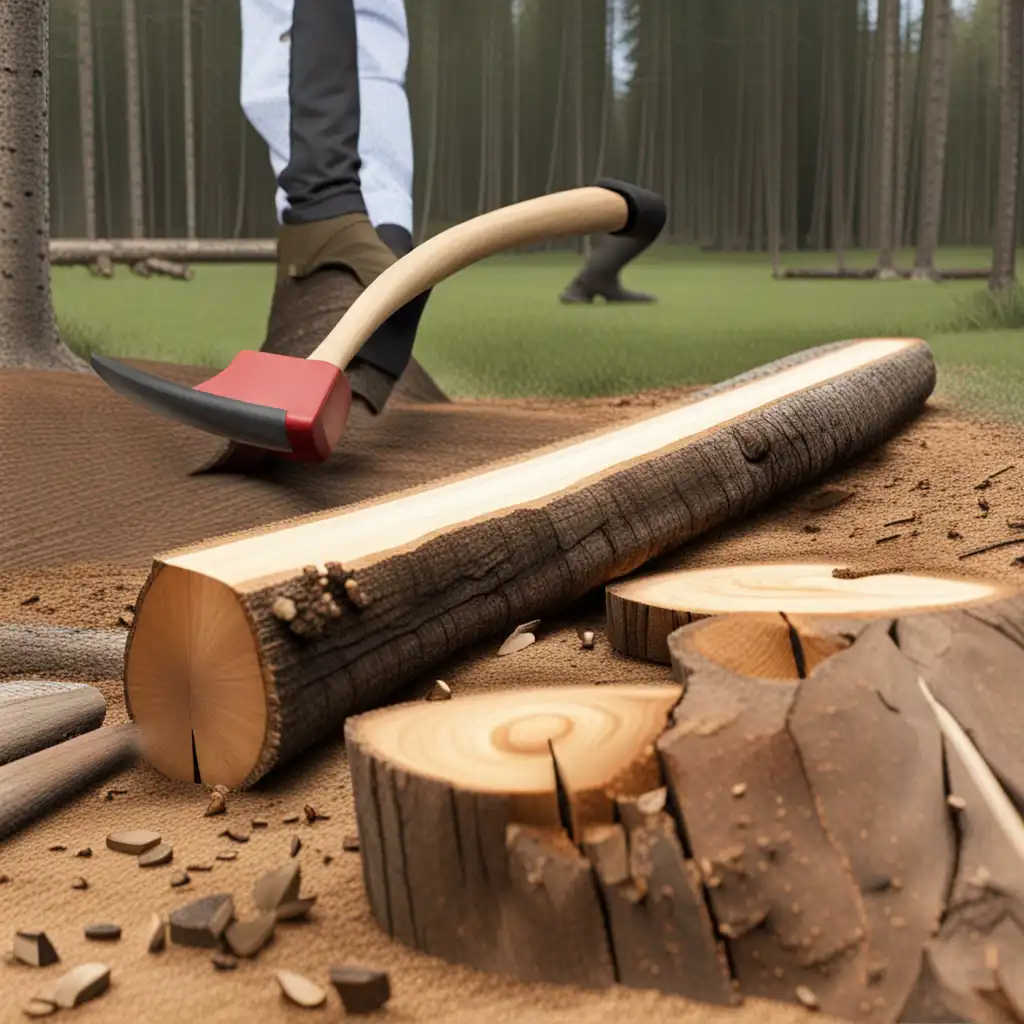
To split or divide something, especially along a natural line or flat surface
The axe cleaved the wood into two parts.
cleave
kliːv
Loading…
kliːv
To split or divide something, especially along a natural line or flat surface
The axe cleaved the wood into two parts.

kliːv
To strongly attach oneself emotionally to something or someone
She cleaved to her principles in spite of everything.

kliːv
In biochemistry, to break down a compound into smaller parts.
The enzyme is used to cleave the protein into smaller fragments.
Audio could not be loaded. Please try again later.
The word 'cleave' has two different meanings that are opposite to each other. The first meaning of the word 'cleave' is to split or cut something into two halves. For example, you can cleave a log of wood with an axe to make firewood. The second meaning of the word 'cleave' is to stick or cling to something very tightly. For example, a magnet can cleave to a piece of metal. So, it is important to know the context in which the word 'cleave' is being used to understand its meaning correctly. If you hear someone say "I will cleave this apple into two pieces," it means they want to cut the apple into two halves. If you hear someone say "I cleave to my friends," it means they are very loyal to their friends and want to stay close to them.
Bisect means to divide something into two equal parts. For example, if a line is bisected, it means it has been divided into two equal halves.
The main difference between the two is that bisect implies equal division while cleave does not necessarily imply equality.
Bisect is commonly used in geometry and mathematics, while cleave is often used in everyday language to describe the action of splitting something apart, such as cutting meat or chopping wood.
Open word: Bisect →Carve means to cut into something, usually with a knife or other sharp tool. This can be used when talking about carving a turkey or carving a pumpkin.
Carve is used when talking about cutting into something, while cleave can describe both cutting and sticking together.
Open word: Carve →Chop means to cut something into small pieces by using a quick and forceful motion (usually with a knife). It's commonly used when referring to cutting food, such as vegetables or meat, but can also be used in other contexts, such as chopping wood.
Chop describes cutting something into smaller pieces while cleave describes splitting something in half or being loyal to something/someone.
Open word: Chop →Hack means to cut something roughly or to break into something quickly. It is applicable when you want to cut something but it's not necessary to be neat, like hacking away at a pile of firewood with an axe.
Open word: Hack →Pierce means to make a small hole or opening in something, often using a sharp object.
This word is applicable when you want to describe the action of putting a hole in paper with a pin or piercing someone's skin with a needle.
Open word: Pierce →Both words, cleave and rend, mean to split or divide something.
Rend tends to imply a more forceful and violent separation, like tearing a piece of cloth or ripping apart a piece of paper.
You would use cleave when you want to describe a more precise or deliberate act of splitting something, while rend is more appropriate when you want to describe a rough, forceful or violent act of splitting something.
Open word: Rend →The words cleave and sever both refer to separating things from each other, but there is a difference in how they are used.
Sever, on the other hand, is most commonly used to describe cutting or breaking something apart completely. For example, you might say that you need to sever a rope with a knife, or that a bad accident has severed someone's spinal cord.
Cleave tends to describe a partial separation or bonding, while sever describes a complete and total disconnection.
Open word: Sever →Cleave means to cut or split something precisely in a specified direction or along a natural line or grain.
Split means to divide something into two or more parts, often with force or violence, and with less precision than 'cleave.' It implies a greater amount of destruction or damage, and is often used to describe things being torn apart with brute force.
For example, you might split a log with an axe or split a piece of paper in half, but both actions would likely be less precise or delicate than 'cleaving.'
Cleave suggests a more careful, intentional approach to cutting, while split implies a more forceful or violent separation.
Open word: Split →Cleave and sunder both refer to separating or dividing something, but they are used in slightly different contexts.
Sunder, on the other hand, implies a more forceful or violent separation.
It can describe breaking apart of a relationship or bond, such as sundering a friendship or sundering a family.
Cleave is typically used when talking about physically cutting or splitting something, while sunder is used more often to describe severe or lasting separations.
Open word: Sunder →Dillie the Deer: Love on...
Watch on YouTube ↗Self-respect is a commodity worth cleaving to.
The math and magic of...
Watch on YouTube ↗I tend to foster drama via bleakness. If I want the reader to feel sympathy for a character, I cleave the character in half, on his birthday. And then it starts raining. And he's made of sugar.
Folding way-new origami...
Watch on YouTube ↗The superior man does not, even for the space of a single meal, act contrary to virtue. In moments of haste, he cleaves to it. In seasons of danger, he cleaves to it.
Michael Merzenich:...
Watch on YouTube ↗I'm proof against that word failure. I've seen behind it. The only failure a man ought to fear is failure of cleaving to the purpose he sees to be best.
How One Brilliant Woman...
Watch on YouTube ↗I have a king bed, one of those memory-foam mattresses that doesn't jiggle as you get in or out. Even if you cleaved it down the middle with a pickax, the thing wouldn't tremble. It's practically earthquake-proof.
How augmented reality...
Watch on YouTube ↗Several millennia ago, the words were written that a man should leave his father and mother and cleave to his wife, and the two shall become one flesh. It was not our idea; it was God's idea.
The Unconquered:...
Watch on YouTube ↗Like Honeycrisp, SweeTango has much larger cells than other apples, and when you bite into it, the cells shatter rather than cleaving along the cell walls, as is the case with most popular apples. The bursting of the cells fills your mouth with juice. Chunks of SweeTango snap off in your mouth with a loud cracking sound.
Introducing a New Baby...
Watch on YouTube ↗Using medicine in the service of cosmesis is generally bad for patients, bad for doctors, and bad for democracy. The only exceptions are when we know the intervention will actually reduce suffering, as with a primary cleft lip repair.
Mena Trott: How blogs...
Watch on YouTube ↗For me, Jesus is my cleft in the rock. He is my safest friend, my safe totally loving accepting big brother.
Robert Thurman:...
Watch on YouTube ↗When I was at Babbo, I was covered in scars and scabs and burned bits - melted hair, ribbed burns I got reaching across the top of a hot skillet... I sliced off the tip of my finger. I cleaved my forehead - a deep, ugly wound. Luckily, it regenerated.