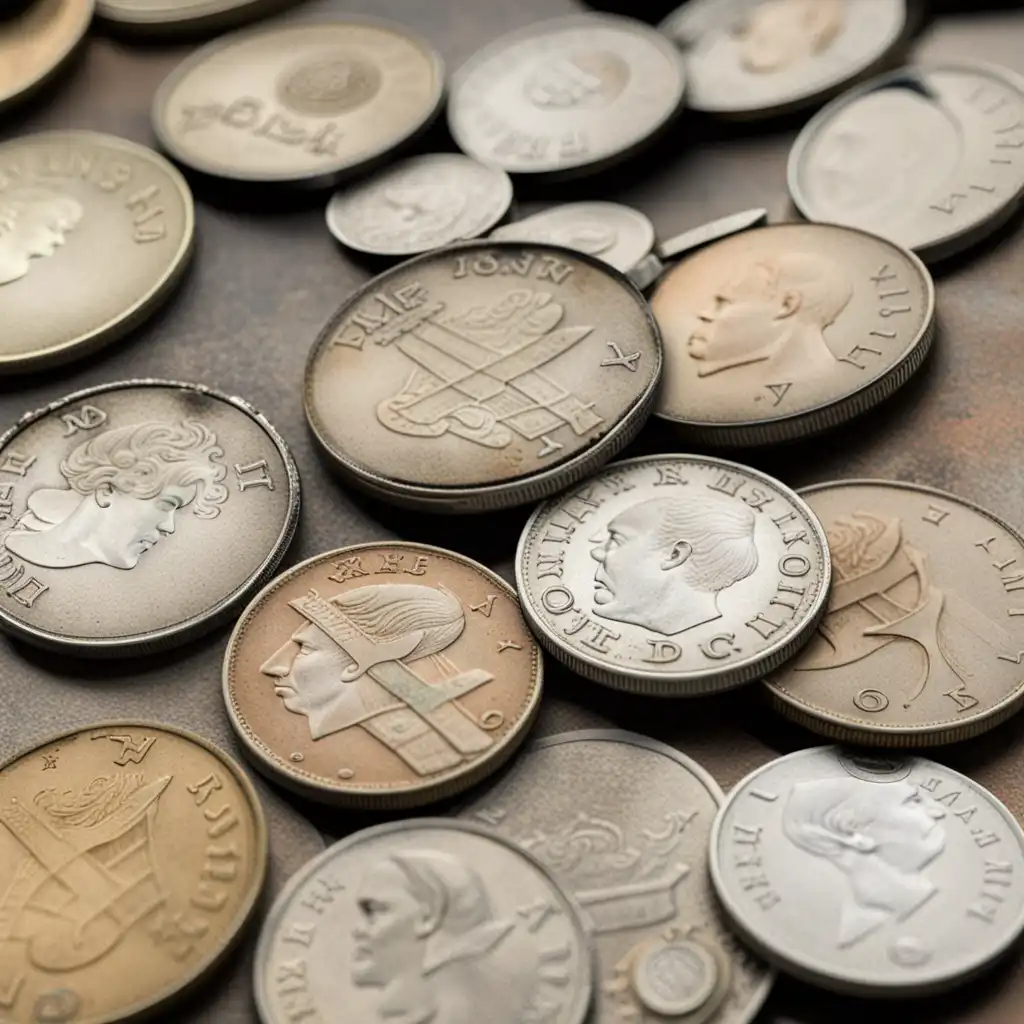
farthing
noun farthing
ˈfɑːrðɪŋ
A British coin that was worth very little, not used anymore.
He didn't have a farthing to his name.
farthing
ˈfɑːrðɪŋ
Chargement…
ˈfɑːrðɪŋ
A British coin that was worth very little, not used anymore.
He didn't have a farthing to his name.

ˈfɑːrðɪŋ
Used to represent a very small amount or value of something.
He won't contribute a farthing to the fund.
Impossible de charger l’audio. Réessayez plus tard.
"Farthing" is an old English word that was used as a unit of currency. In the past, it was worth a quarter of a penny. Nowadays, you won't hear it being used in everyday language, but you might come across it in historical novels or movies set in the past. If you are learning English, it's good to know what the word means but don't worry too much about using it in everyday conversations because it's no longer a commonly used term.
Cent and farthing are both units of currency, but they come from different countries and different time periods.
Cent is a unit of currency still used in the United States. It is worth one-hundredth of a dollar, or one penny.
Farthing is an old British unit of currency that was used from the 13th century until 1960. It was worth one-quarter of a penny, or one-thousandth of a pound.
So, while cent is still used in the US today, farthing is an old British currency that is no longer used.
Ouvrir le mot: Cent →Coin is a general term used to describe any form of currency, such as a piece of metal or paper money used to buy things.
Whereas, farthing is an old English coin that was in circulation until the 1960s, but is no longer used today. Farthing was the smallest denomination used in the old British currency system, and it was worth a quarter of a penny.
Ouvrir le mot: Coin →Copper refers to the metallic element that is commonly used in electrical wiring, plumbing, and coins. Farthing is a small and old British coin that was made of copper or other metals.
Copper is a material, while farthing is a type of coin. Copper is applicable in various industries, while farthing is not used anymore as it was discontinued in 1960.
Ouvrir le mot: Copper →Currency refers to a system of money used in a country, such as dollars or euros, that is accepted as a medium of exchange for goods and services.
Farthing is an obsolete British coin that was worth a quarter of a penny. It is no longer in use as a currency and has been replaced by the modern monetary system.
Currency is applicable in all countries as it represents the standard form of money in circulation. Farthing is not used at all and refers only to a historical form of currency in England.
Ouvrir le mot: Currency →Denomination refers to the value of money, like dollars, pounds or euros.
So, while denomination applies to modern currency and refers to the value of money, farthing is an outdated coin with a specific value that is no longer used today.
Ouvrir le mot: Denomination →Money is a general term referring to currency or any medium of exchange used to purchase goods or services.
Money is a general term for currency that can be used in any country while farthing is an outdated British coin that is no longer in use.
Ouvrir le mot: Money →A farthing and a penny are both old British coins, but a farthing is worth a quarter of a penny. In modern times, neither of these coins is used anymore as they have been replaced by the decimal system with coins worth 1p, 2p, 5p, 10p, 20p, 50p, and £1 and £2 coins.
Ouvrir le mot: Penny →Farthing and shilling are both old British currency units, but they differ in value and usage.
A shilling was a larger unit of currency, worth 12 pence or one twentieth of a pound. It was phased out in 1971 when decimalization was introduced in Britain.
The shilling was used primarily for larger purchases like groceries or drinks in pubs.
A farthing was a small amount of money used for small purchases, while a shilling was a larger amount used for larger purchases.
Ouvrir le mot: Shilling →Sex Change Surgery %\PIPE%...
Voir sur YouTube ↗Virtue knows to a farthing what it has lost by not having been vice.
Beef also was difficult to be procured and exceedingly poor; the price nearly sixpence farthing per pound.