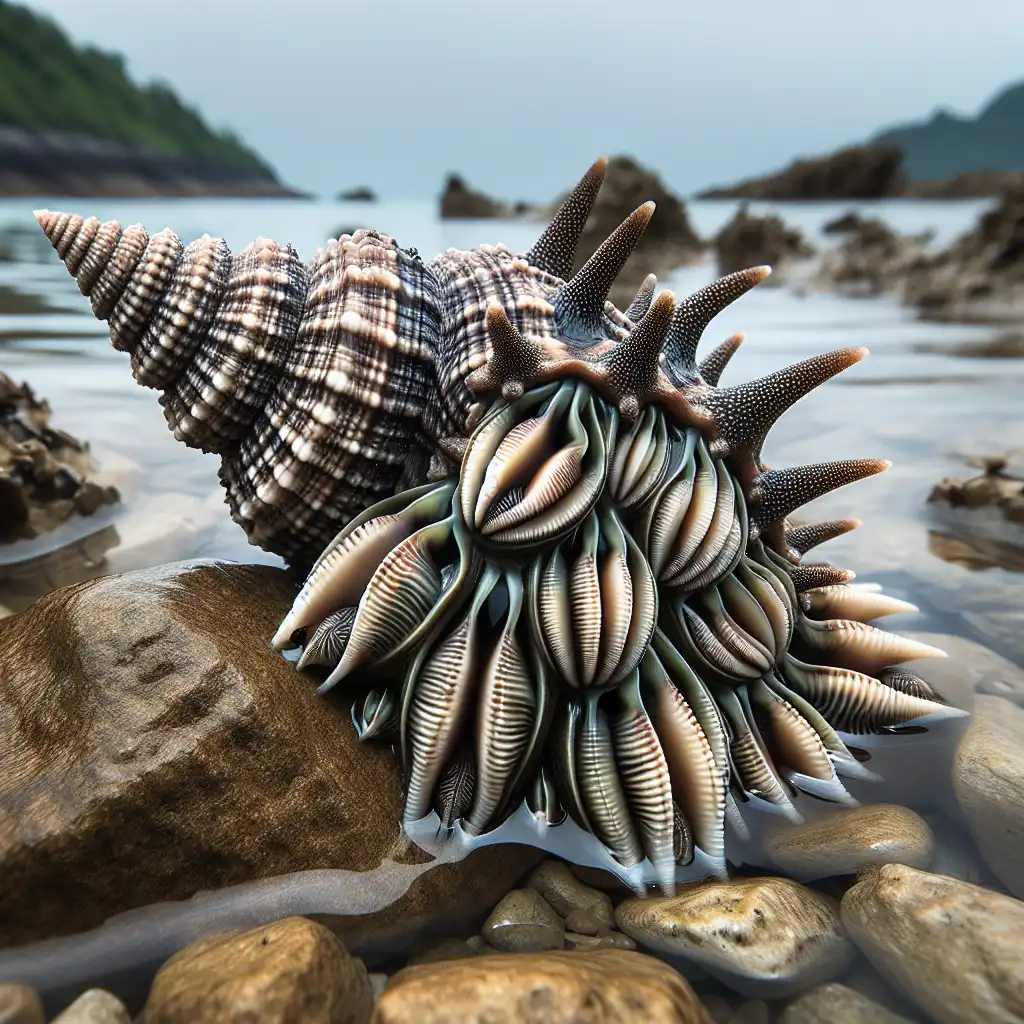
limpet
noun limpet
ˈlɪmpɪt
A type of small sea creature that attaches itself strongly to rocks.
Limpets cling to the rock so tightly that it's nearly impossible to remove them.
limpet
ˈlɪmpɪt
読み込み中…
ˈlɪmpɪt
A type of small sea creature that attaches itself strongly to rocks.
Limpets cling to the rock so tightly that it's nearly impossible to remove them.

ˈlɪmpɪt
A person who is difficult to get rid of.
He's been clinging to me like a limpet all evening.
音声を読み込めませんでした。しばらくしてからもう一度お試しください。
A limpet is a type of shellfish that attaches itself very tightly to rocks or other surfaces in the ocean. It looks like a small cone-shaped shell and is often found in areas where the waves crash against the shore. You might use the word "limpet" when describing the different types of sea creatures you might encounter while exploring the coastline or when discussing marine biology.
Clams and limpets are both types of shellfish, but there are some important differences between them. Clams generally have two shells that they can close tightly to protect themselves, whereas limpets have a single cone-shaped shell that is tightly attached to surfaces.
Clams are found in softer substrates such as sand, mud and gravel, while limpets are mostly found attached tightly to rocks, and other hard surfaces.
In terms of cooking and eating, clams are often steamed, boiled or baked and can be enjoyed on their own or used in dishes such as clam chowder, while limpets are less commonly eaten and are often used as bait for fishing.
単語を開く: Clam →A conch is a type of sea snail with a spiral shape shell that is often used for decoration or as a musical instrument. They are found mainly in tropical waters and their shells can be quite large.
In summary, conchs are large snails with spiral shells mainly found in tropical waters that are used for decoration or as a musical instrument, while limpets are small shellfish with cone-shaped shells found in cooler waters that cling to rocks and other surfaces.
単語を開く: Conch →A gastropod is a type of mollusk that has a coiled shell and a muscular foot for movement. Examples of gastropods include snails and slugs.
Gastropods are applicable in marine and terrestrial environments while limpets are found exclusively in marine environments.
単語を開く: Gastropod →Limpets and mussels are both types of shellfish, but they are different in the way they attach themselves to rocks or other surfaces.
Limpets have a conical shell and they attach themselves to rocks using their strong muscular foot. Mussels have a more elongated shell and they attach themselves to rocks using a sticky, fibrous thread called a byssus.
Mussels are also found on rocky shorelines but can also be found in other habitats such as estuaries and mud flats.
In terms of their culinary value, both limpets and mussels are considered to be delicacies in some parts of the world. Limpets are often eaten raw or cooked in their shells, while mussels are typically cooked and served with a variety of sauces and seasonings.
単語を開く: Mussel →Limpet and oyster are both sea creatures, but they are quite different from each other.
An oyster is a bivalve mollusk that lives in saltwater or brackish water. Unlike limpets, oysters have a hard, calcified shell that protects them from predators.
Oysters feed by filtering plankton and other small particles from the water using their gills. Oysters are considered a delicacy in many parts of the world and are often cultivated for human consumption.
In summary, limpets are small, cone-shaped mollusks that live on rocky shores and feed on algae and other small organisms, while oysters are bivalve mollusks that live in saltwater and are prized as a food source.
単語を開く: Oyster →Limpet and periwinkle are both types of sea creatures with shells, but they are different in shape and habitat. Limpets are flat and oval-shaped and are found on rocks in the intertidal zone, which is the area that is exposed to air during low tide and covered with water during high tide.
Periwinkles are spirally-shaped and are found in tidal pools and on seaweed in the lower intertidal zone, which is the area that is always underwater.
The main difference between limpets and periwinkles is their shape and where they live.
単語を開く: Periwinkle →Shellfish is a more general term that refers to any sea creature with a shell, such as clams, oysters, and mussels.
While limpets are a type of shellfish, the term shellfish is much broader and can refer to many different types of animals.
Limpets are often consumed as a type of seafood, but they are not as commonly eaten as some other types of shellfish.
単語を開く: Shellfish →A snail is a land or freshwater creature that has a spiral or coiled shell. Snails use their muscular foot to move around and also have a retractable head with eyes and tentacles.
The main difference between limpets and snails is their habitat and mode of mobility. Limpets live in the sea and attach themselves to rocks, while snails live on land or in freshwater and move around using their foot.
Additionally, limpets are exclusively herbivorous, while snails can be both herbivorous and predatory.
単語を開く: Snail →Safari Live - Day 166 %\PIPE%...
YouTube で見る ↗In my mind's eye, Shakespeare is a huge, hot sea-beast, with fire in his veins and ice on his claws and inscrutable eyes, who looks like an inchoate hump under the encrustations of live barnacle-commentaries, limpets and trailing weeds.
Lunchtime for Baboons %\PIPE%...
YouTube で見る ↗