bailiff
noun bailiff
ˈbeɪlɪf
A court officer whose duties include keeping order in the court, delivering legal documents, and enforcing court orders.
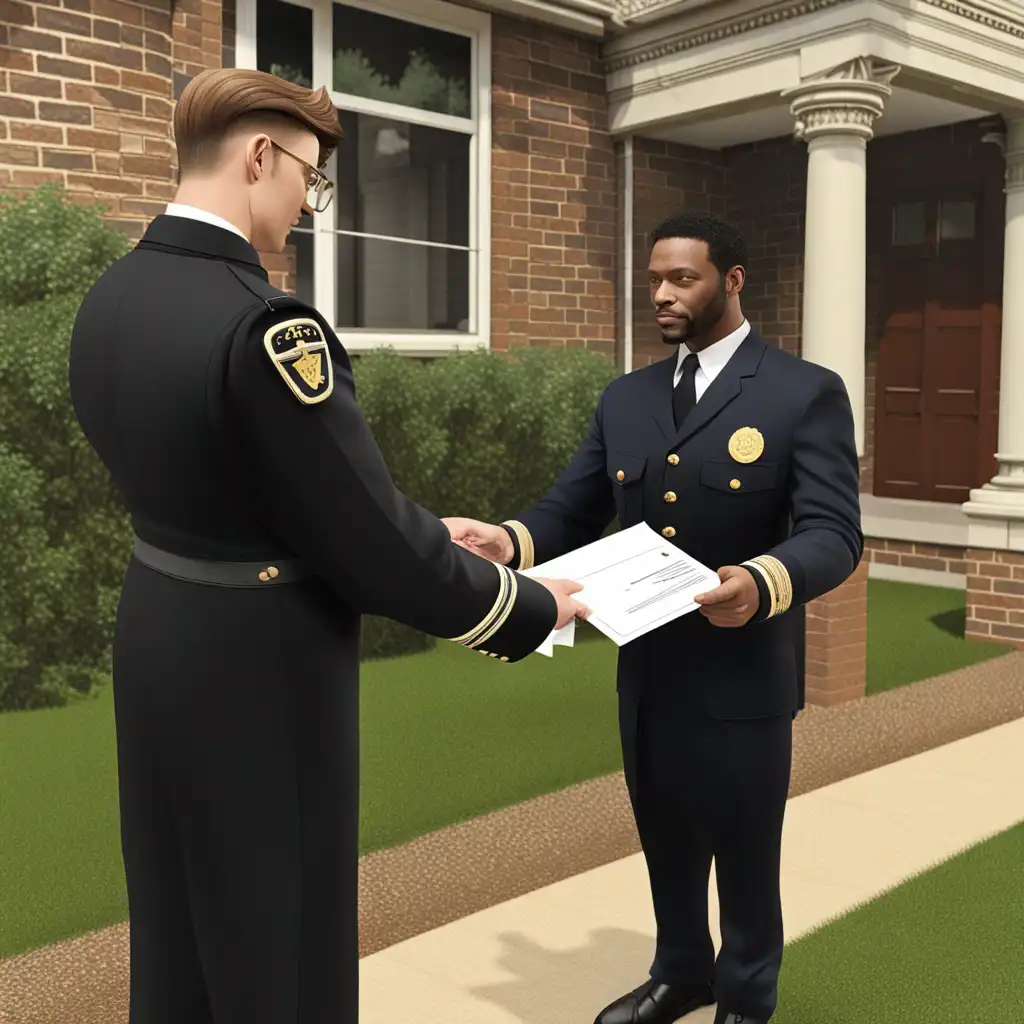
The bailiff delivered a warrant to the suspect's house.
bailiff
ˈbeɪlɪf
Loading…
ˈbeɪlɪf
A court officer whose duties include keeping order in the court, delivering legal documents, and enforcing court orders.
The bailiff delivered a warrant to the suspect's house.

ˈbeɪlɪf
An official in charge of managing a part of a country, or a large estate.
In medieval times, the bailiff managed the lord's estate while he was away.

ˈbeɪlɪf
A manager, overseer, or custodian; a legal officer to whom some degree of authority or jurisdiction is given.
As the school's bailiff, he was in charge of the building's maintenance and security.
Audio could not be loaded. Please try again later.
A bailiff is a person who works for a court or a landlord and is responsible for making sure that people follow the rules. They may be in charge of things like collecting unpaid rent or evicting tenants who don't follow the lease agreement. Bailiffs can also be responsible for serving court papers, which means they deliver legal documents to someone involved in a court case. It is important to use the word 'bailiff' in appropriate situations and contexts, such as when discussing legal matters or tenancy issues.
A bailiwick is the area of jurisdiction or control of a particular person or organization. This term is often used figuratively to refer to someone's area of expertise or responsibility.
A bailiff is a person while bailiwick refers to a jurisdiction or area of control. Bailiffs are typically associated with the legal system, while bailiwicks can be applied to any field where someone has a specific area of responsibility.
Open word: Bailiwick →A bailiff and constable are both officials who have legal powers to enforce the law, but they work in different areas of the legal system.
A constable is a law enforcement officer who has the power to arrest people and enforce the law beyond the court setting.
A bailiff is a court officer who maintains order during legal proceedings, while a constable is a law enforcement officer who enforces the law outside the courtroom.
Open word: Constable →A deputy is an assistant or subordinate to someone else, such as a police deputy who assists a sheriff.
A bailiff is a specific type of court official who ensures the smooth functioning of court proceedings, while a deputy is a general term for someone who assists or works under someone else.
Open word: Deputy →A marshal is usually a law enforcement officer who is responsible for maintaining order in a specific area or region. They have the right to arrest people and enforce laws.
Marshals work outside of a courtroom and are usually part of a larger law enforcement agency such as the US Marshals Service.
A bailiff works in a court and doesn't have the right to arrest, while a marshal works outside of court and has the authority to enforce laws and make arrests.
Open word: Marshal →A sheriff is an elected official who is responsible for law enforcement in a county. They are responsible for maintaining peace and order in a specific geographic area, serving warrants and other legal notices, and providing security in the courtroom during high-profile cases.
A bailiff is responsible for maintaining order in the courtroom while a sheriff is responsible for law enforcement in a specific geographic area.
Open word: Sheriff →A warden is a person who is responsible for the management and control of a specific area, such as a prison or a wildlife reserve.
Wardens often have extensive knowledge of their area of responsibility and have the authority to make decisions regarding the management of the area.
A bailiff is mainly responsible for maintaining order in a court of law, while a warden is responsible for the management and control of a specific area.
Open word: Warden →counts as to all defendants who are mentioned in those counts and have you brought with you the verdict forms for those counts okay would you hand them to the bailiff please
Watch on YouTube ↗I had been working for eight years and all I had to show for it was this horrible debt. At one point we had the bailiff at the door.
And after talking for three hours, Anne invited Anno to her summer party, and today years later, they still meet from time to time and are friends. So our algorithm matched for example this court bailiff.
Watch on YouTube ↗Some bailiffs were tacking on extra charges left, right and centre - a fee for every letter they sent, extra fees for visiting your house, for clamping your car, seizing it, towing it and selling it. It all stacked up and people in debt had no choice but to pay. We have put an end to this.
When I was kid I always wanted to be either the captain of the England cricket team or I wanted to be a river bailiff.
On New Year's Day 2008 I had two bailiffs turn up on my doorstep and because I had so little income I had not been paying bills, and I respect the concept of paying bills, I'm very much in favour of it, I just couldn't quite get it together.
The thing is, most of these courts in San Bernardino know who I am and they've researched me. In fact, a couple of judges have asked me how my back's doing, when my next launch is, so they know who I am. Some of the bailiffs wave hi to me because they follow me on Facebook and see my launch. People know who I am.
You have no idea how humiliating it was, as a boy, to suddenly have all your clothes, your toys, snatched by the bailiff. I mean we were a middle-class family, it's not as if it was happening up and down the street. It made me ashamed, I felt dirty.
I had such a run of bad luck that you lose faith that good things are going to happen any more. I still don't answer the door because I went through so long expecting it to be a bailiff.
We're ending the situation where any old thug can turn up and work as a bailiff.
No longer can a bailiff come crashing through someone's door in the dead of night. We have banned them from visiting between 9 P.M. and 6 A.M.