dale
noun dale
deɪl
A valley, often in the names of natural features or place names.
We hiked through the beautiful Hope Dale in the Peak District.
dale
deɪl
読み込み中…
deɪl
A valley, often in the names of natural features or place names.
We hiked through the beautiful Hope Dale in the Peak District.

deɪl
A unisex name, often a surname or given name in English speaking countries.
Dale Earnhardt Jr. is a former professional stock car racing driver.

deɪl
A command or expression of encouragement or approval, often used in Spanish-speaking countries like Mexico. It is usually translated as 'go ahead' or 'give it'.
Dale! You can do it!
音声を読み込めませんでした。しばらくしてからもう一度お試しください。
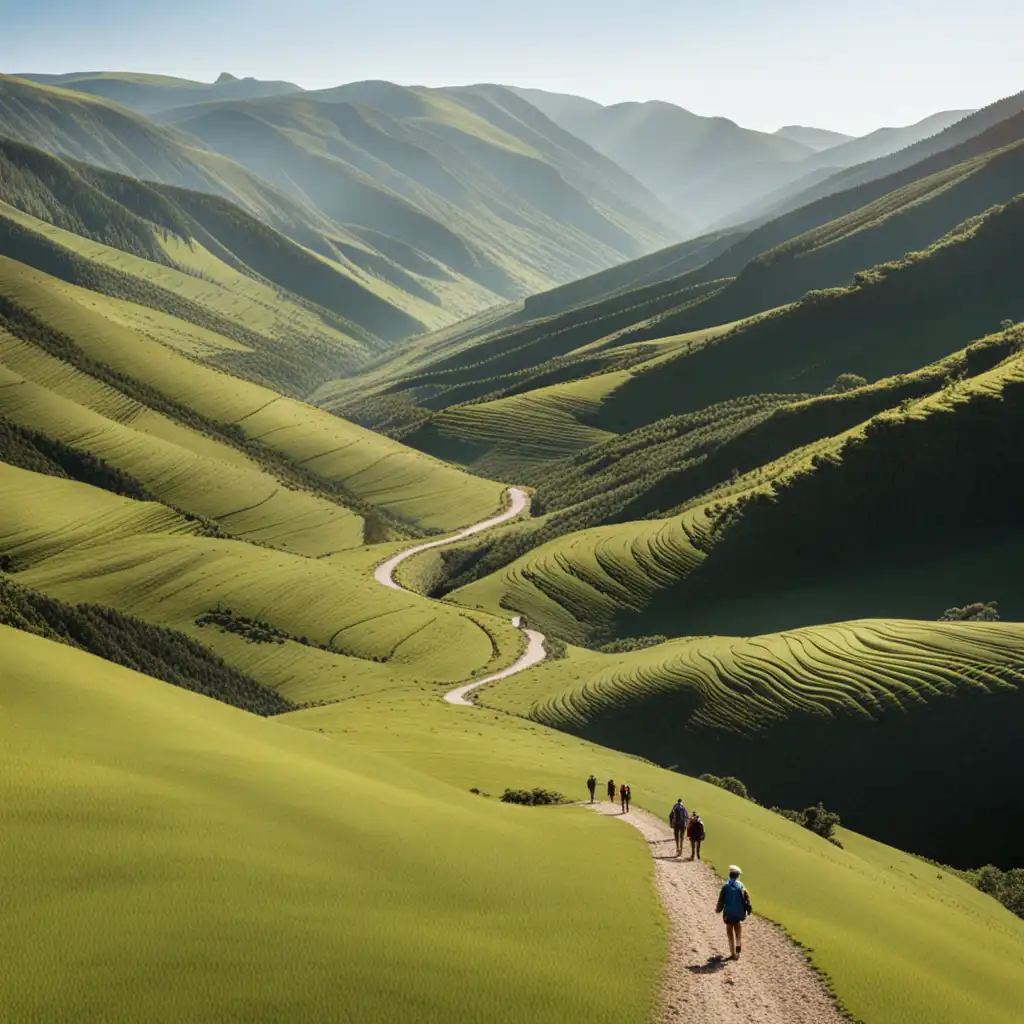
The word "dale" refers to a valley, often with fields or forests on either side. You might hear the word in poems or stories, especially ones set in rural areas or in the past. It can also be used as part of a place name, such as "Rosendale" or "Swaledale."
A basin is a large, bowl-shaped container or depression in the earth's surface that is often filled with water or other substances.
Basins can be artificial, like a sink or a bathtub, or natural, like the Great Basin in the western United States.
It is usually narrower and shallower than a basin and may or may not have a stream or river running through it. Dales are typically found in rural or wilderness areas and are often surrounded by forests or grasslands.
A basin is a broader term that refers to any large, circular or oval-shaped depression in the earth's surface, while a dale is a more specific term that refers to a narrow, elongated depression or valley.
Basins are often associated with water, while dales are often associated with hills and landscapes.
単語を開く: Basin →A canyon is a deep and narrow valley with steep sides, often formed by a river cutting through rock over time.
Examples of famous canyons include the Grand Canyon in Arizona and the Fish River Canyon in Namibia.
In summary, canyons are deep and narrow valleys with steep walls, while dales are broad and gentle valleys with flat terrain.
Canyons are formed by the forces of erosion and can be found in areas with rugged terrain, while dales are often found in areas with gentle slopes and lush vegetation.
単語を開く: Canyon →Dell refers to a small, secluded, and often wooded valley.
Dale refers to a bigger valley, while dell refers to a smaller, more intimate valley with trees.
単語を開く: Dell →Both dale and glen refer to a valley, but there are subtle differences between the two.
Glen is a word commonly used in Scotland to refer to a narrow, steep-sided and typically forested valley. It implies a rugged, natural landscape that is not necessarily settled.
For example, Scotland's famous Glen Coe is a steep-sided, natural valley formed by glaciers.
Dale is more commonly used in England to refer to cultivated valleys, whereas glen is more commonly used in Scotland to refer to natural, forested valleys.
単語を開く: Glen →A dale is a broad, open valley with low hills, usually with a river running through it. While a gorge is a narrow and deep valley with steep sides, usually formed by a river cutting through rock.
A dale is applicable when talking about a scenic valley with a meandering river, gently sloping hills, and lots of greenery, whereas a gorge is applicable when talking about a narrow, rocky channel with dramatic and steep cliffs forming the sides, as well as the sound of crashing rapids echoing through it.
A dale is a wide and open valley with gentle slopes and a river flowing through it, while a gorge is a narrow and deep channel with steep cliffs, often with a rapid and powerful river within it.
単語を開く: Gorge →Both dale and hollow refer to a low area surrounded by higher land, but their meanings are slightly different.
Hollow is a smaller valley or basin that may be more enclosed and wooded.
It is often used to describe a low spot in the hills where a small stream runs. Examples include Cooper's Hollow and Miller's Hollow.
Dale is more open and expansive, while hollow is more secluded and intimate. Both words are used to describe natural features of the landscape.
単語を開く: Hollow →A dale is often larger than a ravine and has a more gradual slope.
A ravine is a narrow and steep valley that is often created by flowing water such as a river or stream.
A ravine is typically smaller than a dale and is not suitable for farming or grazing animals.
A dale is a broad and gentle valley suitable for farming or grazing, while a ravine is a narrow and steep valley typically created by flowing water and not suitable for farming or grazing.
単語を開く: Ravine →Both dale and valley refer to a low area of land between mountains or hills. The main difference between the two is their origin and usage.
Dale is an Old English word used to describe a small valley, often associated with a small stream or creek.
Valley is a Middle English word derived from French, it is more commonly used in American English.
Dale is a smaller valley that is often associated with a stream or creek, while valley can describe any size of low area of land between hills, mountains, or highlands.
単語を開く: Valley →and a stranger becomes your hermano, you say "dale" and a crowd becomes a family reunion. my mother's tongue is a telegram from her mother decorated with the coqui's of el campo so even when her lips can barely
YouTube で見る ↗Dale was just trying to get third. Maybe he was thinking that he could get a run on everyone coming out of Turn 4. But the race was over. Junior and I had pulled away, so there was no need to block. That always hurt me when people said he was blocking for me, because it almost felt like it was my fault that he died. But I don't think that anymore.
your podcast app in conversation that national geographic is produced by davar ardellin executive producer of audio together with sound designer and engineer hans dale sue musical composition comes
YouTube で見る ↗Dale Earnhardt was kind of a hero of mine.
and are there to just show them to you and talk about them and have a great conversation. I might get one of those. Dale These are electric muffins. Where did you guys get those? Will you glide with us?
YouTube で見る ↗Having animals in the city is entirely different from having animals out in the country. For one thing, it's more social. When you live on lots of acres without neighbors within a stone's throw, your dog-walks are usually solitary rambles over hill and dale.
Dale Jr. has never gotten a fair shake from the start because, guess what? He's not his father. He was always supposed to have been someone else. The pressure he's under is unreal.