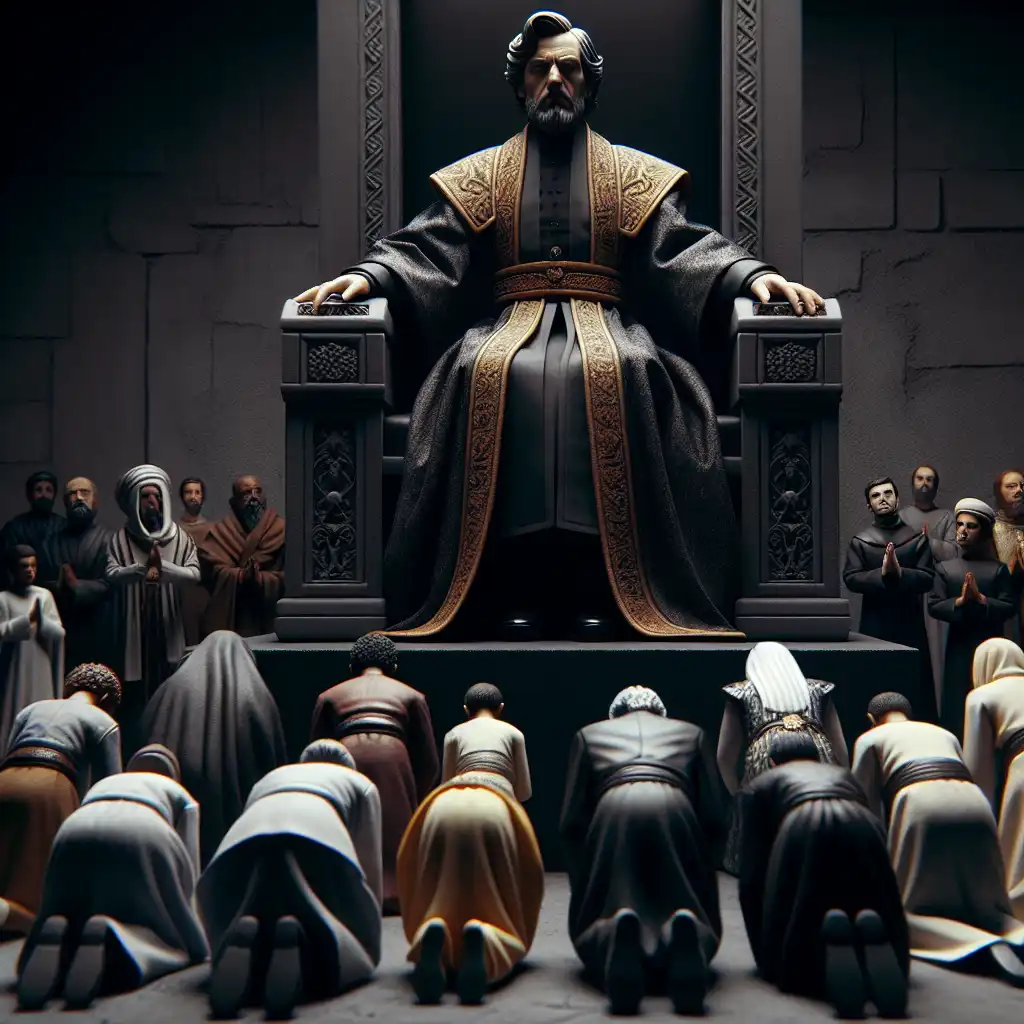
despotism
noun despotism
ˈdespətɪzəm
A system of government where one person has absolute power.
The country suffered under the despotism of the ruthless dictator.
despotism
ˈdespətɪzəm
Chargement…
ˈdespətɪzəm
A system of government where one person has absolute power.
The country suffered under the despotism of the ruthless dictator.

ˈdespətɪzəm
Cruel and unfair treatment by someone with power over others.
The manager ruled with despotism, making the workers' lives miserable.
Impossible de charger l’audio. Réessayez plus tard.
The word 'despotism' means when one person or a small group of people have complete control and power over a country or a place. It is often used to describe a form of government where there are no freedoms for the citizens and where the people in power can do whatever they want without consequences. It can also be used to describe a boss or a leader who is very controlling and doesn't allow others to have any say or input.
Absolutism refers to a system of government where the ruler has unlimited power and is not bound by law or Constitution.
Despotism refers to a form of government where the ruler has unlimited power and abuses it for personal gain. It is a more extreme form of absolutism where the ruler rules with an iron fist and is willing to use violent or oppressive means to maintain their power.
Absolutism can be a form of government that is stable and effective when the ruler is just and competent. Despotism, however, can lead to abuse of power and oppression, and is generally frowned upon in modern times.
Ouvrir le mot: Absolutism →Authoritarianism refers to a type of government where the ruler(s) have complete control and authority over citizens' lives.
An authoritarian government can limit freedoms and control citizens, but still operate within the framework of the law.
Ouvrir le mot: Authoritarian →Autocracy and despotism are both forms of government where a single person holds absolute power.
Autocracy is a form of government where power is concentrated in the hands of one person who has come to their position through legitimate or agreed-upon means, such as inheritance, election, or appointment.
Autocracy is a form of government where a single person holds power through legitimate means, while despotism is a form of government where a single person holds absolute power without regard for any legal or institutional framework.
Autocracy can work in societies with strong democratic institutions, while despotism is usually associated with human rights abuses and oppression.
Ouvrir le mot: Autocracy →Dictatorship refers specifically to a form of government where a single individual, known as a dictator, has complete control over the government and its people.
Despotism refers to a style of governing, while dictatorship is a specific form of government.
Despotism can apply to any type of government, while dictatorship refers to a single individual in control.
Ouvrir le mot: Dictatorship →Fascism is a political ideology that advocates for a totalitarian government, often led by a single leader or party. This type of government is characterized by extreme nationalism, a disregard for individual rights and freedoms, and the use of force and violence to achieve goals.
Fascism is applicable to situations where a political party or movement seeks to establish a totalitarian government. Examples of fascist regimes include Nazi Germany and Mussolini's Italy.
Ouvrir le mot: Fascism →Oppression refers to the unjust or cruel treatment of individuals or groups by those in authority. This can take various forms, such as discrimination, restriction of rights, or the use of violence against people who challenge the regime.
Oppression is applicable in situations where people are being unfairly treated, restricted or denied their rights by those in power.
The main difference between despotism and oppression is that despotism refers to a form of government where one person or group has complete power, while oppression refers to the unjust or cruel treatment of individuals or groups by those in authority.
Ouvrir le mot: Oppression →Tyranny refers to a form of government where the ruler exercises excessive and arbitrary power over the citizens, often using violence or threats.
Both terms refer to authoritarian forms of government that disregard the rights and freedoms of citizens, but despotism usually refers to a system of government while tyranny is more about the behavior of the ruler.
Ouvrir le mot: Tyranny →Why wasn’t the Bill of...
Voir sur YouTube ↗The whole commerce between master and slave is a perpetual exercise of the most boisterous passions, the most unremitting despotism on the one part, and degrading submissions on the other. Our children see this, and learn to imitate it.
How to see past your own...
Voir sur YouTube ↗The despotism of custom is everywhere the standing hindrance to human advancement.
I am astonished but not discouraged by my enormous responsibility. Devoted both from affection and duty to the cause of the people, I shall combat with equal ardor aristocracy, despotism, and faction.
To add to our misery and despair, a bloated aristocracy has sent to China - the greatest and oldest despotism in the world - for a cheap working slave.
Despotism increases in severity with the number of despots; the responsibility is more divided, and the claims are more numerous.
Democracy passes into despotism.
Despotism is a long crime.
The alternate domination of one faction over another, sharpened by the spirit of revenge natural to party dissension, which in different ages and countries has perpetrated the most horrid enormities, is itself a frightful despotism. But this leads at length to a more formal and permanent despotism.
Our defense is in the preservation of the spirit which prizes liberty as a heritage of all men, in all lands, everywhere. Destroy this spirit and you have planted the seeds of despotism around your own doors.
The strength and power of despotism consists wholly in the fear of resistance.