
catechism
noun catechism
ˈkætəkɪzəm
A written series of questions and answers used to teach religious beliefs.
The pupils were made to memorize and recite the catechism.
catechism
ˈkætəkɪzəm
불러오는 중…
ˈkætəkɪzəm
A written series of questions and answers used to teach religious beliefs.
The pupils were made to memorize and recite the catechism.
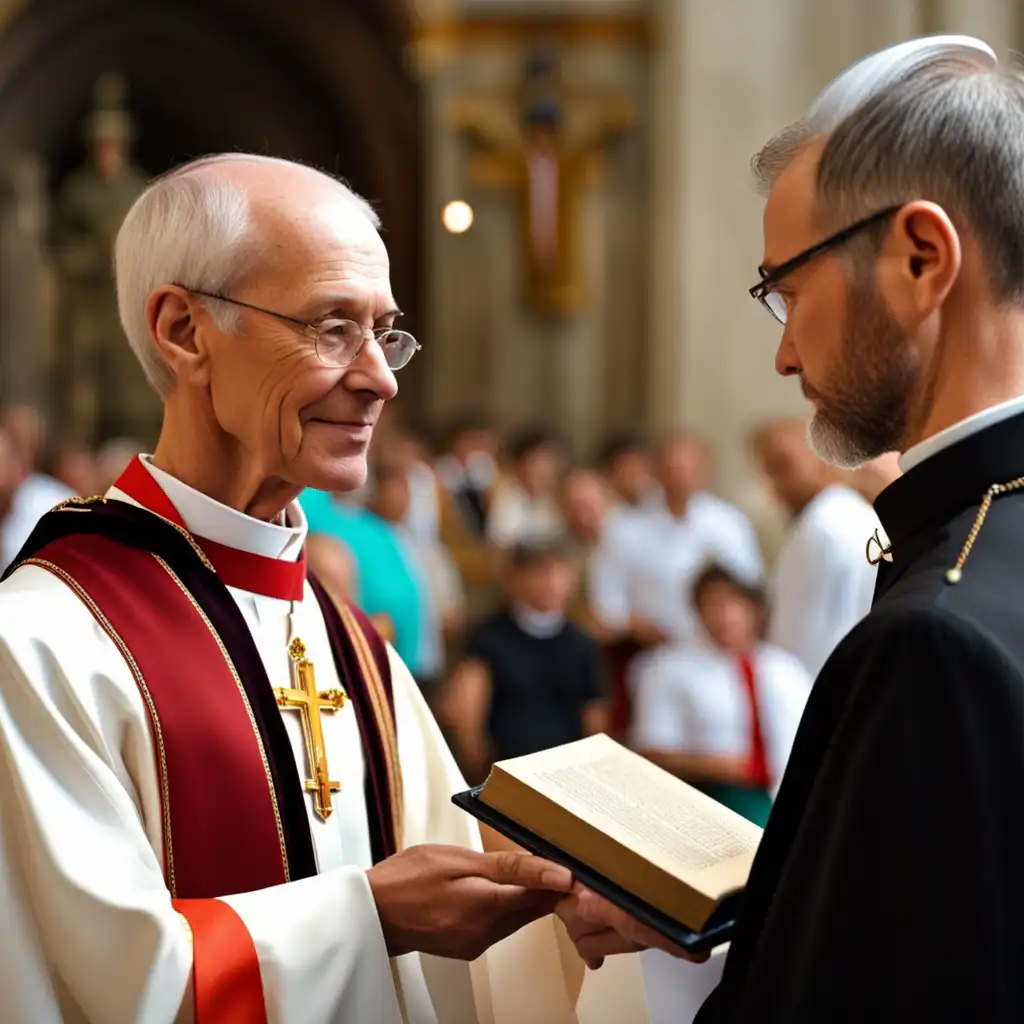
ˈkætəkɪzəm
A book or manual containing a summary of principles, especially of religious doctrine, in the form of questions and answers.
The priest provided me with a catechism book to understand the principles of the Catholic faith.

ˈkætəkɪzəm
A series of fixed questions or formulas used for a systematic instruction.
The driving instructor put me through a real catechism about road safety regulations.
오디오를 불러오지 못했어요. 잠시 후 다시 시도해 주세요.
Catechism is a word that refers to a set of questions and answers that help teach someone about a particular topic, usually related to religion. For example, in Christianity, a catechism might be used to teach someone about the beliefs and practices of the church. Catechisms can also be used in other contexts, such as for teaching basic knowledge about a particular subject.
Belief refers to a personal conviction or acceptance of something as true or real. It is subjective and can vary from person to person.
For example, a person may have a belief in a higher power or believe in the importance of honesty.
It is more objective and standardized than personal beliefs. For example, a Catholic catechism outlines the beliefs and practices of the Catholic Church.
Belief is applicable in everyday life and personal choices, while catechism is specific to religious teachings and practices.
단어 열기: Belief →A creed is a statement or belief or principles, often religious or political.
A creed is a summary of the beliefs in a religion.
A creed serves as a statement of faith that people in a religion use to express their beliefs.
단어 열기: Creed →Doctrine refers to a more comprehensive set of beliefs that govern an entire system of thought or practice.
It encompasses a wide range of teachings and principles, such as political or philosophical doctrines.
In summary, while a catechism is a specific set of teachings within a particular religion, a doctrine is a broader set of beliefs that can apply to many different areas of life.
단어 열기: Doctrine →Dogma refers to a set of principles or beliefs that are considered to be unquestionable and absolute within a particular religion.
Dogma tends to be more rigid than catechism, and adherents are expected to accept these beliefs without question.
Catechism refers to a set of teachings or instructional materials, while dogma refers to a set of absolute beliefs or principles within a religion.
Catechism is applicable to individuals who are seeking to learn more about a particular religion, while dogma is more relevant to those who adhere to a specific religious tradition.
단어 열기: Dogma →Educate refers to a broader process of teaching and learning, encompassing a wide range of subjects and skills. It may involve formal classroom-based instruction, but also includes informal learning through everyday experiences and interactions.
While catechism is applicable primarily within a religious context, educate can be used in any situation where learning and knowledge acquisition is at work.
단어 열기: Educate →Instruction refers to the act of teaching or providing guidance on a specific subject, which can apply to various fields like academics, sports, or even cooking.
In other words, catechism is a specific type of instruction that is focused on religious teachings and belief systems.
단어 열기: Instruction →A lesson refers to a broader educational concept that can be applied to any type of instruction.
Lessons can take many different forms, from hands-on activities to lectures to discussions, and can cover a wide range of subjects.
Catechism is specific to religious education, while lessons are a more general educational concept that can be applied to any subject.
단어 열기: Lesson →Catechism refers to a process of learning through formal religious teachings, often involving a series of questions and answers.
It is typically used in the context of teaching the principles and beliefs of a particular religion, and is often associated with memorization and repetition.
Teach is a general term that refers to any process of imparting knowledge or skills to someone.
So, while catechism is specifically related to religious education, teach can be applied to any type of education or instruction.
단어 열기: Teach →swine flu bird flu West Nile, we can begin almost a catechism and listen to all the cacophony of these names. But there were 30 to 50 novel viruses that jumped into human beings. And I'm afraid looking forward, we are in the age of pandemics, we have to behave like that,
YouTube에서 보기 ↗We apply the catechism by opening Italy's doors to women and children who come here legally on aeroplanes, but no more men on rubber dinghies. We will help them grow up and work in their own countries. Let's spend in Africa the money that needs to be spent.
The Church doesn't censor. It tries to guide its faithful through catechism.
I support non-discrimination for homosexuals, but I think, or at least I have the right to think - without saying whether I think it or not - I have the right to think, along with the catechism of the Catholic Church, that homosexuality is morally wrong.
Little by little, not without astonishment, I rediscovered the great names of the eighteenth and nineteenth centuries, who had been the master thinkers of my grandfather and other Mexican liberals. They did no offer me a doctrine or a catechism: they were and they are a source, an inspiration.
I like Pixie Sticks. Yeah, screw the middle man. Just a tube of sugar... I'd pour two of those in a big 12 ounce coke. And I'd go out to catechism class and try to concentrate on the priest. I saw Jesus several times. I swear I did.
A catechism is simply a tool for teaching the fundamentals of the faith. Unlike a creed or confession, a catechism uses questions and answers. Many Protestant confessional traditions, like Lutherans, Presbyterians, and Reformed, have used catechisms for centuries. Initially, most catechisms were intended for children.
We took our Catholicism very seriously. We never missed Mass; our father was a lector, and both our parents taught catechism. At 3 in the afternoon on Good Friday, we gathered in the living room for 10 minutes of silence in front of a painting of the Crucifixion.
The catechism says rich nations should welcome strangers within the limits of the possible. In Italy, we have reached the limits of the possible.
When we use old confessions and catechisms, we help teach our people that their faith is an old faith, shared by millions over many centuries. We also help them realize that other Christians have asked the same questions.