Impossible de charger l’audio. Réessayez plus tard.
Comment l’utiliser
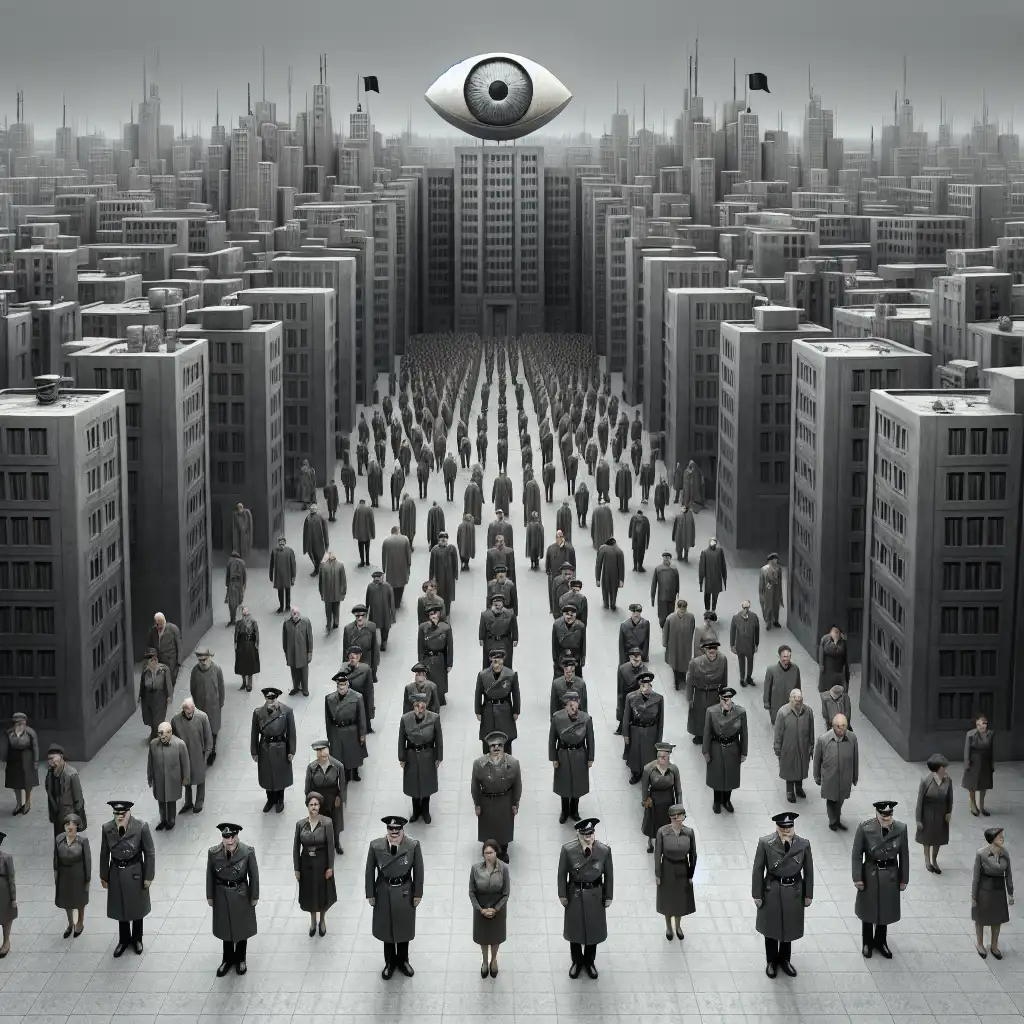
Totalitarianism refers to a political system in which the government has complete control over everything in a society, including people's thoughts, beliefs, and actions. This means that individuals have no freedom and human rights are often violated. The word is typically used to describe oppressive regimes or dictatorships, such as Nazi Germany under Adolf Hitler, or the Soviet Union under Joseph Stalin. It is important to use this word carefully and with sensitivity, especially when discussing historical events, as it can be very loaded and emotionally charged.
Absolutism refers to a political system where the ruler has absolute power and authority over the state and its people.
While absolutism is applicable to monarchies and other forms of autocratic rule, totalitarianism is associated with modern authoritarian regimes that seek to control and dominate their populations.
Autocracy refers to a form of government where one person or a small group has complete and absolute power, usually gained through inheritance or coup.
Autocracy is applicable in countries like Saudi Arabia or North Korea, where power is vested in one person or family. Totalitarianism is applicable in countries like Nazi Germany, Soviet Union, and China under Mao, where the government had complete control over all aspects of society.
Autocracy is about one person having all the power, while totalitarianism is about the government having all the power.
Despotism refers to a form of government where a single person, often a king or dictator, holds all the power and control over the country without any restrictions or limitations.
Despotism is characterized by a single ruler with complete power, while totalitarianism is characterized by a government with total control over all aspects of society.
Despotism is applicable to historical examples such as absolute monarchies, while totalitarianism is applicable to modern examples such as communism or fascism.
Dictatorship refers to a type of government where the ruler has absolute power and authority, often through force or manipulation.
In a dictatorship, the ruler might allow some level of personal freedom or private enterprise, while in totalitarianism, there is no room for independent thought or action.
Dictatorship can be seen in countries where there is a single leader or small group of leaders who hold power through force, such as in North Korea, Cuba, or Zimbabwe.
Fascism is a political ideology that is characterized by extreme nationalism, militarism, and authoritarianism.
It is usually associated with a single charismatic leader who has complete control over the government and the people. Fascism often involves the suppression of political dissent and the use of violence and propaganda to maintain power.
Both fascism and totalitarianism are forms of authoritarian government, but fascism tends to focus more on nationalism and militarism, while totalitarianism is more concerned with control over all aspects of society.
Fascism is often associated with Italy under Mussolini and Germany under Hitler, while totalitarianism has been seen in countries like North Korea and China.
Oligarchy refers to a form of government where a small group of people hold power and make decisions for the entire society.
Oligarchy can be seen in societies where a few wealthy or influential individuals hold the most power and make important decisions, such as in some modern-day dictatorships, monarchies, or aristocracies.
Oligarchy is a type of government in which a small group holds power, while totalitarianism is a type of government in which the state has complete control over society.
Tyranny refers to a government that uses its power to oppress and exploit its citizens. A tyrant is a ruler who exercises absolute power without consideration of the law or the people's rights.
Tyranny may involve arbitrary arrests, torture, and even genocide.
Both totalitarianism and tyranny involve governments that have unchecked power over their citizens.
However, totalitarianism is more focused on controlling people's thoughts and beliefs, while tyranny is more focused on using force to maintain control.
Totalitarianism can be found in countries with a one-party system, while tyranny can be found in countries with a dictator or monarch.
The strongest argument against totalitarianism may be a recognition of a universal human nature; that all humans have innate desires for life, liberty and the pursuit of happiness. The doctrine of the blank slate... is a totalitarian's dream.
The Internet was supposed to be the greatest tool of global communications and means of sharing knowledge in human history. And it is. But it has also become the most effective instrument of mass surveillance and potentially one of the greatest instruments of totalitarianism in the history of the world.
For the Left, tolerance does not mean tolerance. It means first, acceptance. And second, celebration. That is totalitarianism: You not only have to live with what you may differ with, dear citizen, you have to celebrate it or pay a steep price.
Totalitarianism is not about some state that appears out of nowhere and suddenly is all-powerful. There can't be any such thing. Totalitarianism starts when the difference between your public life and your private life is effaced.
What difference does it make to the dead, the orphans, and the homeless, whether the mad destruction is wrought under the name of totalitarianism or the holy name of liberty or democracy?