cube
noun cube
kjuːb
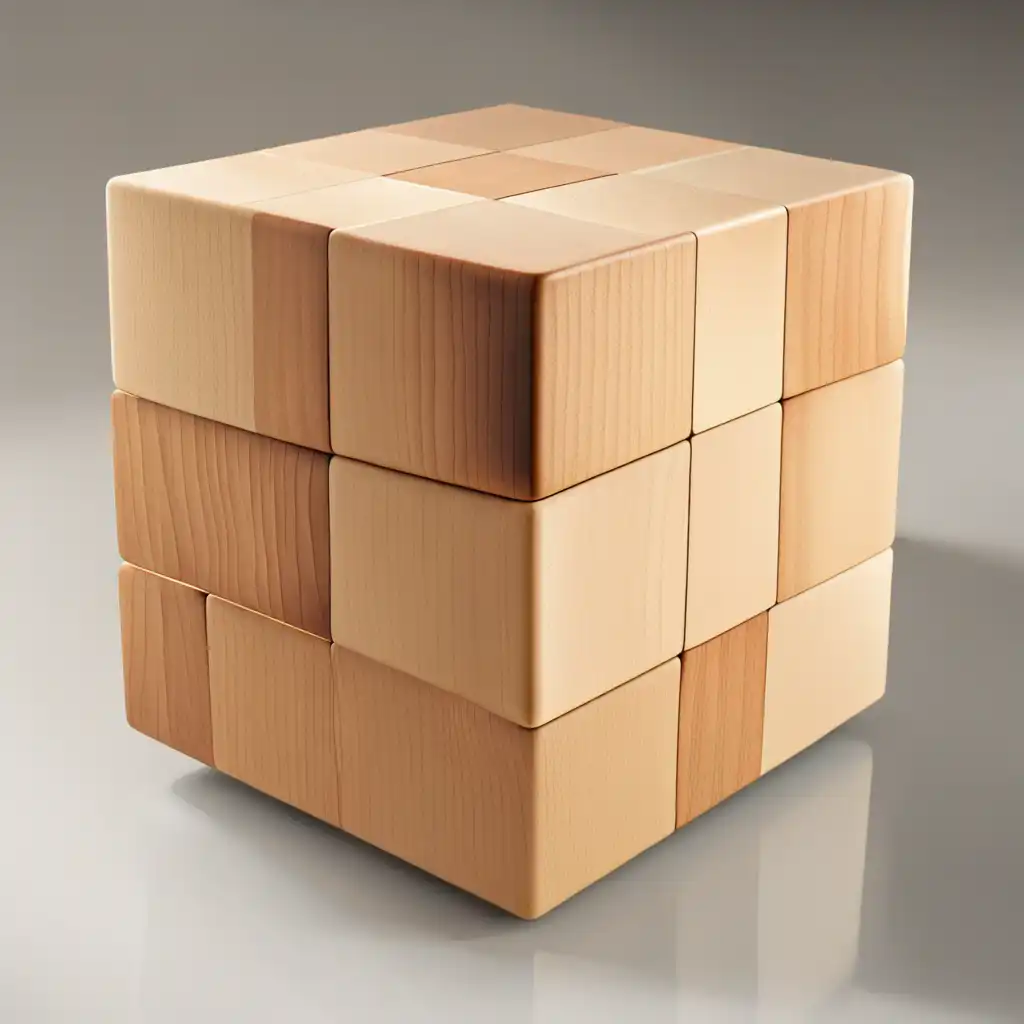
A three-dimensional solid object bounded by six square faces, facets or sides, with three meeting at each vertex.
She played with a wooden cube block.
cube
kjuːb
Chargement…
kjuːb
A three-dimensional solid object bounded by six square faces, facets or sides, with three meeting at each vertex.
She played with a wooden cube block.
kjuːb
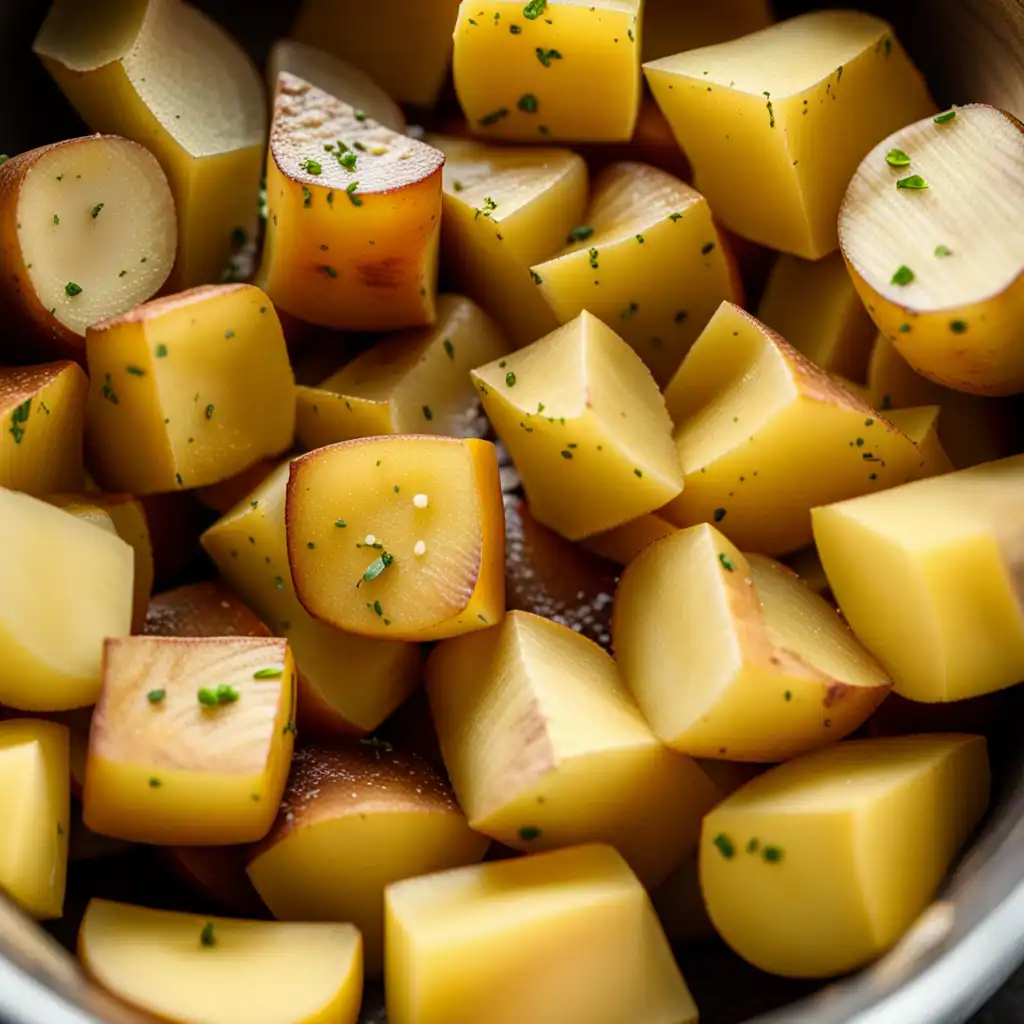
To cut something into small cube-shaped pieces.
She cubed the potatoes and put them in the pot.
kjuːb
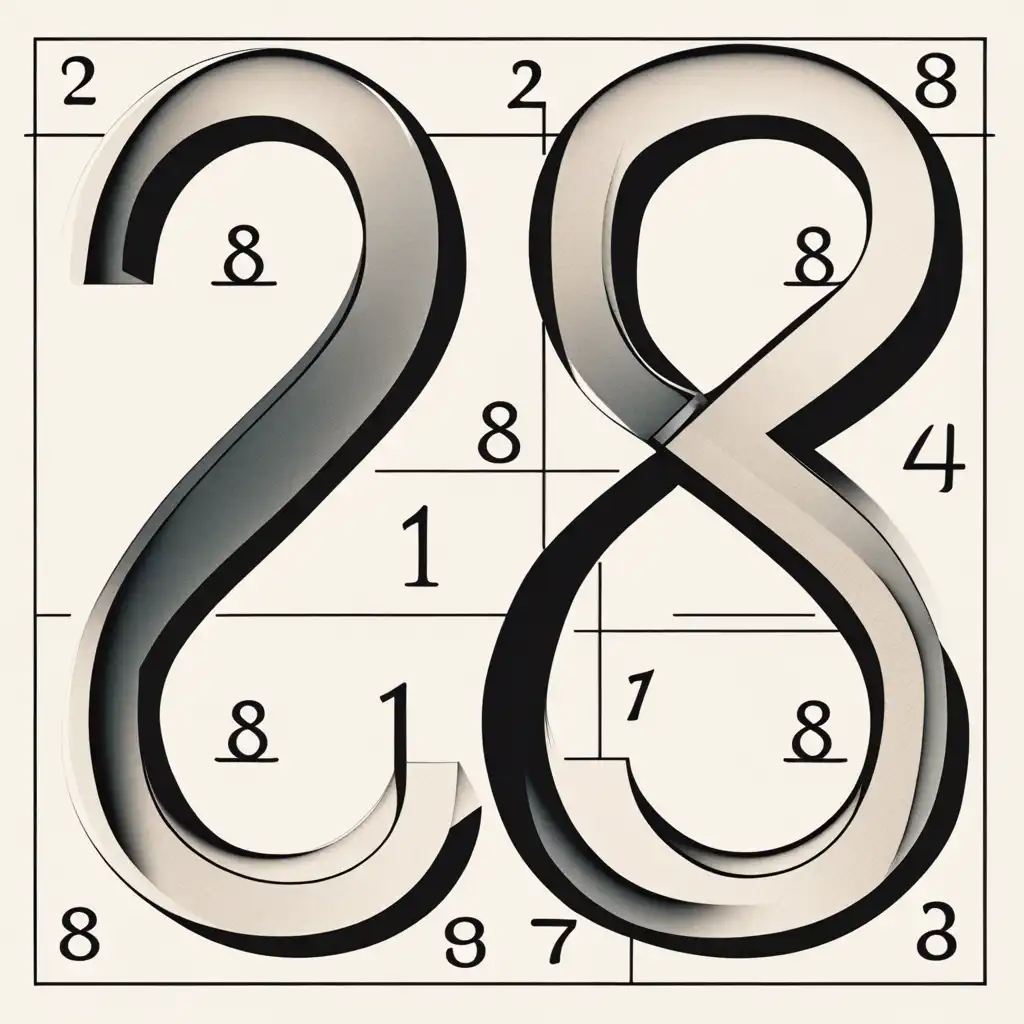
The product that results when a number or expression is multiplied by itself three times.
The cube of 2 is 8.

kjuːb
A cubicle, especially one of those found in a shared office.
John has decorated his cube with family pictures.
Impossible de charger l’audio. Réessayez plus tard.
The word 'cube' refers to a solid shape that has six equal square sides. It is often used in math when counting or measuring volume, or in geometry when discussing different shapes. You might also see it used in relation to Rubik's Cube, a popular puzzle game. In everyday life, you might use a cube of sugar for your coffee, store items in a cube-shaped container, or decorate your room with cube-shaped furniture.
A block is a general term for a solid piece of material that has undefined or irregular shapes.
A cube is a specific three-dimensional shape that has six equal square faces. It is a type of block.
An example of when you might use the word block is when describing a pile of rocks that have been stacked together. You might say, "there was a huge block of rocks in the clearing.".
A block is a general term for a solid object with undefined shape, while a cube is a specific shape consisting of six equal square faces.
Ouvrir le mot: Block →A cuboid is a type of shape where all of its faces are rectangular and opposite faces have the same size and shape.
For example, a Rubik's cube is a cube because all of its sides are the same length and each face is a square. A box of tissues, however, is a cuboid because its sides are not all the same length and each face is a rectangle.
A cuboid is applicable when the shape needs to fit objects of varying sizes, such as a container for storage or a building block for children.
Ouvrir le mot: Cuboid →Both cube and dice refer to a six-sided object, but cube specifically refers to a solid object with six identical square faces, while dice refers to small cubes used in games of chance, also known as 'die'.
In simpler terms, a cube is a three-dimensional shape with six sides that are all the same shape and size, while dice are small cubes typically used for playing games or making decisions by chance.
So when you are referring to an object in general, you would use the word cube, and if you are talking about a small cube used in games, you would use the word dice.
Ouvrir le mot: Dice →A hexahedron is a three-dimensional shape that has six faces, each of which is a rectangle, and all angles are right angles.
In simpler terms, a cube is a specific type of hexahedron where all the faces are equal squares.
A cube may be used in dice games or in packing objects together, while a hexahedron may be used in the design of buildings or machines.
Ouvrir le mot: Hexahedron →A cube is a specific type of polyhedron that has six square faces and each face meets at a right angle. It has eight vertices (corners) and 12 edges.
A polyhedron is a three-dimensional shape with flat faces and straight edges.
A cube is a type of polyhedron with specific characteristics, while a polyhedron can be any three-dimensional shape made up of flat faces and straight edges.
Both words are applicable in math and geometry to describe three-dimensional shapes, but cube specifically refers to a type of polyhedron that has six square faces with right angles.
Ouvrir le mot: Polyhedron →A prism is a solid 3D shape that has two identical parallel faces and all other faces are rectangles.
The main difference between a cube and a prism is the shape of their faces.
A cube has six square faces, while a prism has two identical parallel faces and all other faces are rectangles.
A prism is applicable in situations that require a solid with a flat surface on both the top and bottom sides, such as a building's foundation, a stack of books, or a pencil box.
Overall, both cubes and prisms are 3D shapes that are used in various fields such as architecture, engineering, and mathematics.
Ouvrir le mot: Prism →Cube refers specifically to a three-dimensional shape with six square faces that are all equal in size. Solid is a more general term used to describe any three-dimensional object that has a defined shape and size.
For example, a dice is a cube because all of its sides are equal squares. But a rectangular prism is still a solid, even though its sides could be rectangles of different sizes.
A rock, a book, or a drum are all solids too, even though they have irregular shapes.
Cube is a specific term for a shape with six equal square faces, whereas solid is a more general term that applies to any three-dimensional object with a defined shape and size.
Ouvrir le mot: Solid →A cube is a 3-dimensional shape that has six square-shaped faces that are equal in size, and each corner of the cube has a 90-degree angle.
A square is a 2-dimensional shape that has four sides of equal length and four right angles.
In simpler terms, a cube is a solid object with six equal sides that has volume, whereas a square is a flat object with equal sides that has area.
Ouvrir le mot: Square →Unlike ice cubes formed when liquid freezes into a solid, snowflakes form when water vapor turns straight into ice. But that still doesn't explain why snowflakes have six sides. To understand that, we need to delve deeper into the physics of water.
Voir sur YouTube ↗I don't want to spend my life on an ice cube.
that will be true forever and ever, for longer than any diamond you may have. But what happens if we go to three dimensions? If I want to fill the space with equal pieces, without leaving any gaps, I can use cubes right?
Voir sur YouTube ↗The markets are the world's greatest Rubik's cube. And I love solving puzzles.
that it's slightly cubed now what about that I love it when scientists have access to this sort of technology to answer these sorts of questions. You know I didn't realise what i was missing from my life until this moment i was missing the cross section of our wombat intestinal system yeah with
Voir sur YouTube ↗I am obsessed with ice cubes. Obsessed.
equals the natural log of 1 plus v squared. And since v equals y over x that gives us the final function x squared plus y squared minus c x cubed equals 0. And speaking truthfully sir your mere presence
Voir sur YouTube ↗Big cubes, small cubes - it's all ice. I'm not that fancy.
century and it is as popular and challenging today as when it first appeared the cube became part of the culture an iconic design like this that is now recognized all over the world so
Voir sur YouTube ↗Bubble cubes are central to what I do.
You can see where we're going with this. Take the whole cube and extend it out one inch, this time perpendicular to all three existing directions, and we get a 4D hypercube, also called a tesseract. For all we know, there could be four-dimensional lifeforms somewhere out there, occasionally poking their heads
Voir sur YouTube ↗I always feel like sugar cubes aren't big enough.
Imagine the darkest emptiest thing you can and cube it a gazillion times and that's where we are. And then suddenly, bang! A universe appears an entire universe. And we've crossed our first threshold.
Voir sur YouTube ↗In the morning, I always use a cube of ice on my face - it gives me a natural lift.
Can you get it? How many of you can't get it? That'll help. Now you can get it. These are two very different phenomena. When you see the cube one way behind the screen,
Voir sur YouTube ↗I like to have straight-up black coffee, but when you get it, sometimes you'll burn your tongue, or it spills on your hands, and you get third degree burns. I happen to be the kind of human being who doesn't want to sue coffee companies for money, so I just say, 'Hey, can you give me some coffee, but can you also give me like, eight ice cubes.
with each individual module placed anywhere in the cube, and at any orientation. It can also break itself apart and reassemble into any other orientation. Now comes your job. The probe will need a special protective coating
Voir sur YouTube ↗But it is impossible to divide a cube into two cubes, or a fourth power into fourth powers, or generally any power beyond the square into like powers; of this I have found a remarkable demonstration. This margin is too narrow to contain it.
But most importantly without water, we wouldn't have iced tea. Mmmm iced tea. Why do these ice cubes float? If these were cubes of solid argon in a cup of liquid argon, they would sink.
Voir sur YouTube ↗In tech-land, no one cares what kind of car you drive, and frankly, they're not going to find out anyway. You're not going to go to lunch together, because you're going to be sitting in your cube with a brown bag eating lunch.