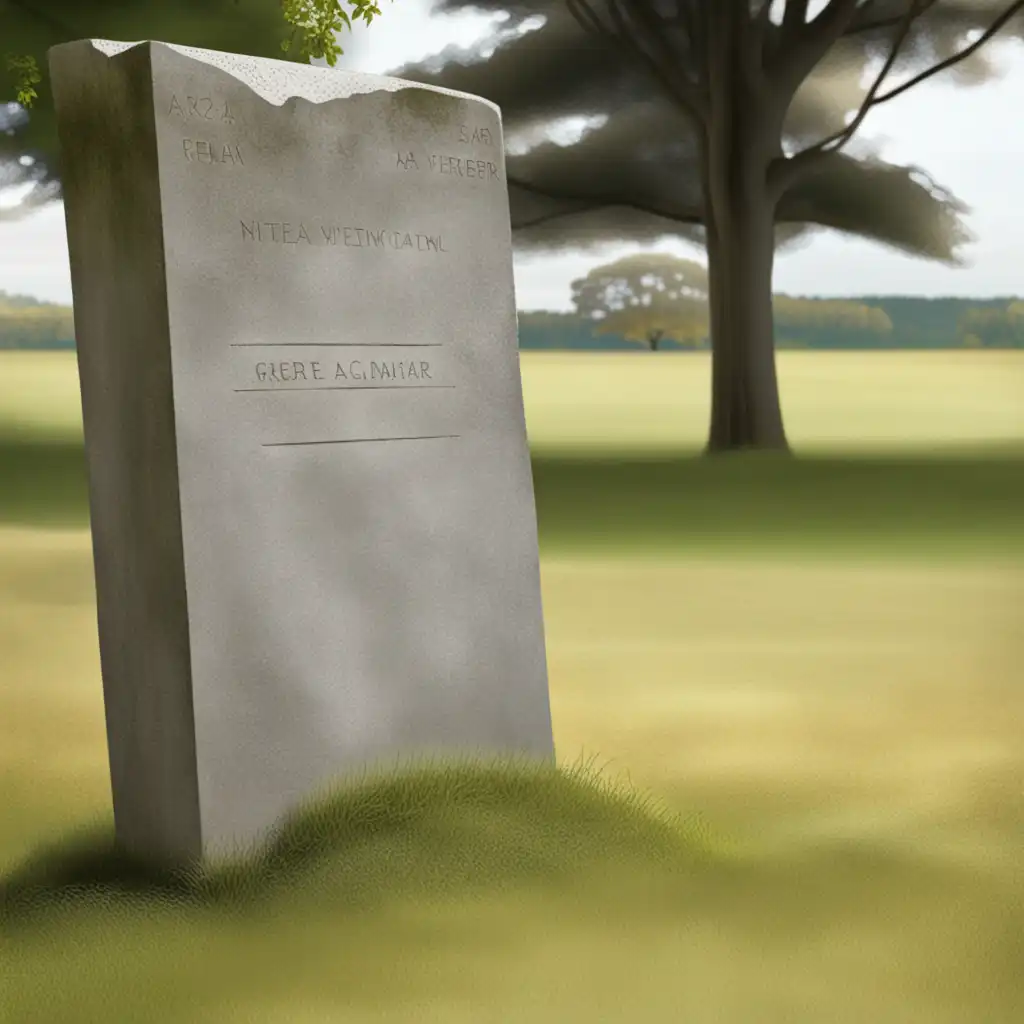
gravestone
noun gravestone
ˈɡreɪvstəʊn
A stone slab, set up over a grave to remember the person who has died.
Her name was written on the gravestone.
gravestone
ˈɡreɪvstəʊn
불러오는 중…
ˈɡreɪvstəʊn
A stone slab, set up over a grave to remember the person who has died.
Her name was written on the gravestone.
오디오를 불러오지 못했어요. 잠시 후 다시 시도해 주세요.
A gravestone is a piece of stone that goes on top of a grave to remember someone who has passed away. It usually has the person's name, birth and death dates, and sometimes a special message or symbol. Gravestones are typically found in cemeteries, which are places where people are buried after they pass away.
A cenotaph is a monument or structure erected in honor of a person or group of people whose remains are elsewhere or unknown.
Cenotaphs can also be used to honor public figures or ordinary citizens who do not have graves.
In summary, cenotaphs are used to honor people whose bodies are not present, while gravestones are used to mark the burial site of a deceased person.
단어 열기: Cenotaph →An epitaph is the inscription on a gravestone or a small plaque that is used to honor a deceased person. It could be a quote or a saying that signifies the person's life or some memorable event in their life.
A gravestone is a physical object placed on a grave to mark the location, while an epitaph is a commemorative message or quote inscribed on the gravestone or a plaque.
단어 열기: Epitaph →Both gravestone and headstone are terms used to describe a marker or monument that is placed at a person's final resting place.
However, the term headstone is generally used to describe a marker that is positioned upright above the ground, while a gravestone is usually a flat marker that is placed flush with the ground.
You might see a headstone in a cemetery with a person's name, dates of birth and death, and perhaps an epitaph or decoration.
Ultimately, while the differences between headstones and gravestones may seem small, they can be important in the context of funeral traditions, cemetery design, and individual preferences for burial arrangements.
단어 열기: Headstone →A marker is smaller and can be made out of metal, plastic or other materials. Markers are usually temporary and may be placed at a burial site until a gravestone is installed or to mark a grave in a cemetery.
Markers can also be placed to commemorate a location or event. So, in summary, gravestones are larger and are permanently placed at a burial site, while markers are smaller and can be temporary or used to commemorate other places or events.
단어 열기: Marker →A memorial is a tribute to a person who has died, which can take many different forms.
A memorial doesn't necessarily have to be placed on a burial site and can be located anywhere.
A gravestone is a specific type of memorial that marks the physical location of a person's burial site, whereas a memorial can take many different forms and can be placed anywhere as a tribute to a person's memory.
단어 열기: Memorial →A monument is a much larger and more elaborate structure that is often erected to commemorate a historical event, a famous person, or an important achievement.
Monuments can take many forms, including statues, memorials, obelisks, and other large structures.
A gravestone is a small marker that is used to mark a person's final resting place, while a monument is a larger structure that is used to commemorate an important event or person.
단어 열기: Monument →A plaque is a flat, thin piece of metal or other material that is attached to a wall or other surface as a memorial or commemorative marker.
In summary, gravestones are used to mark graves, while plaques are used in a broader context to commemorate people, events, or sites.
단어 열기: Plaque →Both gravestone and tombstone refer to markers placed on a burial site to identify the individual who is buried there.
Tombstone usually refers specifically to markers made of stone or concrete.
Gravestone is a broader term and can apply to any type of marker, while tombstone is usually reserved for markers made of a specific material.
단어 열기: Tombstone →“Here lies Arthur king who was and king who will be.” So reads the inscription on King Arthur’s gravestone
YouTube에서 보기 ↗If I go to a baseball game, I hear 'Shoeless Joe,' but otherwise, I hear 'toe pick' five times a day. No matter how many more movies I make, that'll be on my gravestone.
he turned an aboveground tomb into a two-story house few people would want to do their laundry only feet away from a corpse and a crypt or brush their teeth on top of a gravestone there's even an
YouTube에서 보기 ↗I'm going to put on my gravestone, 'He never owned a cell phone.
the ones who have the eulogy written, the menu for the funeral lunch. My grandparents did. And everything but the final date chiseled into the gravestone.
YouTube에서 보기 ↗Learn your lines.' I want that on my gravestone.
on science to to answer the question what is it that animates living boomers what is the difference between a piece of rock that's carved into a gravestone and me
YouTube에서 보기 ↗On my gravestone, I want 'Here lies the singer,' not 'Here lies the T.V. presenter'.
I will go to my grave being known as Marge Gunderson. It'll be on my gravestone if I have one. I don't mind that, because it was a great character.
When I've been asked what should be on my gravestone, I've said: 'Here lies Gandalf. He came out.' Two big achievements.
You better be very convinced, very sure, before you pull your plug or someone else's plug, that you know what's on the other side of the gravestone.
One puts off the biography like you put off death. To write an autobiography is to etch the words on your own gravestone.
Somebody asked what I wanted on my gravestone. I'm just going to put: 'Glad I Could Help.
I always tell my wife, 'If you're ever looking for something to put on my gravestone, put down, 'He was an honest man, and he never held a grudge.