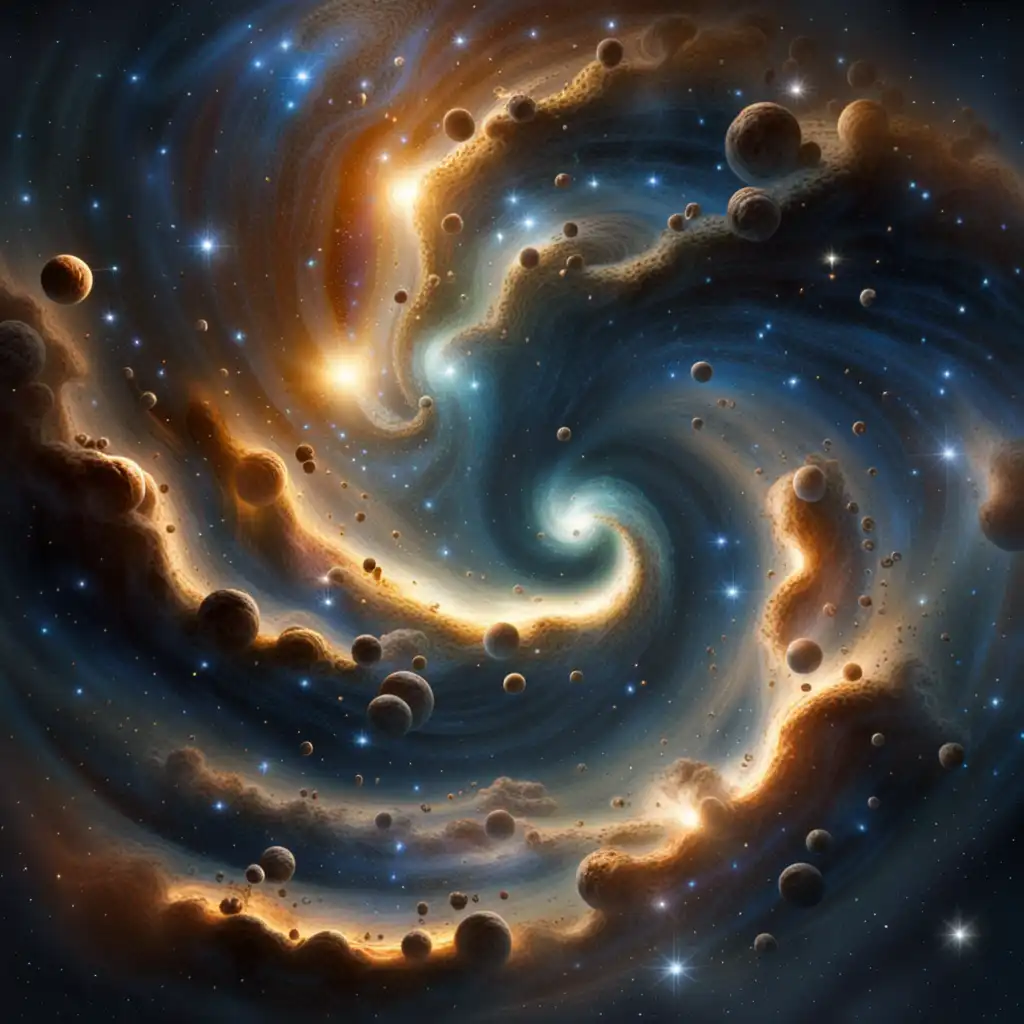
galaxy
noun galaxy
ˈɡæləksi
A large group of stars, gas, and dust in space that's bounded together by gravity.
The Milky Way is a galaxy that contains our solar system.
galaxy
ˈɡæləksi
Chargement…
ˈɡæləksi
A large group of stars, gas, and dust in space that's bounded together by gravity.
The Milky Way is a galaxy that contains our solar system.
ˈɡæləksi
A very large or impressive group or collection of something.
She has a whole galaxy of fans following her on social media.
ˈɡæləksi
A type of candy bar made from milk chocolate.
She bought a Galaxy bar from the store for her dessert.
Impossible de charger l’audio. Réessayez plus tard.
The word galaxy refers to a large group of stars, gas, and dust that are held together by gravity. Our solar system is a part of the Milky Way galaxy. Galaxies are very big and can contain billions of stars. People use the word galaxy to talk about our own galaxy, the Milky Way, or to describe other galaxies that exist in the universe. The word can be used in different contexts like science, astronomy, and space exploration. It is also used in popular culture, such as in movies or TV shows that feature space or sci-fi themes.
A cluster is a group of stars that are close together, but not necessarily bound together by gravity.
Clusters can be small, with just a few stars, or they can be large, with thousands of stars.
Clusters are often found in galaxies.
Ouvrir le mot: Cluster →A constellation is a grouping of stars that appear to form a pattern or shape, typically named after mythological figures, animals, or objects.
These groupings are visible from Earth and have been recognized and named by humans for thousands of years. Constellations are often used for navigation and stargazing.
Galaxies can contain millions or even billions of stars, and there are countless galaxies in the universe. Unlike constellations, galaxies are not visible to the naked eye and can only be observed with telescopes.
In short, constellations are patterns of stars that we can see from Earth, while galaxies are huge collections of stars and other matter that exist throughout the vast expanse of the universe.
Ouvrir le mot: Constellation →The cosmos refers to everything in existence, including all galaxies, planets, stars, black holes, etc. It describes the entire universe.
Cosmos is a more general term used to describe everything in the universe, while galaxy is a term used specifically to refer to a large system of stars and other celestial objects.
Ouvrir le mot: Cosmos →A nebula is a cloud of gas and dust in space.
Nebulas can be colorful and have interesting shapes, and many are the birthplace of new stars.
A galaxy is a large system of stars, while a nebula is a cloud of gas and dust.
Galaxies can be identified by their shape and are known to contain immense numbers of stars, while nebulae can signal the birthplace of new stars.
Ouvrir le mot: Nebula →A galaxy is a large system of stars, planets, gas, and other matter held together by gravity. There are many galaxies in the universe, and ours is called the Milky Way.
A universe refers to everything that exists, including all matter, energy, and space. It includes all the galaxies, stars, planets, black holes, and other celestial bodies.
So, while a galaxy is a part of the universe, the universe is much bigger and includes everything that exists.
Ouvrir le mot: Universe →is intimately connected to those distant invisible galaxies. We can think of them as part of our universe. They make up a single giant edifice, obeying the same physical laws and all made from the same types of atoms electrons, protons quarks neutrinos that make up you and me.
Voir sur YouTube ↗In less than a hundred years, we have found a new way to think of ourselves. From sitting at the center of the universe, we now find ourselves orbiting an average-sized sun, which is just one of millions of stars in our own Milky Way galaxy.
one mission more than any other has deepened our understanding of the galaxy a spacecraft bearing the name of an
Voir sur YouTube ↗I love science fiction, but I have a hard time feeling for characters in a galaxy far away. Choosing movies is the one thing in my life where there's no compromising.
one of the most distant images of our universe ever observed. Everything you see here is a galaxy, comprised of billions of stars each. And the farthest galaxy is a trillion trillion kilometers away.
Voir sur YouTube ↗There must be enormous numbers of planets around the stars in the many galaxies in our observable universe. We may be sure that wonderful things are happening on these planets that the human race never will observe.
discovered the first black hole. An untold number of black holes are scattered throughout the universe, constantly warping space and time, altering entire galaxies and endlessly inspiring both scientists and our collective imagination.
Voir sur YouTube ↗I have to believe there's some other life force out there. I don't know in what form. But we can't have all these galaxies and universes without something going on.
our galaxy is just one of hundreds of billions of galaxies in the universe that is a lot of opportunities to find life Mars it's simply the first step thank you
Voir sur YouTube ↗I've always thought that we, as human beings, would be naive and arrogant to pretend that we're the only life form in the galaxy.
And those smudgy galaxies? They're millions of light years away. It has taken millions of years for that light to reach us. So the universe itself is in some sense an inbuilt time machine. The further we can look back the younger the universe we are probing.
Voir sur YouTube ↗Even though 'Star Wars' takes place in another galaxy, a lot of the themes and things that characters deal with in terms of lessons that they're learning are things that are completely relatable to real life.
That's incredible when we think about how vast the universe is. Why would we expect it to be the same across such huge distances? On the scale of a galaxy let alone the universe, we're smaller than we can readily comprehend, but we do have the capacity to wonder, to question, to explore,
Voir sur YouTube ↗Finding the first seed black holes could help reveal how the relation between black holes and their host galaxies evolved over time.
Astrophysicists don't just see the billions of stars among the billions of galaxies in the universe. They hear feel and sense them through many channels, each revealing a different story. But it all begins with light the kind we can see and the kind we can't.
Voir sur YouTube ↗For example, if the big bang had been one-part-in-a billion more powerful, it would have rushed out too fast for the galaxies to form and for life to begin.
Useful as the universe's most massive laboratories. And as laboratories to describe galaxy clusters is to describe the experiments that you can do with them. And I think there are four major types, and the first type that I want to describe
Voir sur YouTube ↗We have stars, planets and galaxies in space. There's lots of nothingness out there, but it's really not. There's gas, dust and other bits of matter floating around emptier' areas of the universe, but you can't see it very easily.
is intimately connected to those distant invisible galaxies. We can think of them as part of our universe. They make up a single giant edifice obeying the same physical laws and all made from the same types of atoms, electrons protons quarks neutrinos that make up you and me.
Voir sur YouTube ↗There are at least as many galaxies in our observable universe as there are stars in our galaxy.