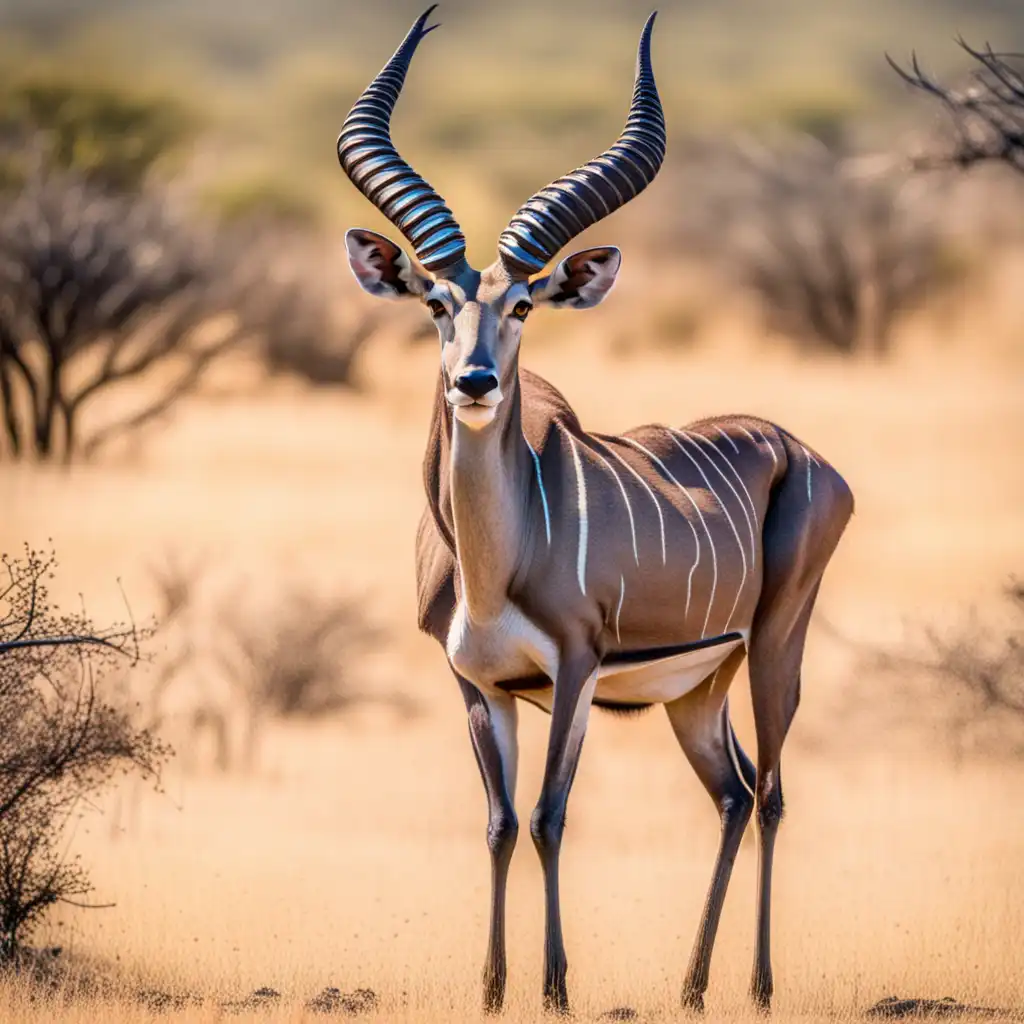
kudu
noun kudu
ˈkuːduː
A type of large African antelope with horns that twist back.
The hunter photographed a majestic kudu in the wild.
kudu
ˈkuːduː
Cargando…
ˈkuːduː
A type of large African antelope with horns that twist back.
The hunter photographed a majestic kudu in the wild.
No se pudo cargar el audio. Inténtalo de nuevo más tarde.
The word 'kudu' refers to a type of antelope that is found in Africa. It has long, spiral horns and brownish-grey fur. The word 'kudu' can be used when talking about African wildlife or when referring to a specific type of antelope.
Antelopes and kudus are both types of African ungulate (hoofed mammal) and belong to the same family, but they are two different species.
Antelopes are generally small to medium-sized deer-like animals, with slim bodies, long legs, and short tails. They come in various colors, including brown, tan, and white, and have curved horns, which vary in size and shape depending on the species.
On the other hand, kudus are larger African antelopes that are mainly found in woodland areas. They have long, twisted horns, and their coats have distinctive white stripes on a brownish-grey background.
In summary, antelopes refer to a diverse group of small to medium-sized ungulates found in Africa, while kudus are a type of larger African antelope with distinct features such as their white striped coats and long, twisted horns.
Abrir palabra: Antelope →Buck typically refers to male deer in general or to specific types of deer found in North America, such as the white-tailed deer or mule deer.
Buck is applicable to male deer found in North America and kudu is applicable to a species of antelope found in Africa.
Abrir palabra: Buck →Deer and kudu are different types of antelopes that live in different parts of the world. Deer are mainly found in North America, Europe, and Asia, while kudu are found in Africa.
Deer are generally smaller in size than kudu, with shorter, more slender horns or antlers. They are often hunted for their meat and their hides, and can also be kept as pets or used in zoos.
Deer and kudu are both types of antelopes, but they differ in size, location, and horn structure. Deer are found in North America, Europe, and Asia while kudu in Africa.
Abrir palabra: Deer →Doe and kudu are both names of animals, but they are different animals.
A doe is a female deer, usually a white-tailed, mule, or black-tailed deer found in North America.
Doe can be used to refer to any female deer but it is most commonly used to refer to these three specific species.
To summarize, doe is applicable for female deer in North America while kudu is applicable for a type of antelope found in eastern and southern Africa.
Abrir palabra: Doe →Elk and kudu are two completely different animals. Elk are found in North America while kudu are found in Africa.
Elk are a type of deer and are typically larger than other deer species. They have large antlers and can weigh up to 700 pounds.
Elk are hunted for their meat and antlers, and are also a popular animal for wildlife viewing.
Elk are found in North America and are a type of deer, while kudu are found in Africa and are a type of antelope with impressive spiral horns.
Abrir palabra: Elk →Gazelles and kudus are both types of antelopes, but they have different physical characteristics and habitats.
Gazelles are generally smaller and faster, with slender legs and a more streamlined body. They live in open grasslands and deserts, where they can outrun predators like cheetahs.
Gazelles are also more social, often living in large herds.
The key difference between gazelles and kudus is their size, habitat, and social behavior. Gazelles are smaller, live in open areas, and are more social, while kudus are larger, live in more wooded areas, and are more solitary.
Abrir palabra: Gazelle →Kudu and stag are both male deer but they belong to different species. Kudu is a type of antelope found in Africa and stag is a type of deer found in Europe and Asia.
Kudu has long horns that curve upwards while stag has antlers that branch out. Kudu is applicable in the context of African wild animals while stag is applicable in the context of European or Asian wildlife.
Abrir palabra: Stag →Safari Live - Day 133 %\PIPE%...
Ver en YouTube ↗When we were younger, my brother and I would go out bow hunting. That got me into it. We hunted all kinds of wildlife - things with big horns normally. Deer, kudu, stuff like that.
The Intense 8 Hour Hunt...
Ver en YouTube ↗When I visit my brother in South Africa, I order things I've only seen in zoos. Little deers and kudu, all the mammals you would never think of eating.
Safari Live - Day 166 %\PIPE%...
Ver en YouTube ↗Whenever I have a little time off, I try to go back to my farm in South Africa. I'll spend time with my family and hunt antelope, kudu and springbok. During a 2010 hunting trip, I tore some ligaments in my ankle when I stepped in a hole.
Safari Live - Day 121 %\PIPE%...
Ver en YouTube ↗Safari Live - Day 35 %\PIPE%...
Ver en YouTube ↗Safari Live - Day 320 %\PIPE%...
Ver en YouTube ↗Safari Live - Day 368 %\PIPE%...
Ver en YouTube ↗Safari Live - Day 11 %\PIPE%...
Ver en YouTube ↗Introducing a New...
Ver en YouTube ↗Growing Up in the...
Ver en YouTube ↗