
symposium
noun symposium
sɪmˈpəʊziəm
A meeting or conference for discussing a particular subject, often academic or scientific.
He attended a symposium on cancer research at the local university.
symposium
sɪmˈpəʊziəm
Loading…
sɪmˈpəʊziəm
A meeting or conference for discussing a particular subject, often academic or scientific.
He attended a symposium on cancer research at the local university.
sɪmˈpəʊziəm
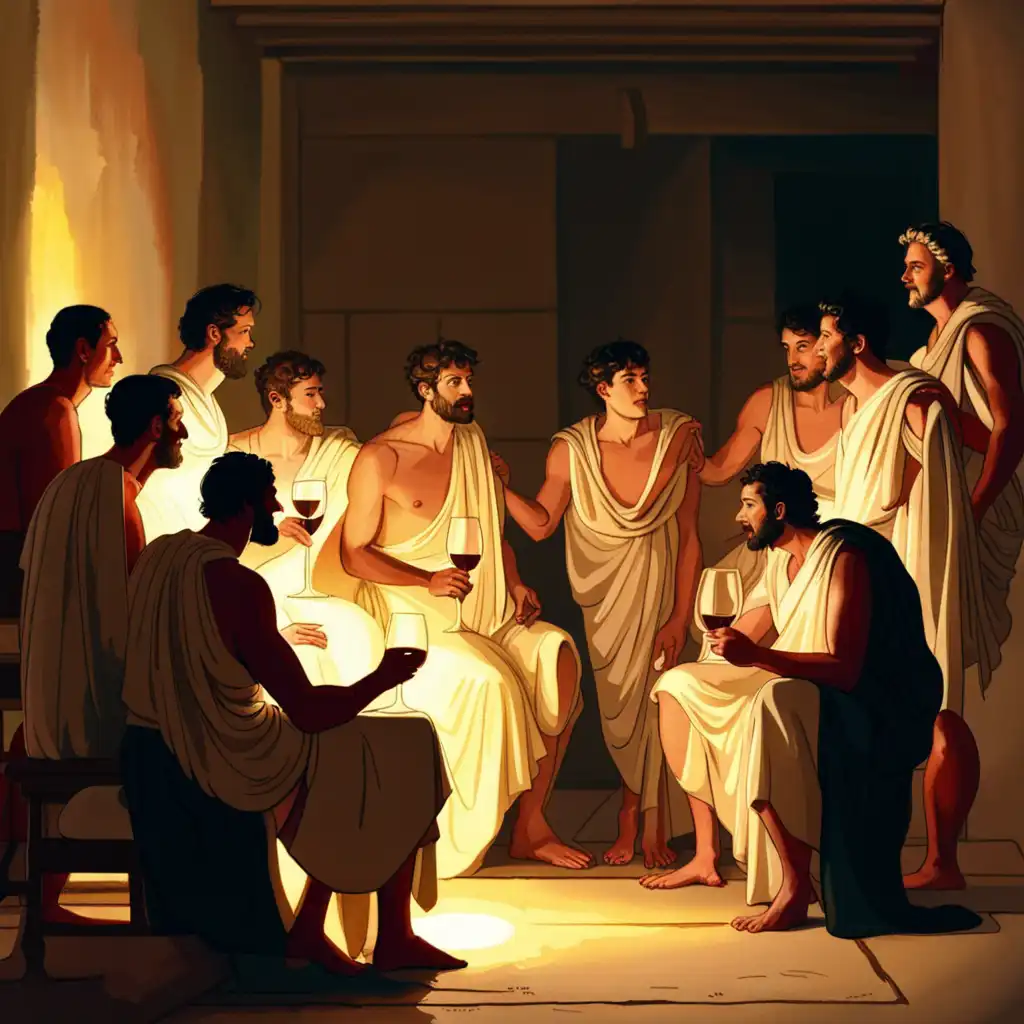
In ancient Greece, a drinking party, particularly one following a dinner, where philosophical discussions happened.
In Plato's Symposium, famous Athenians discuss the nature of love.
Audio could not be loaded. Please try again later.
A symposium is a type of academic or professional gathering where experts come together to discuss and share ideas on a particular topic. It is often organized by universities, research institutions, or associations. During a symposium, different speakers give presentations or lectures, and there may be group discussions or question-and-answer sessions. The goal is to exchange information, learn from each other, and promote collaboration. The word symposium can also refer to a social gathering where people discuss a common interest.
Assembly refers to a gathering of people for a specific purpose, usually to discuss or make decisions on a particular topic or issue.
It can be used for meetings like school assemblies, community assemblies, or political assemblies.
An assembly is a general gathering, while a symposium is a gathering of experts.
Open word: Assembly →A conference is a meeting where people gather together to share ideas and information on a particular topic or theme, usually with presentations or speeches by different experts in their respective fields, and often with opportunities for workshops and networking.
A symposium is a more specific type of academic conference, usually focused on a single subject or area of study, with presentations and discussions by researchers or scholars in that field.
It is generally more formal and structured than a regular conference, with a specific agenda and schedule of events.
Both conferences and symposia can be held in a variety of settings, such as academic institutions, professional organizations, or industry associations.
Open word: Conference →A convention is an assembly of people who come together for a common purpose or interest. It usually involves a large group of people who gather to discuss, network, and learn about a particular topic, such as a trade show, a political rally, or a fan convention.
A convention can be held for either professionals or amateurs, and it can be open or closed to the public.
It is usually more academic or intellectual than a convention and often involves smaller groups of people.
A convention is a more general term that can refer to various types of meetings, while a symposium is a more specific type of meeting for professionals in a particular field.
Open word: Convention →A forum is an open discussion where people can share their opinions, ideas and thoughts on a particular topic. It is a public meeting where everyone can participate.
Forums are applicable in situations where different perspectives or voices need to be heard, while symposiums are better suited for academic or professional settings where specialized knowledge is required.
Open word: Forum →Gather means to come together or assemble in one place for a particular purpose, while the word symposium is a formal meeting or conference at which experts discuss a particular topic.
Gather is more general and can refer to any kind of meeting or gathering, big or small, formal or informal. You might say "Let's gather all our friends for a movie night" or "The family gathered for a holiday dinner.".
Symposium is more specific and usually refers to a formal gathering of experts, scholars or professionals to discuss a particular topic in depth.
Gather is a general term for any kind of coming together, while symposium is a formal meeting for experts to discuss a particular topic in depth.
Open word: Gather →Meet typically refers to a gathering or encounter between people, usually for a specific purpose such as discussing something, making plans, or socializing.
A symposium usually refers to a formal meeting or conference where experts in a particular field come together to discuss and present their ideas or research on a specific topic.
You can use meet for informal gatherings with friends, appointments, and discussions, while a symposium is more commonly used for academic or professional meetings.
Open word: Meet →A seminar is a meeting where a group of people share and discuss their knowledge and ideas on a specific topic.
Seminar is applicable when people want to learn from each other and take part in a discussion, while symposium is suitable when presenting research or data to an audience.
In simpler terms, a seminar is like a group study session where everyone can share their thoughts and opinions, while a symposium is more like a conference where people present their work and findings to others.
Open word: Seminar →A summit refers to a meeting where leaders or representatives of countries or organizations come together to discuss and address a specific problem or issue.
For example, the G7 summit brings together leaders of the seven largest economies in the world to discuss global economic issues.
Summits are usually used in political or diplomatic settings.
A summit is applicable in political or diplomatic settings, while a symposium is applicable in academic or professional settings.
Open word: Summit →for example our expanded resources have made it possible to build some amazing public facing elements around this symposium creating our first-ever explores festival to showcase our explores work to the world just last
Watch on YouTube ↗If two scientists are giving their papers at a symposium, and one of them is just naturally better at talking to the public or talking to a group of people, that scientist is liable to get more attention - in fact, I'm told that they do get more attention - than the one who's a little more stiff about it. Well, that's not good for science.
But over the course of history, some of our most respected philosophers have put forward some intriguing theories. Love makes us whole again. The ancient Greek philosopher Plato explored the idea that we love in order to become complete. In his "Symposium" he wrote about a dinner party,
Watch on YouTube ↗The college stations have a big voice, and I would like to become more involved with them. I would like to have symposiums with the members of various college radio stations.
for discussions about the things that ensued. One of the most exciting things about this experiment was the conversation that happened afterwards. An entirely spontaneous symposium happened in the park.
Watch on YouTube ↗We have Al Jazeera Arabic news, Al Jazeera English news, of course; we have three sports channels, and we have Al Jazeera Mubasher, which is a live channel that broadcasts live press conferences and symposiums and meetings. And, of course, we have Al Jazeera commentary in Arabic.
The New Nordic diet originated in 2004, when the visionary chefs Rene Redzepi and Claus Meyer called a symposium of regional chefs to address the public's increasing consumption of processed foods, additives, highly refined grains, and mass-produced poultry and meat.
In the spring of 1854, some of my publications persuaded King Maximilian II of Bavaria to offer me, at the suggestion of Emanuel Geibel, a position in Munich with an annual salary of 1000 guilders, to take part in his so-called symposia, weekly soirees at which scholars and poets were gathered.