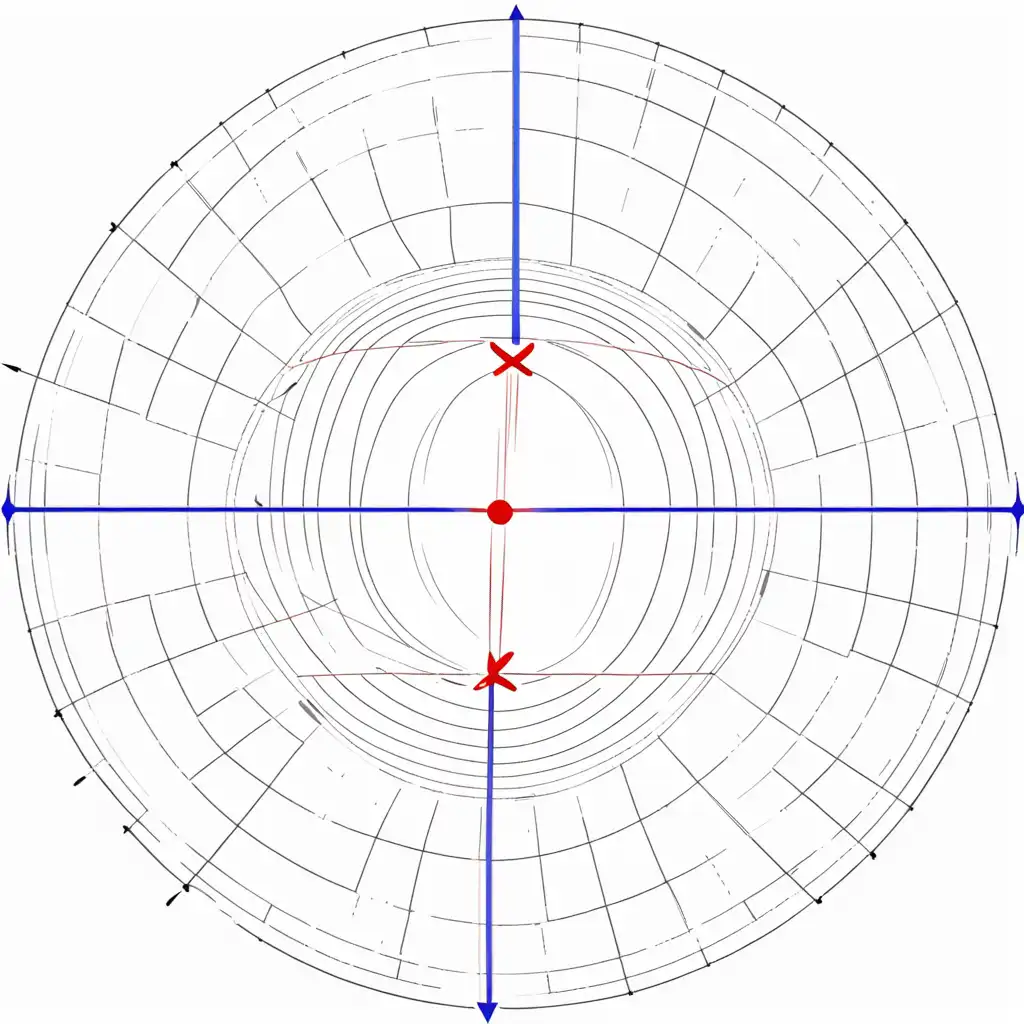
It is a measurement used in astronomy and navigation to find the direction of a star or object, usually in degrees. It is calculated from the north in a clockwise direction.
By determining the azimuth, one can accurately navigate using the stars.
Azimuth is a technical term used in navigation, astronomy and geography. It refers to the horizontal angle of an object in relation to where you are standing. Basically, it tells you which direction to look or point to find something. For example, if you were trying to find the North Star, you would need to know its azimuth, or the direction in which it is located from where you are standing. In everyday conversation, the word azimuth is rarely used, but in fields like engineering, military, and geology, it is an important term to know.
An angle is a measurement of the space between two lines or planes that intersect.
An angle can be acute (less than 90 degrees), obtuse (greater than 90 degrees), or right (equal to 90 degrees).
Azimuth is a specific type of angle measurement used in navigation and astronomy. It measures the horizontal angle between a celestial object (such as a star or planet) and the observer's true north.
Angle is a general term for the measurement of space between two lines or planes, while azimuth is a specific type of angle measurement used in navigation and astronomy to determine the direction of celestial objects.
Arc and azimuth are both words used in navigation and geometry. An arc is a part of a circle, and refers to the measure of the curved section of the circle between two points on the circumference.
In simpler terms, an arc helps measure the length of a curve or circle, while an azimuth is used to measure the direction or angle between two points.
Arc is often used in construction and engineering, while azimuth is commonly used in navigation and astronomy.
Both azimuth and bear are used to describe directions or angles, but they are used in different contexts.
Bear is a term used in land navigation and describes the compass direction of travel.
It is often used in conjunction with navigation using a map and compass. For example, if someone says "take a bearing of 320 degrees and head west," they are using the term bear to describe the direction of travel.
Azimuth is a horizontal angle used to determine direction to a point of interest, while bear is a compass direction of travel.
Azimuth and course are terms used to describe direction, but they are used in different contexts.
A course is a predetermined direction for moving from one point to another. It is commonly used in aviation, boating, and driving.
For example, if you are driving from one city to another, you might plan your course by using a map and following a route that will take you directly to your destination.
In simpler terms, an azimuth is used to determine the direction of an object, while a course is used to plan a route from one point to another.
Azimuth and head are both terms used to describe the direction in which something is facing or moving, but they are used in different contexts.
Head is a more general term that can be used in many contexts to describe the direction something is facing or moving.
It can refer to the front or forward direction of a person, vehicle, or vessel. For example, the head of a ship is the front or bow, while the "tail" is the back or stern.
Azimuth is a technical term used in scientific and navigational fields, while head is a more general term used in everyday language to describe the direction of movement.
Azimuth and orientation are both used to determine direction, but they are used in different contexts.
Orientation refers to the relative position of an object with respect to a specific reference point.
It is often used in architecture or engineering to describe the arrangement of structures or components. For example, an architect might use orientation to describe the placement of a building on a site, taking into account factors like solar orientation and prevailing winds.
Azimuth is used to determine direction in navigation and surveying contexts, while orientation describes the position of an object in relation to a reference point, commonly in architecture and engineering.
Traverse refers to the process of measuring distances and directions between several points to determine their relative positions.
It is used in surveying and mapping to create accurate maps of an area. Traverse is applicable in situations where you need to create a detailed map of an area by measuring the distances and directions between multiple points.
Even from their infancy we frame them to the sports of love: their instruction, behavior, attire, grace, learning and all their words azimuth only at love, respects only affection. Their nurses and their keepers imprint no other thing in them.