molecule
noun molecule
ˈmɑːlɪkjuːl
The smallest unit of a substance that keeps the same chemical properties
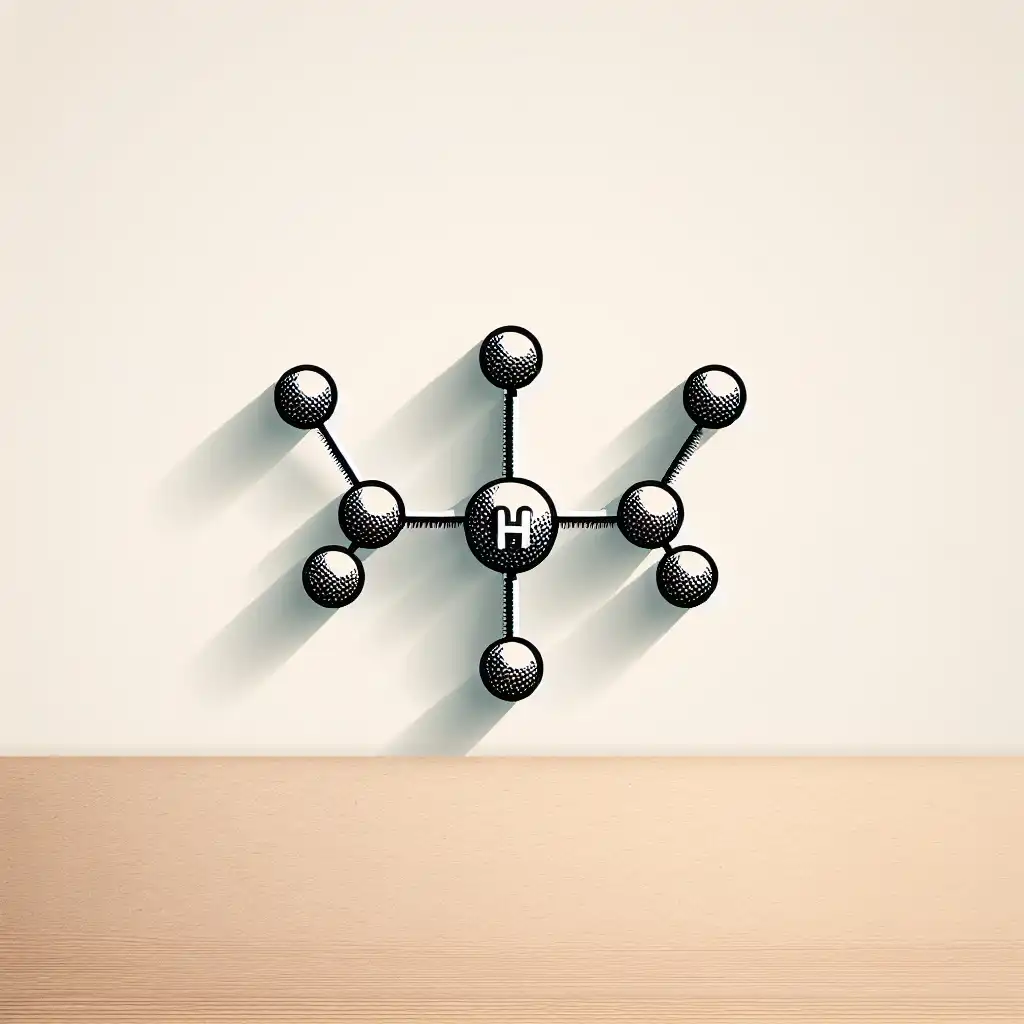
Water is a molecule made up of two hydrogen atoms and one oxygen atom.
molecule
ˈmɑːlɪkjuːl
読み込み中…
ˈmɑːlɪkjuːl
The smallest unit of a substance that keeps the same chemical properties
Water is a molecule made up of two hydrogen atoms and one oxygen atom.
ˈmɑːlɪkjuːl
A group of atoms bonded together
A molecule of oxygen forms when two oxygen atoms bond together.

ˈmɑːlɪkjuːl
A very small amount of something
I didn't get a molecule of sleep last night.
音声を読み込めませんでした。しばらくしてからもう一度お試しください。
A molecule is a really small particle that is made up of two or more atoms. We use this word a lot when talking about chemistry, which is the study of how different substances react and interact with each other. For example, water is made up of two hydrogen atoms and one oxygen atom, so we would say that the molecule of water is H2O. We also use the word molecule when talking about things like medicine or food, because understanding how the molecules in these things work can help us figure out how to use them to treat illnesses or create new foods. Basically, a molecule is just a tiny building block that helps make up everything around us.
An atom is the basic unit of matter which cannot be broken down into smaller parts without losing its properties. It is the smallest component of an element.
For example, the element hydrogen consists of only one atom.
A molecule is a group of two or more atoms that are chemically bonded together. Molecules have their own unique properties and can be broken down into their individual atoms through a chemical reaction.
For example, water is a molecule made up of two hydrogen atoms and one oxygen atom (H2O).
In summary, atoms are the building blocks of matter while molecules are the result of the combination of two or more atoms through chemical bonding.
単語を開く: Atom →A compound is a substance made up of two or more different elements that are chemically bonded together. For example, water (H2O) is a compound made up of two hydrogen atoms and one oxygen atom chemically bonded together.
A molecule is the smallest unit of a compound or any other chemical substance that can exist by itself and still retain its chemical properties.
A compound is made of two or more different elements chemically bonded together, while a molecule is the smallest unit of a compound or any other chemical substance that can exist by itself.
Both compounds and molecules are applicable in chemistry and can describe different types of substances.
単語を開く: Compound →An entity is any individual thing or object that exists as a separate and distinct entity. For example, a person, a car, a tree, or a rock could all be considered entities.
A molecule is a specific type of entity made up of two or more atoms that are chemically bonded together.
An entity refers to any distinct and individual thing or object, while a molecule specifically refers to a group of atoms that are chemically bonded together.
単語を開く: Entity →A particle is a general term used to refer to anything that has mass and takes up space, including molecules.
Particles can be atoms, molecules, or subatomic particles like electrons or protons.
A molecule is a specific type of particle made up of two or more chemically bonded atoms, while particle is a more general term that can refer to anything with mass and occupying space.
単語を開く: Particle →Medicine that slides down your throat can help treat a headache, a sore back, or a throbbing sprained ankle. But how does it get where it needs to go in the first place? The answer is that it hitches a ride in your circulatory blood stream, cycling through your body in a race to do its job before it's snared by organs and molecules designed to neutralize
YouTube で見る ↗There is neither spirit nor matter in the world. The stuff of the universe is spirit-matter. No other substance but this could have produced the human molecule.
other saw the same thing. My second instinct that kicked in quite quickly was, is the signal real? If it is is it for sure phosphine or could there be another molecule mimicking it? And if it is real and it is phosphine was I right in saying that only life could produce it?
YouTube で見る ↗We went from a world where almost nobody knew anything about computers to a world where almost all of us are computer geeks for a huge fraction of our day. And I'd like to see that happen with the digital world of biological molecules, too.
are hydrogen and oxygen atoms, and that's what water is. Of course we don't. We understand very easily very straightforwardly, that water is nothing more than the hydrogen and oxygen molecules suitably arranged. Everything else in the universe is the same.
YouTube で見る ↗I have lived much of my life among molecules. They are good company.
On what? This isn't a new thought. Just a new way of seeing it. What if this is the way to prove the existence of molecules? Doesn't it sound like fun dolly? You and me writing a paper that could change the world. And probability of chaos. Not the title I would choose but we can discuss it.
YouTube で見る ↗I know that, except for carbon, there would be no life in the universe. Except for this one atom, there would be no life. Well, why? When you think about it, it does get spooky. Encountering these molecules are spiritual experiences similar to what I remember in church as a child, only these are more serious.
and has the capacity manipulate matter with thousands of little drug molecules and thousands of little cells and nothing else but to me there is something more fundamental which is this idea that in our world we're stuck with two ways of making things there is the subtractive you can
YouTube で見る ↗Our world isn't made of earth, air and water or even molecules and atoms; our world is made of language.
Otherwise you'd be getting zapped all the time. Conductors like metals and salt water tend to have loosely bound outer electrons, which can easily flow between molecules. On the other hand insulators like plastics rubber and glass
YouTube で見る ↗The infinite variety in the properties of the solid materials we find in the world is really the expression of the infinite variety of the ways in which the atoms and molecules can be tied together, and of the strength of those ties.
You might think that would happen at absolute zero, the coldest possible temperature. No one's ever managed to cool anything down that much, but even if we could, molecules would still move due to a quantum mechanical principle called zero-point energy. In other words everything has been moving since the universe's very first moments,
YouTube で見る ↗The problem is how do molecules react. Because if you want to transform a molecule into something useful or something you're interested in, it helps a lot to understand the structure. That means you can explore much more complicated systems, much more complicated reactions.
We already know that the world is made of things, things like cats and macaroni salad, and macaroni salad is made of things like mayo and mustard and celery, which are all made of molecules. As we'll see these molecules are made of the same stuff, just mixed together in different ways.
YouTube で見る ↗Carbon-carbon bond formation reactions are important processes in chemistry because they provide key steps in building complex, bio-active molecules developed as medicines and agrochemicals.
that didn't violate the first law of thermodynamics, it still wouldn't work in the real world because of the second law. The second law of thermodynamics tells us that energy tends to spread out through processes like friction. Any real machine would have moving parts or interactions with air or liquid molecules
YouTube で見る ↗I love making stuff. There's a joy in having the first molecule of an idea, then testing it in front of audiences at secret shows that people only know about the day before. I videotape those, study them, enjoy being in the character and figuring out the movie.
that cause neurons to fire more sluggishly and slow the release of important brain-signaling molecules. In other words you get sleepy. Caffeine is what's called an adenosine receptor antagonist.
YouTube で見る ↗The question we ask is - if there is life on other planets, should we expect it to be based on the same molecules, i.e. be universal - or should we expect it to depend on the local conditions, i.e. on the planet's geochemistry. So to find out, we try experiments on biomolecules, starting with such geochemistry conditions.