
deadpan
adjective deadpan
ˈdedpæn
Showing no emotion or change of expression.
He delivered the joke with a deadpan expression.
deadpan
ˈdedpæn
読み込み中…
ˈdedpæn
Showing no emotion or change of expression.
He delivered the joke with a deadpan expression.

ˈdedpæn
A way of telling a joke, making a comment, without showing any emotion or laughing.
Her deadpan made the joke even funnier.
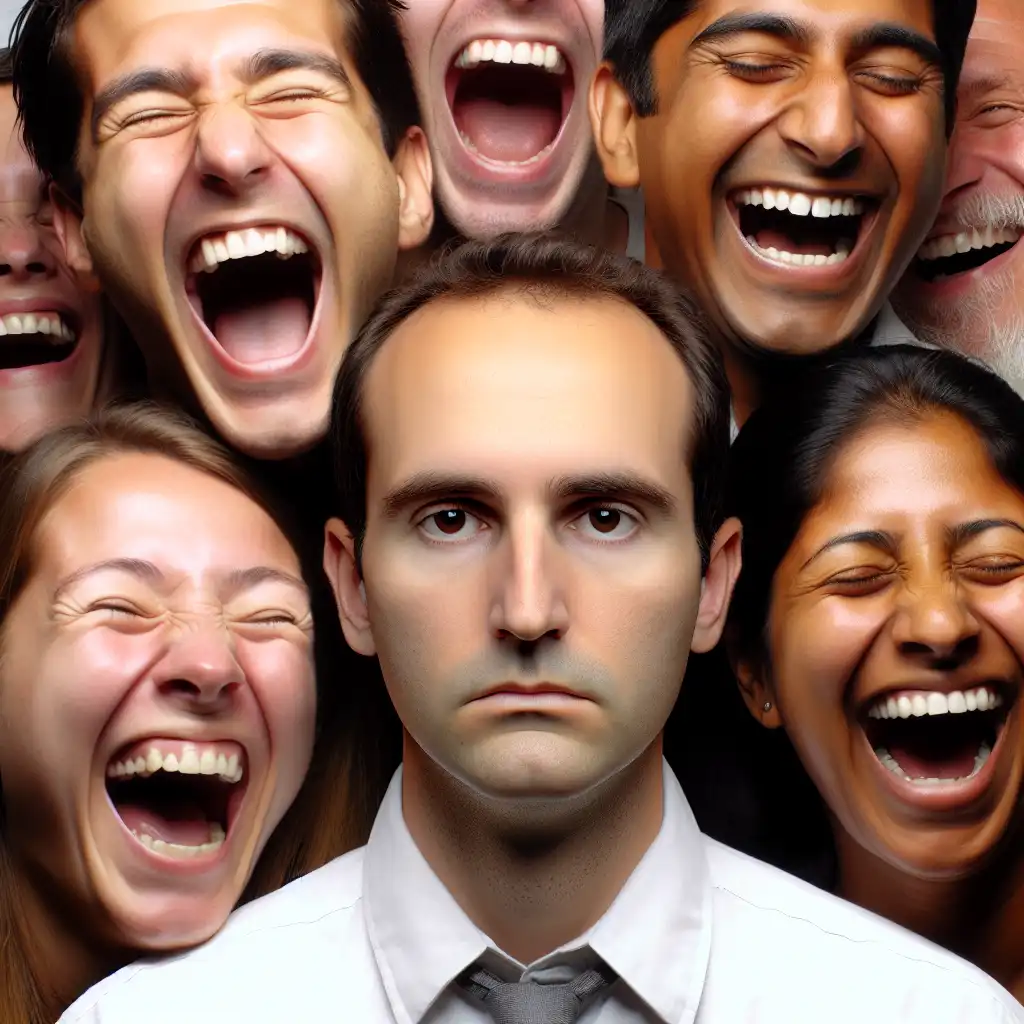
ˈdedpæn
In a manner that is deliberately impassive or expressionless.
They responded deadpan to the news.

ˈdedpæn
To express (something funny) in a serious manner.
He deadpanned the punchline of the joke.
音声を読み込めませんでした。しばらくしてからもう一度お試しください。
The word 'deadpan' is used to describe a way of speaking or reacting where someone shows no emotion on their face or in their tone of voice. It is often used to describe someone who tells a joke in a serious way, without laughing or smiling. For example, if someone says something funny but doesn't laugh or show any expression on their face, you could say they delivered the joke 'deadpan'. This word is often used in comedy or storytelling to create a humorous effect, but it can also be used in everyday conversation to describe someone's behavior.
Blank means having a facial expression that shows no emotion or having an empty mind with no thoughts.
Blank is related to having no expression on someone's face or mind, while deadpan is about delivering a joke or statement with an emotionless face.
単語を開く: Blank →Dry, on the other hand, refers to a sense of humor or wit that is subtle, understated, and lacking in overtly comedic elements such as puns or wordplay.
Someone who is being dry may be making a joke or wry observation, but they are doing so in a way that is not obvious or over-the-top.
Deadpan refers to a lack of emotion in speech or expression, while dry refers to a subtle, understated sense of humor or wit.
単語を開く: Dry →Emotional describes a range of intense feelings such as joy, sadness, anger, or fear. It is applicable in situations where the person is expressing their genuine emotions.
For example, if someone is crying because they are sad, they are being emotional.
単語を開く: Emotional →Deadpan refers to a person's facial expression when they show no emotion or reaction to something, while expression refers to the way someone's face or body shows their feelings or thoughts.
Expression is applicable in everyday life when communicating and expressing emotions, such as happiness or sadness, or conveying intentions or thoughts through nonverbal cues like body language or tone of voice.
単語を開く: Expression →Deadpan and impassive are both words used to describe a lack of emotion or expression on someone's face or in their tone of voice.
However, deadpan typically has a humorous or sarcastic connotation, while impassive refers more to a serious, unemotional demeanor.
For example, a comedian might deliver a joke with a deadpan expression to emphasize the humor in the situation, while a detective might maintain an impassive expression during an interrogation to keep their emotions hidden and maintain control of the situation.
Deadpan is usually used in a humorous or sarcastic context, while impassive is more serious and often used to convey control or lack of emotion in a tense situation.
単語を開く: Impassive →Serious describes a situation or person who is grave, earnest, and sincere, without any hint of humor or irony. Deadpan is applicable in situations where humor or irony is intended, while serious is more suitable for situations that call for respect, gravity, and importance.
単語を開く: Serious →Stoic describes someone who remains calm and unemotional, especially in a difficult situation.
A stoic person might remain composed despite experiencing pain or tragedy.
Deadpan is about having no visible emotional reaction, while stoic is about remaining emotionally composed in difficult situations.
単語を開く: Stoic →Stolid means someone who's unemotional or not easily excited.
Deadpan is about how something is delivered, while stolid describes someone's general temperament.
単語を開く: Stolid →Ben Saunders: Three...
YouTube で見る ↗My dad has a dry, deadpan sense of humor, and my mom has an unexpected, wacky take on things. They really encouraged laughing at ourselves and the weirdness of situations that come up growing up in politics.
When I concentrate, my face is deadpan and I can see there is a coldness there - when I'm making business decisions I know I can be quite dispassionate.
I never even thought of myself as deadpan until someone wrote an article about me about a year after I was doing comedy. There was a paper called the 'Boston Phoenix,' and someone wrote a description of what I was doing and that's where I first saw 'deadpan.
Donald Westlake's lean prose and deadpan delivery are engaging, as always.
There's something about Vonnegut's deadpan irony that I really like. And I like Borges' puzzle structure.
I just have a deadpan sense of humor, I guess.
I love playing a smart person and not that blonde deadpan.
I have no social agenda with my work. I'm deadpan about it.
So, deadpan I think just means not acknowledging for one second that you think that this is funny and clever.
It occurred to me that it would benefit me to play without emotion - well, without emotion others could see, anyway. Card players profited from having a poker face so opponents wouldn't know how good or bad their hand was, and I figured a deadpan expression would work in tennis, too.