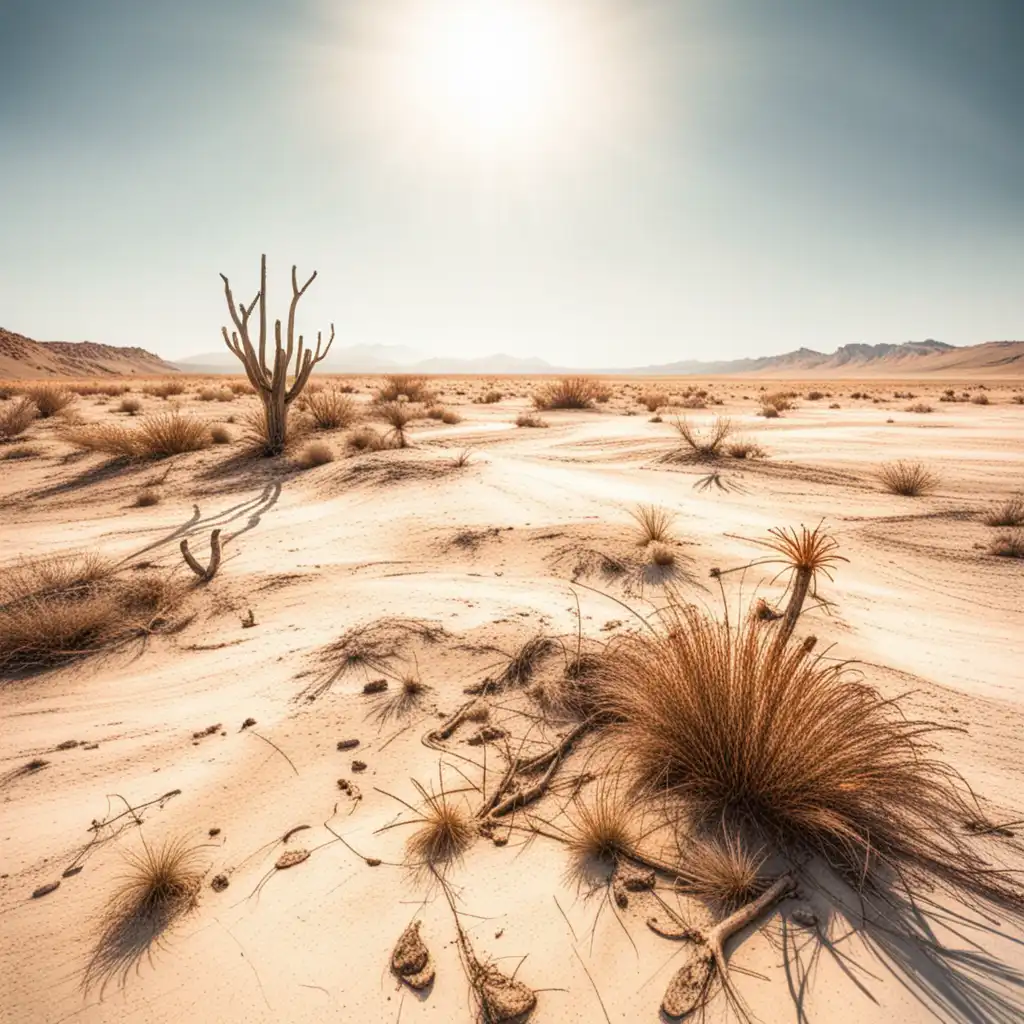
desiccated
adjective desiccated
ˈdesɪkeɪtɪd
completely dried out or dehydrated
The desert was filled with desiccated plants, withering under the scorching sun.
desiccated
ˈdesɪkeɪtɪd
Cargando…
ˈdesɪkeɪtɪd
completely dried out or dehydrated
The desert was filled with desiccated plants, withering under the scorching sun.

ˈdesɪkeɪtɪd
lacking interest, passion, or energy
His desiccated delivery made the lecture extremely dull and tedious.
No se pudo cargar el audio. Inténtalo de nuevo más tarde.
The word 'desiccated' describes something that has been completely dried out or deprived of moisture. It's often used to describe food, such as fruits and vegetables that have been dried for preservation. Desiccated coconut, for example, is made by shredding and drying coconut meat until all the moisture has evaporated. The word 'desiccated' can also be used to describe people or animals who are extremely dehydrated, usually as a result of exposure to the sun or lack of water. In medical terms, it can refer to tissue or organs that have dried out due to disease or injury. However, it's not typically used in everyday conversation to describe people or animals, and can come across as harsh or insensitive. Overall, 'desiccated' is a word that describes something that is very dry and lacking in moisture, and is often used in the context of food and preservation.
Arid means lacking in moisture or extremely dry, usually referring to a place or climate.
So, in short, arid refers to a dry place or climate, while desiccated refers to something that has been dried out completely.
Abrir palabra: Arid →Barren refers to land or ground that is unable to produce plants or crops, and is generally used to describe a lack of fertility.
Desiccated can be applied to anything from food products to plant matter to human skin. Therefore, while barren has more to do with the fertility of land, desiccated relates to the state of dryness or lack of moisture.
Abrir palabra: Barren →The words dehydrated and desiccated both refer to the removal of moisture, but they are used in different contexts.
Dehydrated is used when referring to the removal of water from something like food or a living organism. This is usually done to preserve the item, extend its shelf life or to make it easier to transport.
For example, dehydrated fruit is fruit that has had its water content removed to make it less prone to spoilage.
Dehydrated is used when referring to living things while desiccated is used when referring to non-living things.
Abrir palabra: Dehydrated →Desiccated means that something has had all its moisture or water removed. It usually refers to something that has been purposely dried for preservation, such as desiccated coconut.
Dry means that something doesn't have moisture or water in it or on it.
It can refer to anything that doesn't have much water content left in it, such as dry clothes, dry foods, or even dry skin.
Both words have similar meanings, but desiccated is generally used in situations where something has been dried intentionally, while dry can refer to any situation where there is a lack of moisture or water content.
Abrir palabra: Dry →Lifeless means that something is without life or vitality.
So, while both words refer to a lack of moisture or vitality, desiccated specifically refers to something that has been intentionally dried out for preservation, while lifeless refers to something that is completely devoid of life or vitality.
Abrir palabra: Lifeless →Parch means to make something dry, usually by exposing it to heat and/or direct sunlight.
The key difference between desiccated and parch is that desiccated refers to something that is completely and intentionally dried out, while parch refers to something that has become dry due to external factors like heat or sun exposure.
Abrir palabra: Parch →Sterile means free from bacteria or other microorganisms that can cause disease. It is applicable in medical settings, such as hospitals or surgeries, where equipment and surfaces must be kept free from harmful germs to prevent infections.
Desiccated means dried out, while sterile means free from harmful bacteria. They are used in different contexts, with desiccated being more appropriate for preserving food or other materials, and sterile being more appropriate for medical or hygienic settings.
Abrir palabra: Sterile →Wither refers to something that is becoming dried up or losing its vitality.
It usually describes plants or other living things that are losing their freshness and vitality, such as leaves that are withering on a plant.
Desiccated refers to something that has been completely dried out, while wither refers to something that is in the process of losing its moisture and vitality.
Abrir palabra: Wither →Spotting the World's...
Ver en YouTube ↗A plump, well-fed stream is as satisfying to behold as a well-fed animal or a thrifty tree. One source of charm in the English landscape is the full, placid stream the season through; no desiccated watercourses will you see there, nor any feeble, decrepit brooks, hardly able to get over the ground.
Craig Venter: On the...
Ver en YouTube ↗If we just had an election which is a kind of desiccated calculation, obviously I think the Conservatives have the best economic plans, but it is about more than that. It is about the overall person.
Can you solve the...
Ver en YouTube ↗I am truly bored with 99 per cent of conventional novels. I do think it's a somewhat desiccated form.
Growing Food on Mars %\PIPE%...
Ver en YouTube ↗I know that the right kind of political leader for the Labour Party is a desiccated calculating machine.
Advocating for gender...
Ver en YouTube ↗The most Martian place...
Ver en YouTube ↗How we can make crops...
Ver en YouTube ↗Grave Secrets of...
Ver en YouTube ↗Sandra Postel: Troubled...
Ver en YouTube ↗Safari Live - Day 272 %\PIPE%...
Ver en YouTube ↗