
mute
adjective mute
mjuːt
Unable to speak, often because of a physical or biological condition
He is mute due to a vocal cord injury
mute
mjuːt
불러오는 중…
mjuːt
Unable to speak, often because of a physical or biological condition
He is mute due to a vocal cord injury

mjuːt
A device used to soften or muffle the sound of a musical instrument
She uses a mute to soften the sound of her trumpet
mjuːt
To silence or reduce the volume of sound
Please mute your microphone while not speaking

mjuːt
Not expressing or showing feelings or emotion
His face was mute as he listened to the news
오디오를 불러오지 못했어요. 잠시 후 다시 시도해 주세요.
The word 'mute' is used to describe someone or something that is silent or not making any sound. For example, if a person is not talking or making any noise, they can be referred to as being mute. Additionally, the word can also be used to describe a television or computer that is turned to silent mode, or a musical instrument that has been silenced. It's important to note that the word 'mute' can also be used as a verb, meaning to silence or lower the volume of something. For instance, you can mute a phone call or mute the sound on a video.
Dumb refers to someone who is unable to speak, while the word mute refers to someone who chooses not to speak.
Dumb is usually applicable when someone is born with a speech impediment or has lost the ability to speak due to a medical condition, while mute is applicable when someone intentionally chooses not to speak, often due to social anxiety or selective mutism.
단어 열기: Dumb →Hush means to make someone or something quiet by saying "shh" or by gesturing for silence.
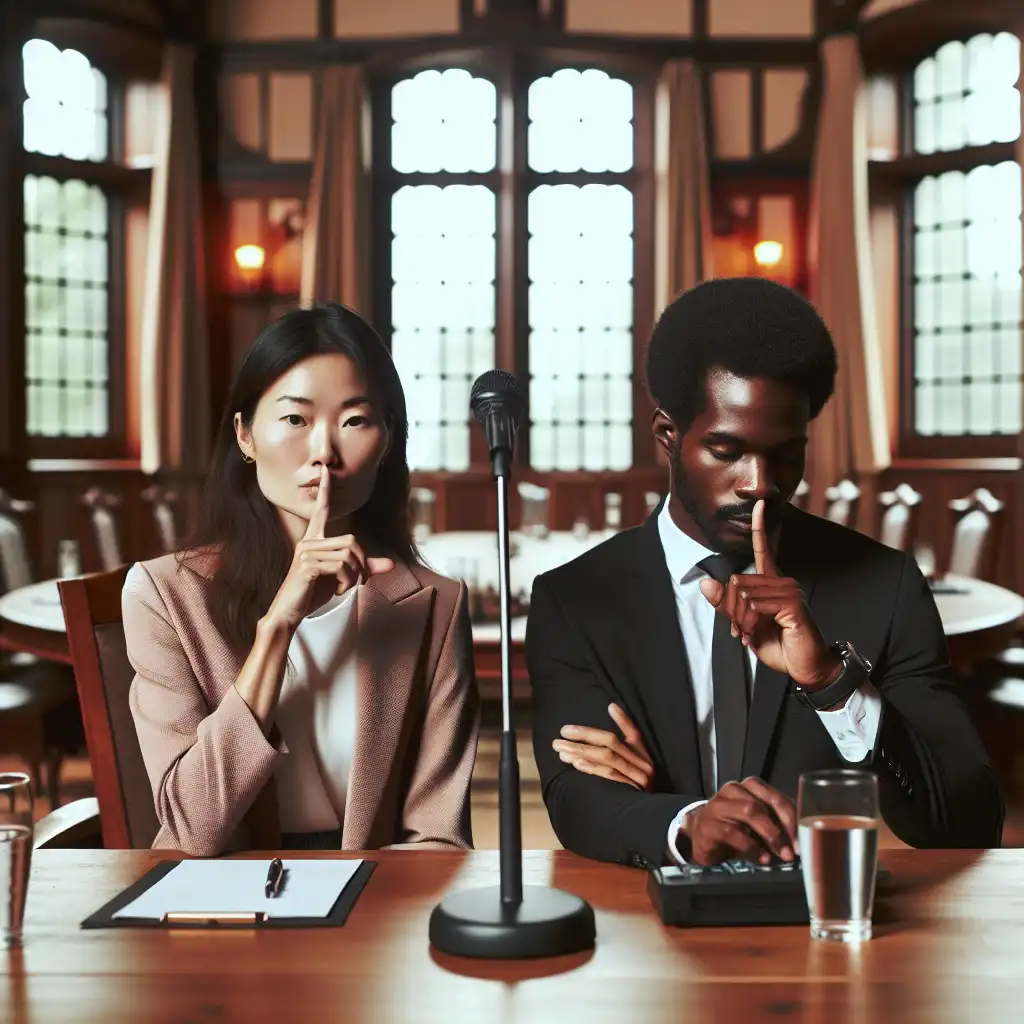
It is usually used as a command or request for someone to be quiet or to stop making noise, such as a parent telling their child to hush during a movie.
Hush is a gentle way of asking someone to be quiet or stop making noise, while mute is a way of completely silencing something or someone.
단어 열기: Hush →Muffle means to dampen or soften the sound of something, while the word mute means to completely silence or turn off the sound of something.
Muffle is applicable when you want to reduce the noise level of something without completely eliminating the sound, like when you put a muffler on an engine to reduce the noise it produces.
Overall, muffling is a way to decrease the volume of something, while muting is a way to turn off all sound.
단어 열기: Muffle →Mute means completely silent or unable to speak, whereas quiet means a low volume of sound or a calm state without a lot of noise.
Mute is used when there is absolutely no sound or when a person cannot speak, while quiet is used when there is little sound or when the environment is peaceful.
For example, a person watching a movie on mute would mean there is no sound at all, while a person watching a movie quietly would mean the sound is low but still audible.
단어 열기: Quiet →Responsive refers to something that is sensitive to changes or stimuli in its environment and reacts accordingly.
For example, a responsive website is one that automatically adjusts to the screen size of the device it is being viewed on.
A responsive person is quick to react or respond to changes in their surroundings.
Mute refers to the absence of sound or response, while responsive refers to sensitivity to changes or stimuli and reacting to them accordingly.
단어 열기: Responsive →Silent means that there is no sound, regardless of intention. For example, a library may be silent because people are making an effort to be quiet, but if there are no people, the library may still be silent.
Mute implies a deliberate or intentional choice to not make sound, while silent simply refers to the absence of sound.
단어 열기: Silent →Mute means silence or without sound. When something is mute, it doesn't make any noise.
Sound means having noise or making a noise. When something has sound, it emits a noise or makes a noise.
For example, when you turn the volume off on your TV, it becomes mute because it doesn't make any noise. But when you turn the volume back up, it starts to have sound and makes noise again.
Mute is applicable when something is silent or lacking sound, while sound is applicable when something is making noise or has a noise.
단어 열기: Sound →Speechless, on the other hand, refers to a feeling of being unable to speak due to shock or excitement.
It can describe someone who is unable to find words to express their emotions or someone who is rendered speechless by a surprising event.
Mute describes a physical inability to speak, while speechless describes an emotional or psychological state of being unable to speak.
단어 열기: Speechless →Voiceless refers to a sound or speech sound that is produced without using the vocal cords, like the "s" sound in "snake."
Mute is about the inability to use one's voice, while voiceless is about sounds that don't require the use of the vocal cords.
You would use mute to describe a person who cannot speak, and voiceless to describe a speech sound.
단어 열기: Voiceless →in my late 20s, and despite being a pathologically shy virtual mute with low self-esteem who'd never held a microphone before, I knew as soon as I walked and stood in front of the audience, I knew before I'd even landed my first joke, I knew that I really liked stand-up,
YouTube에서 보기 ↗I think that crying is a way women and men express frustration, anger, or passion. And we should not feel compelled to mute those emotions.
from and indulge even statues of monkeys get trays of colorful food and a bottle of water the sponsor of all this monkey business mr. young mute knows how to make an entrance
YouTube에서 보기 ↗I'm slammed with an identity that can no longer say a word; mute with responsibility.
because sounds from the outside world have to travel through the mother's abdominal tissue and through the amniotic fluid that surrounds the fetus the voices fetuses here starting around the fourth month of gestation are muted
YouTube에서 보기 ↗Autumn wins you best by this its mute appeal to sympathy for its decay.
here in dorset hundreds of mute swans gather each year to breed
YouTube에서 보기 ↗I'd really like to play a character who's inarticulate. I always play people with language. It would be good to play a mute or a fool or a saint.
treat speech like an intruder that would make fool of me in a room filled with people salad silence stays a sit-in in my mouth by age four my parents did not call it mute they called it shy called me a wind of a boy a breeze that would pick up conversation eventually that my
YouTube에서 보기 ↗If you are a woman with this full life who is incredibly ambitious like I am, you have to find somebody who is into it, respects it, encourages it, and celebrates it because he loves that about you. Otherwise, you're going to feel like you're muting yourself.
I have been tempted at every step of my career, tempted personally and tempted by coaching of others, to mute who I am in the world. I'm a woman of super strong opinions,
YouTube에서 보기 ↗Music is almost like a therapy for me. It helps keep me centered and think straight. Before I discovered it, I was walking around, and it felt like there were 25 extra pounds of gravity on my shoulders. It's like you're mute or something.
They can hit the pause button. They can rewind the professor. Heck they can even mute the professor. So this form of self-pacing can be very helpful to learning. The third idea that we have is instant feedback.
YouTube에서 보기 ↗It's shocking to think of the universe now without Robin Williams' energy, even muted.
Your personality appears to vanish into a heavy fog and all of your emotions and desires are constricted stifled and muted within you. For me the worst was the feeling of utter powerlessness. I simply existed. It's a very dark place to find yourself
YouTube에서 보기 ↗What is a farm but a mute gospel?
Sometimes I wish I had the eyes of a child. And by that I mean I wish I could look at the world in the same as I did when I was a small boy. I think there is a danger as we get older, that our curiosity becomes slightly muted or dulled by familiarity.
YouTube에서 보기 ↗Books are mute as far as sound is concerned. It follows that reading aloud is a combination of two distinct operations, of two 'languages.' It is something far more complex than speaking and reading taken separately by themselves.
that gives meaning to architecture. And of course expressive spaces are not mute. Expressive spaces are not spaces that simply confirm what we already know. Expressive spaces may disturb us. And I think that's also part of life.
YouTube에서 보기 ↗When I was 8 years old I became a mute and was a mute until I was 13, and I thought of my whole body as an ear, so I can go into a crowd and sit still and absorb all sound. That talent or ability has lasted and served me until today.