telescope
noun telescope
ˈtelɪskəʊp
A tool for making far away things look closer and bigger
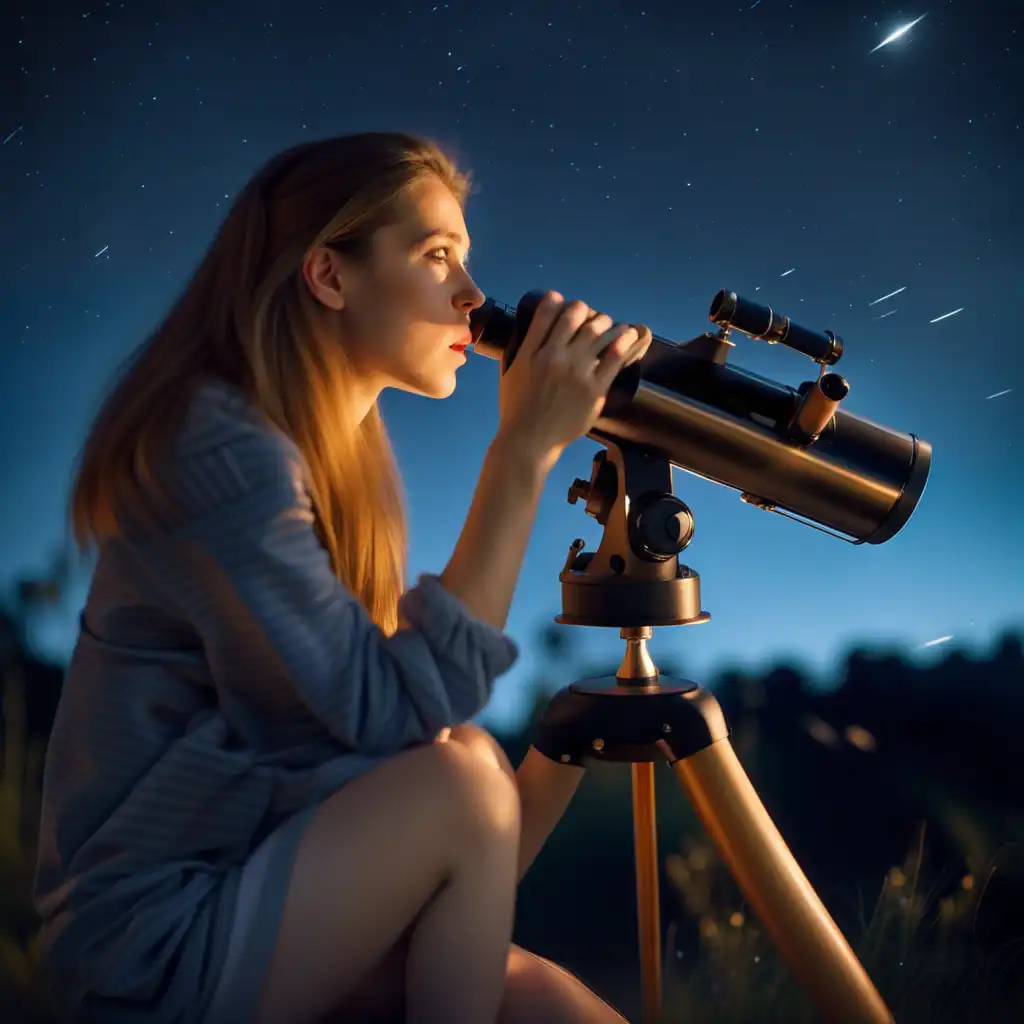
She looked at the stars through her telescope.
telescope
ˈtelɪskəʊp
Đang tải…
ˈtelɪskəʊp
A tool for making far away things look closer and bigger
She looked at the stars through her telescope.

ˈtelɪskəʊp
To slide one inside another, like parts of a telescope
The car accident caused the vehicles to telescope into each other.

ˈtelɪskəʊp
To decrease quickly in size, amount, or importance until almost nothing remains
Because of the economic crisis, the country's budget had been telescoped to practically nothing.
ˈtelɪskəʊp
To represent or explain a long process or period of time in a short way
The film tries to telescope twenty years of history into 90 minutes.
Không tải được âm thanh. Vui lòng thử lại sau.
A telescope is a device that helps you see faraway things like stars and planets up close. You use it by looking through a lens on one end, and the lens magnifies the image on the other end. People use telescopes to explore space, watch birds or animals from far away, and look at distant places on Earth. You can find telescopes at observatories, science museums, and even in your own backyard!
A refractor is a type of telescope that uses lenses to bend and focus light to make distant objects appear closer. It is also called a "dioptric telescope." Refractors work best for observing planets, stars, and other bright objects in the night sky.
Telescopes can be used for observing the same objects as refractors but are generally larger in size and require more setup and maintenance.
Mở từ: Refractor →A spyglass and a telescope are two different types of optical instruments used for observation. The main difference between them is in their design and application.
A spyglass is a small, handheld instrument that has a simple design, typically consisting of two smaller lenses mounted at either end of a metal or plastic tube.
A spyglass is a small, portable instrument used for short-range observations, while a telescope is a larger and more complex instrument used for long-range observations.
Mở từ: Spyglass →Think about Machine intelligence is the last invention that humanity will ever need to make. Machines will then be better at inventing than we are, and they'll be doing so on digital timescales. What this means is basically a telescoping of the future.
Xem trên YouTube ↗Fantasy is a necessary ingredient in living, it's a way of looking at life through the wrong end of a telescope, and that enables you to laugh at life's realities.
is said to have come up with the first compound microscope, along with the first telescope. Both claims are often disputed, as apparently he wasn't the only bored guy with a ton of glass lenses to play with at the time. Despite this, the microscope soon became a hot item
Xem trên YouTube ↗I'm baffled all the time. We don't know what's driving 96% of the universe. Everybody you know and love and heard of and think about and see in the night sky through a telescope: four percent of the universe.
There's something seriously weird going on that perhaps perhaps this is life. And that just blew me away. It was so exciting. So you can see that really they look very like each other. So it was a robust result two telescopes nothing to do with each other saw the same thing.
Xem trên YouTube ↗Hubble is the most important telescope in history after Galileo's first telescope.
back using the biggest radio telescope we can get our hands on arthur c clarke famously said either we are alone in the universe or we are not both are equally terrifying in that
Xem trên YouTube ↗We live inside our universe and cannot get a bird's-eye view of it from outside. And we cannot even see all of our universe. Distant parts of it are expanding away from us so fast that they are invisible; they go faster than the speed of light. Having bigger telescopes to see fainter stars will not help us here: invisible is truly invisible.
we need to do it for nearby stars however there's a big coincidence and that is is that if we look at the evolution of telescopes then what we see is that we've been making them bigger and bigger to see farther and farther and deeper and deeper into the universe take these famous telescopes here here's
Xem trên YouTube ↗We are now able to put our minds in other places in the universe with the use of telescopes. That is very exciting.
Studying different wavelengths not only gives us a more complete picture of any single object but also different views of the universe. For this reason astrophysicists use several different kinds of telescopes
Xem trên YouTube ↗We find them smaller and fainter, in constantly increasing numbers, and we know that we are reaching into space, farther and farther, until, with the faintest nebulae that can be detected with the greatest telescopes, we arrive at the frontier of the known universe.
and even the largest are just fuzzy patches in the fields of high-powered telescopes. But if one of these planets is close in size to the Earth and orbits not too close and too far away from its parent star, it could be rocky and warm enough to have oceans and perhaps life.
Xem trên YouTube ↗The Keck telescope, which is the largest in the world, had opened just before I began my faculty position at UCLA.
from any object observed with a telescope we can learn what it's made of, how hot it is and how much pressure it's under, as well as whether it's moving in what direction and how fast. And these six measurements like six points of light, reveal the history of the universe.
Xem trên YouTube ↗If I had a time machine, I'd visit Marilyn Monroe in her prime or drop in on Galileo as he turned his telescope to the heavens.
Aided by some distance and direction information from the neutrino detectors, the amateur astronomers and scientists alike will scan the skies and share information to quickly identify the new galactic supernova and turn the world's major telescopes in that direction.
Xem trên YouTube ↗What goes on inside a star is better understood than one might guess from the difficulty of having to look at a little dot of light through a telescope, because we can calculate what the atoms in the stars should do in most circumstances.
has given us increasingly energetic and continuously surprising views of the universe. We are now at the dawn of the age of neutrino astronomy, and we have no idea what revelations IceCube and other neutrino telescopes may bring us
Xem trên YouTube ↗Tears are often the telescope by which men see far into heaven.