chronicler
noun chronicler
ˈkrɑːnɪklər
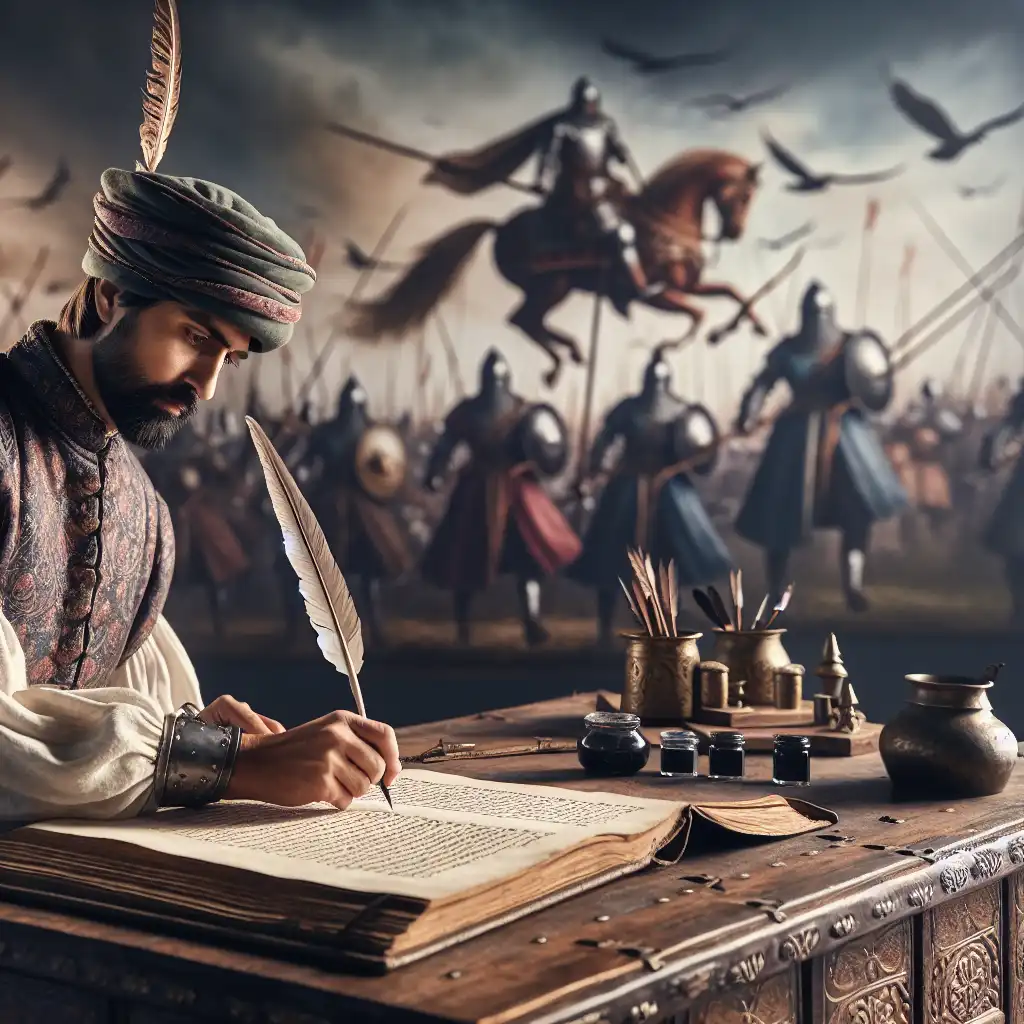
A person who writes down the history or events as they happen.
Samuel was the chronicler of the war, reporting on every battle in great detail.
chronicler
ˈkrɑːnɪklər
読み込み中…
ˈkrɑːnɪklər
A person who writes down the history or events as they happen.
Samuel was the chronicler of the war, reporting on every battle in great detail.

ˈkrɑːnɪklər
A person who displays an ordered record of events in a certain area.
The chronicler of this town has meticulously kept a record of all major incidents for centuries.
音声を読み込めませんでした。しばらくしてからもう一度お試しください。
A chronicler is someone who records events or happenings in order to preserve them for later. They are like a historian who keeps a record of important events in history for people to read and learn from them. For example, a chronicler might write about battles, wars or even daily life in a particular time period or place. In short, a chronicler is a person who documents important things so that others can have a better understanding of them in the future.
An annalist is someone who records events in chronological order, year by year. They provide a day-to-day account of events.
An annalist is suitable for recording factual events, such as battles, political appointments, and natural disasters. Their accounts are meant to be objective and to provide a clear timeline of events.
単語を開く: Annalist →A historian is someone who not only records events but also studies and analyzes them in order to understand their historical significance and their impact on societies and cultures.
An example of a chronicler would be a journalist reporting on current events, while a historian might be someone studying and writing about the causes and effects of a particular war or revolution.
In general, chroniclers focus on specific events or periods of time whereas historians tend to take a broader view of history and how events are interconnected.
単語を開く: Historian →A recorder is someone who simply takes note of information, without necessarily trying to create a narrative or historical record.
A chronicler is focused on telling a story from the past, while a recorder is focused on capturing information in the present.
単語を開く: Recorder →A chronicler is someone who writes historical accounts or records of events, while a scribe is someone who writes or copies documents.
A chronicler describes someone who collects information about an event or story and writes it down for historical purposes, like a historian or a biographer.
A scribe describes someone who writes or copies documents such as legal papers, religious texts or literature. This can also include writing letters or books by hand before the invention of printing.
A chronicler writes historical accounts or records, while a scribe writes or copies documents.
単語を開く: Scribe →A chronicler is someone who records historical events, while a story is a narrative that can be fictional or non-fictional.
A story is a way of communicating an experience or event in a more dramatic and creative way. This can include things like a novel, a film, or a personal anecdote.
While both can be used to convey information, a chronicler is more concerned with the accuracy of events, while a story is more concerned with the emotional impact of those events.
単語を開く: Story →How Magellan circumnaviga...
YouTube で見る ↗I would like to be the chronicler of something that I think is going down the drain very swiftly, and that is small-town, middle-class southern life.
Katherine Fulton: You...
YouTube で見る ↗A trusty comrade is always of use; and a chronicler still more so.
I'm seen as a chronicler of the class system, which I don't think is unfair.
What does it take to be a great social chronicler? Perhaps one of the key attributes is an understanding of what it feels like to fall from grace.
My duty is that of a chronicler; and if I perform that conscientiously, the lessons which my observations suggest will need no pointing out.
It was no easy feat becoming Dominick Dunne. Think about it. He was the most celebrated chronicler of downtrodden socialites. He feasted on their famine with little sympathy or admiration for their formerly exalted positions. Yet somehow they invited him back.
So I do not consider myself a chronicler of my fatherland or even a chronicler of Havana.
As an early-and-often chronicler of Chicago-on-the-Potomac, I am amazed at the stubborn and clingy persistence of President Barack Obama's snowblowers in the media. See no scandal, hear no scandal, speak no scandal.
I'm a chronicler of Negroland, a participant-observer, an elegist, dissenter, and admirer; sometime expatriate, ongoing interlocutor.