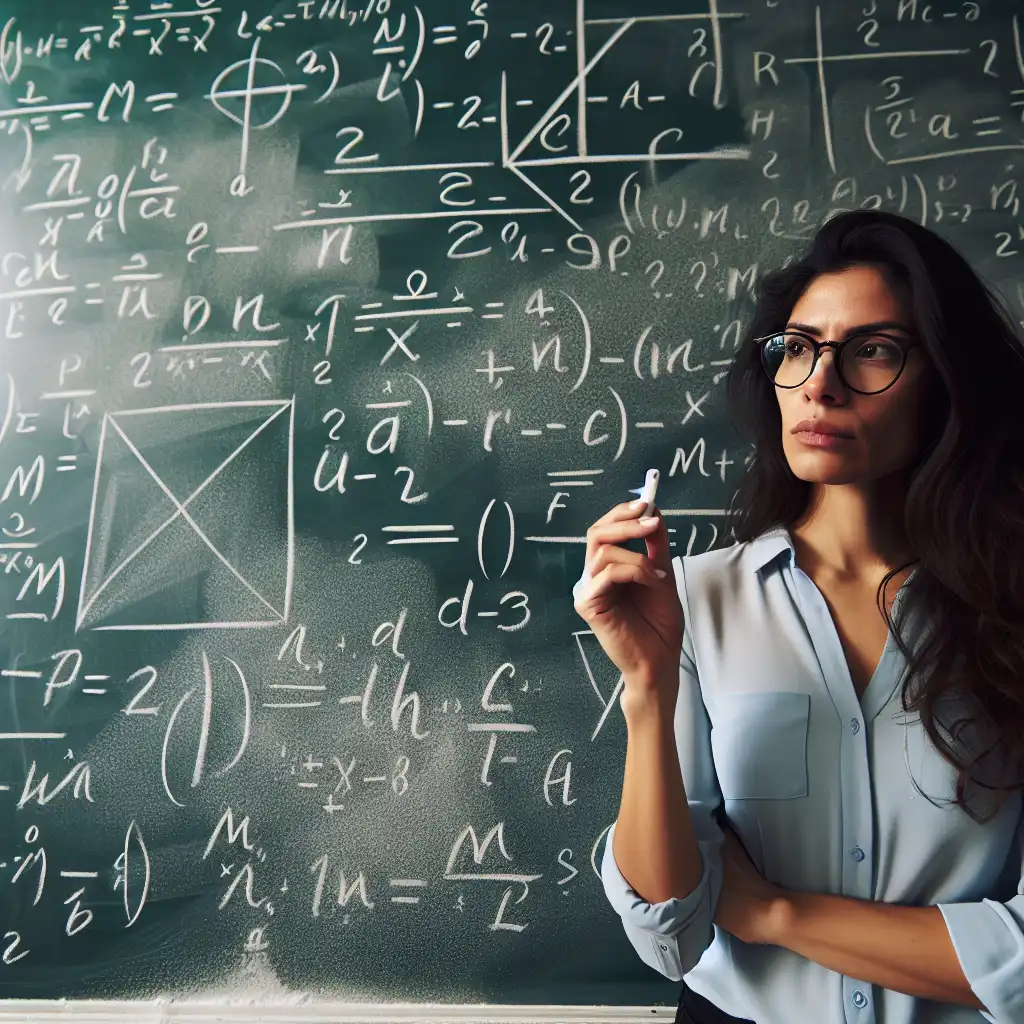
mathematician
noun mathematician
ˌmæθəməˈtɪʃn
A person who studies, teaches, or is an expert in mathematics.
John is a well-known mathematician in the field of algebra.
mathematician
ˌmæθəməˈtɪʃn
読み込み中…
ˌmæθəməˈtɪʃn
A person who studies, teaches, or is an expert in mathematics.
John is a well-known mathematician in the field of algebra.
音声を読み込めませんでした。しばらくしてからもう一度お試しください。
A mathematician is someone who studies and solves problems related to math. They use numbers, formulas, and equations to help understand and explain things. Mathematicians can work in many areas, including science, finance, or engineering. If you are talking about a person who loves math or is really good at it, you can call them a mathematician. For example, "My teacher is a mathematician, he's really good at solving difficult math problems."
An analyst is someone who analyzes and interprets data to draw conclusions and make decisions. They may work in fields such as business or finance, examining data to provide insights that can be used to improve strategies or make informed decisions.
An analyst applies mathematical concepts and techniques to analyze data and draw conclusions, while a mathematician focuses on developing and understanding mathematical theories.
単語を開く: Analyst →A calculator is a device that performs mathematical operations automatically.
A calculator is a tool for doing basic arithmetic calculations, while a mathematician is a person who uses advanced mathematics to solve complex problems.
A calculator is applicable in everyday life, while a mathematician is applicable in advanced fields that require complex mathematical analysis.
単語を開く: Calculator →A logician is someone who studies and applies principles of reasoning and inference, while a mathematician is someone who studies and applies principles of numbers, quantities, and shapes.
Logicians focus more on the process of reasoning itself, including how to evaluate arguments, identify fallacies, and construct valid arguments.
A logician is more concerned with the process of reasoning, while a mathematician is more concerned with numbers and shapes.
単語を開く: Logician →A statistician is someone who uses statistical methods to collect, analyze, and interpret data. They work with real-world data sets to identify patterns, relationships, and trends in order to draw conclusions or make predictions.
Statisticians can work in many industries including healthcare, marketing, sports, and government.
In summary, mathematicians focus on developing and applying mathematical theories while statisticians focus on collecting, analyzing, and interpreting data.
単語を開く: Statistician →A theorist is a person who develops theories or explanations about a specific field or phenomenon. They can be found in almost any field, including science, philosophy, and social sciences.
Theorists use evidence and analysis to develop and test hypotheses and theories that attempt to explain and predict how things work.
A mathematician specializes in solving mathematical problems, while a theorist creates theories to explain concepts in a particular field of study.
単語を開く: Theorist →and it got so bad for him that he suffered severe depression, and spent the last half of his life in and out of mental institutions. But eventually his ideas won out. Today they're considered fundamental and magnificent. All research mathematicians accept these ideas, every college math major learns them, and I've explained them to you in a few minutes.
YouTube で見る ↗I still think in a parallel universe, I became a mathematician.
he said well that's for you to find out that was her dream catherine johnson found her way to hampton virginia and there is nasa nasa was hiring black mathematicians
YouTube で見る ↗The truth has never been of any real value to any human being - it is a symbol for mathematicians and philosophers to pursue. In human relations kindness and lies are worth a thousand truths.
Well we mathematicians devote ourselves to come up with theorems. Eternal truths. But it isn't always easy to know the difference between an eternal truth or theorem and a mere conjecture. You need proof. For example,
YouTube で見る ↗Every intelligent person, whether he's an artist or not - a mathematician, a doctor, a scientist - possesses a poetic way of seeing and describing the world.
better and then we went through a party and that doctor little the science and personality guy would come over and we'd say there's about to be a party and he'd say no I'm an introvert I'm an introvert and then we'd have to go put him in the back room and then maybe the French mathematician with the beautiful cravat
YouTube で見る ↗One can re-create what was in the mind of a mathematician a thousand years ago, recapture the truth of the intellect wherever it may have once come to light; but the image of art, that infinite variable of perception and expression in the individual, - that is not easily re-created, at least, not with certainty and in its original fulness.
Some of the most influential mathematicians and scientists of all of human history have chimed in on the issue as well, often in surprising ways. So is mathematics an invention or a discovery? Artificial construct or universal truth?
YouTube で見る ↗May not music be described as the mathematics of the sense, mathematics as music of the reason? The musician feels mathematics, the mathematician thinks music: music the dream, mathematics the working life.
but he still had a lot to contribute. So what is it about this that has so intrigued mathematicians the world over? In short it's full of patterns and secrets. First and foremost there's the pattern that generates it.
YouTube で見る ↗The mathematician, carried along on his flood of symbols, dealing apparently with purely formal truths, may still reach results of endless importance for our description of the physical universe.
It was the mathematician Archimedes describing the fundamental principle behind the lever. The idea of a person moving such a huge mass on their own might sound like magic, but chances are you've seen it in your everyday life.
YouTube で見る ↗The idea would be in my mind - and I know it sounds strange - is that the most important advances in medicine would be made not by new knowledge in molecular biology, because that's exceeding what we can even use. It'll be made by mathematicians, physicists, computer scientists, figuring out a way to get all that information together.
less predictability and most importantly less hospitably to human life. The hypothetical models that mathematicians study in detail may not always look like actual situations, but they can provide a framework and a way of thinking
YouTube で見る ↗You don't have to be a genius mathematician to have a career in cyber security, but it certainly helps to be a strong mathematician.
the rotated triangle would look different to the original. In other words an equilateral triangle is not symmetric with respect to rotations of 90 degrees around its center. But why do mathematicians and scientists care about symmetries? Turns out they're essential in many fields of math and science.
YouTube で見る ↗And when I go around and talk to schools, what I tell the kids are, first of all, you have to accept each other's differences. Some of you are going to be a crappy football player, some of you are going to be a great mathematician. Whatever it is, accept each other's differences and help prop each other up.
But another reason is that honeybees are in fact, excellent mathematicians. Scientists claim the tiny insects can calculate angles, and can even comprehend the roundness of the Earth. But there's particular mathematical bee genius behind the most important aspect of honeybee the hive.
YouTube で見る ↗Artists realise that mathematicians have a way of looking at the world that can make them see things differently.