soothsayer
noun soothsayer
ˈsuːθseɪər
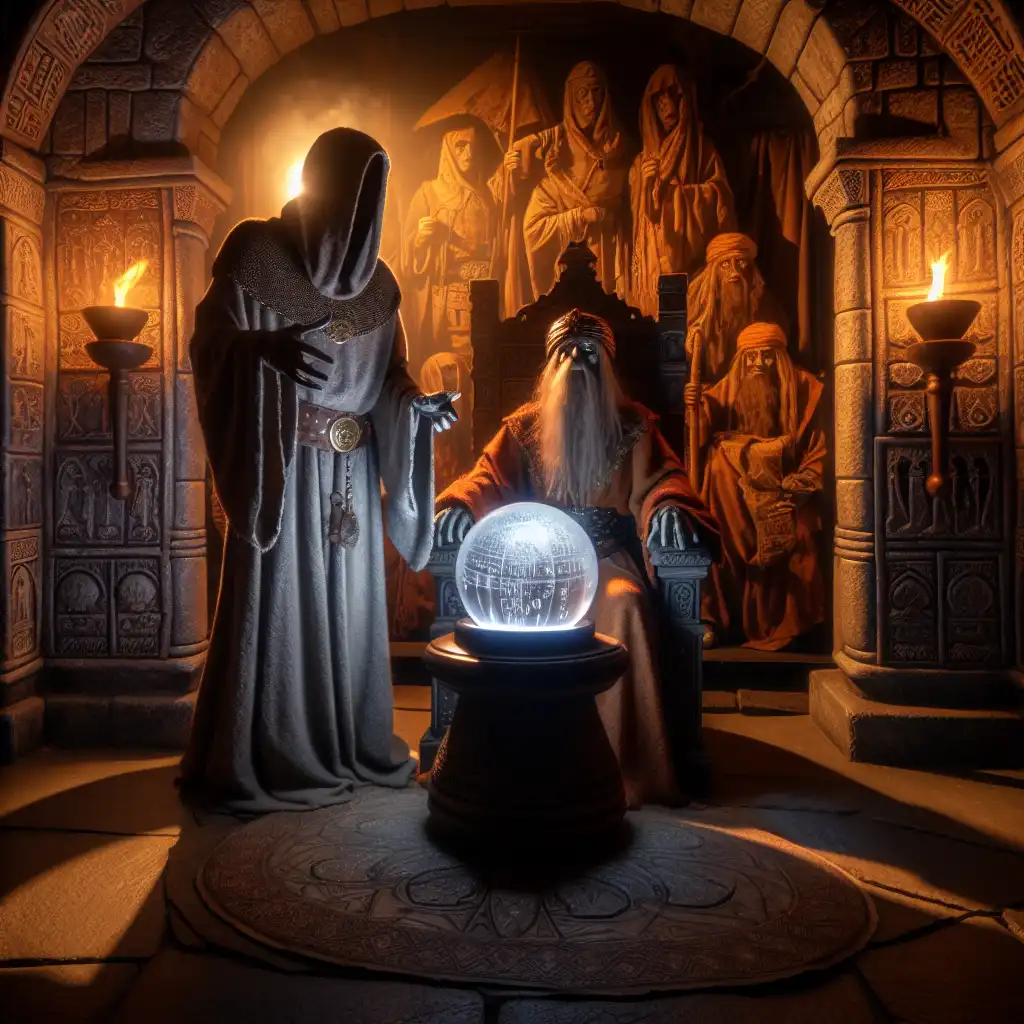
A person who is believed to be able to predict the future.
The soothsayer warned the king that he would lose his throne.
soothsayer
ˈsuːθseɪər
Cargando…
ˈsuːθseɪər
A person who is believed to be able to predict the future.
The soothsayer warned the king that he would lose his throne.

ˈsuːθseɪər
Someone who makes predictions about what will happen in the future, often in a general or vague way.
He was seen as a soothsayer for predicting the economic downturn.
No se pudo cargar el audio. Inténtalo de nuevo más tarde.
A soothsayer is someone who claims to be able to predict the future. They might use things like tarot cards or horoscopes to do this. The word is often used in stories or movies to describe a character who can see things that others can't. It can also be used in real life to describe someone who gives predictions about what might happen next.
Both augur and soothsayer refer to people who can predict the future.
An augur was a person in ancient Rome who practiced divination, which means seeking knowledge of the future or the unknown by supernatural means.
Augurs would read signs or omens, such as the flight of birds or the behavior of animals, to predict what would happen in the future.
Today, an augur can refer to a person who predicts future events based on their observations and knowledge.
An augur is someone who predicts the future based on observations and knowledge, while a soothsayer is someone who predicts the future through supernatural means.
Abrir palabra: Augur →Both clairvoyant and soothsayer are nouns used to describe individuals who claim to possess or have the ability to predict future events, typically through some form of supernatural or intuitive means.
The main difference between the two words is that clairvoyant specifically refers to a person who has extrasensory perception or psychic abilities, whereas soothsayer refers to someone who makes predictions or prophecies based on a combination of divination, intuition, and observation.
Clairvoyant is a more modern and scientific-sounding term that is often associated with paranormal or psychic phenomena, while soothsayer has more of a traditional, mystical connotation and is typically used to describe people in ancient or historical contexts who were believed to possess supernatural powers.
Both terms are generally used in a figurative sense, and while some people do claim to be clairvoyants or soothsayers in real life, there is no scientific evidence to support the existence of such powers.
Abrir palabra: Clairvoyant →Both words refer to a person who can predict the future, but oracle usually describes a sacred or holy place where people would go to receive advice or prophecies from a supernatural being.
Both words are used in literature and mythology, but oracle is more commonly associated with religion, while soothsayer may be used in a more general sense to refer to anyone who claims to be able to predict the future.
Abrir palabra: Oracle →Prognostic refers to a prediction or forecast based on facts or data. It's often used in a medical context, like when a doctor gives a prognostic for a patient's recovery.
Prognostic is used when a prediction is based on real information, while soothsayer is used when the prediction is based on superstitious or irrational beliefs.
Abrir palabra: Prognostic →A prophet is someone who is believed to have a divine connection or inspiration, and is able to predict future events. Prophets are usually associated with religious beliefs and are seen as messengers of God or gods.
A soothsayer is someone who predicts the future through the interpretation of omens, signs, and symbols. Unlike prophets, soothsayers are not necessarily associated with religion and may not have a divine connection.
In summary, prophets are associated with divine inspiration and religious beliefs, while soothsayers focus on interpreting signs and symbols to predict the future.
Abrir palabra: Prophet →Psychic refers to someone who has abilities to perceive information through extrasensory perception (ESP), such as through the mind or emotions.
Both terms are often used interchangeably, but psychic is more general in nature and can encompass a wide range of abilities beyond just predicting the future.
Abrir palabra: Psychic →A seer is someone who is able to see or perceive things that others cannot, often through supernatural or intuitive means.
Both terms are often used interchangeably to refer to someone who can predict the future or provide insight, but generally speaking, a seer is seen as having more of an intuitive or supernatural ability, while a soothsayer relies more on divination and other methods of predicting the future.
Abrir palabra: Seer →A visionary is someone who has original and creative ideas about the future. They imagine possibilities and see potential where others do not.
A soothsayer is applicable in settings where people want to know what will happen in the future, like in myths and legends, while a visionary is applicable in settings where people want to bring about change and innovation, like in science or business.
Abrir palabra: Visionary →Eating Dog %\PIPE% National...
Ver en YouTube ↗David Attenborough's 'Life' series is phenomenal. He's a wonderful modern soothsayer.
Mysteries of vernacular:...
Ver en YouTube ↗What skills I lacked in, say, math or science, I like to think I made up for in my ability to read people and situations with great clarity. I therefore considered myself as a sort of valued soothsayer when it came to dispensing opinions to my friends about their life choices or relationships.
I wasn't in any way a kind of soothsayer or not surprised when Sept. 11 happened. I was absolutely shocked.