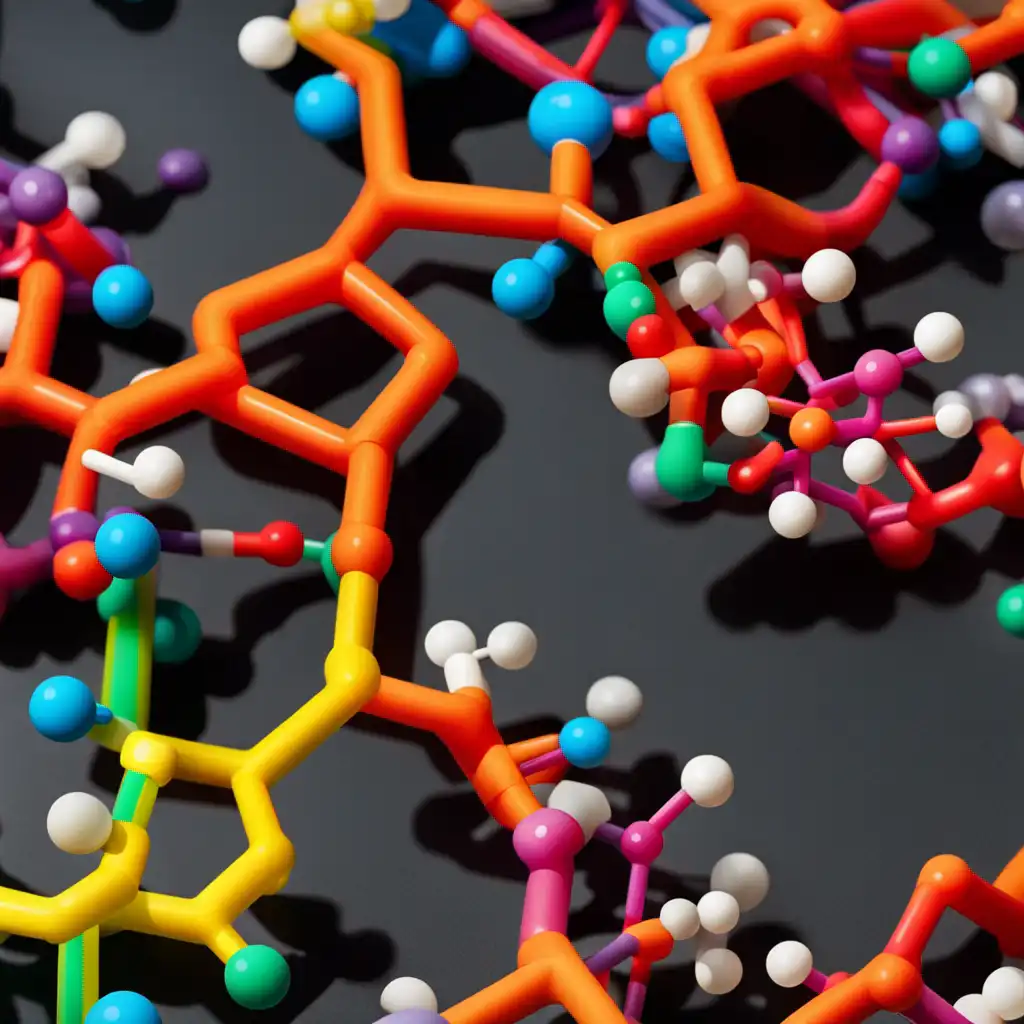
polymer
noun polymer
ˈpɑːlɪmər
A large molecule that is made by connecting many smaller molecules together.
Plastics are made from polymers.
polymer
ˈpɑːlɪmər
Cargando…
ˈpɑːlɪmər
A large molecule that is made by connecting many smaller molecules together.
Plastics are made from polymers.

ˈpɑːlɪmər
A type of chemical substance that is used in making plastics, paints, and other materials.
He's studying the properties of polymers in his chemistry class.
No se pudo cargar el audio. Inténtalo de nuevo más tarde.
A polymer is a type of material that is made up of many repeating units called monomers. Polymers can be found in everyday objects such as plastic bags, water bottles, and even clothing. They are formed through a process called polymerization, where monomers chemically bond together to form a long chain. People use polymers for a variety of reasons, such as their strength, flexibility, and ability to resist certain chemicals. If you are learning English, it is important to know the word polymer because it is commonly used in science and engineering fields.
Compound refers to any substance composed of two or more different types of atoms chemically bonded together. This could be as simple as water (H2O), which is a compound made up of hydrogen and oxygen atoms, or as complex as a medication formulated with several different chemical compounds.
On the other hand, Polymer refers to a type of compound made up of repeating units called monomers. These monomers bond together in a chain-like fashion to create a larger, more complex polymer molecule.
In summary, while all polymers are compounds, not all compounds are polymers.
Compounds can refer to any substance composed of two or more different types of atoms chemically bonded together, while polymers specifically refer to compounds made up of repeating monomer units.
Abrir palabra: Compound →Plastic and polymer are similar in that they both refer to materials that are made up of long chains of molecules.
However, plastic typically refers to materials that are made from synthetic or semi-synthetic organic compounds, while polymer refers to any material that consists of long chains of repeating units, which can be natural or synthetic.
Plastics are used in a wide variety of applications, from packaging to toys to automotive parts, and are often designed to be lightweight, durable, and flexible.
Plastic is a type of polymer that is typically synthetic and often used for specific applications, while polymer refers to a more general category of materials composed of long chains of repeating units.
Abrir palabra: Plastic →A resin refers to a type of polymer that starts out as a liquid or semi-liquid material and then hardens to a solid. Resins are often used in coatings, adhesives, and casting materials.
So while all resins are polymers, not all polymers are resins.
Abrir palabra: Resin →Meet the microbes that...
Ver en YouTube ↗Nature works with five polymers. Only five polymers. In the natural world, life builds from the bottom up, and it builds in resilience and multiple uses.
A Rare Look at the...
Ver en YouTube ↗In spite of the evidence for the disorder-induced M-I transition as inferred from the transport and optical measurements, the metallic state of conjugated polymers has been a subject of controversy.
Nina Jablonski breaks...
Ver en YouTube ↗In 1957, at the age of 18, I entered Kyoto University, which was known to be the most active institution in the research of polymer chemistry.
Creating a Bio-Industrial...
Ver en YouTube ↗All vinyl polymers may be regarded as built from monomeric units containing a tertiary carbon atom.
From DNA to Silly Putty,...
Ver en YouTube ↗Like the Tebbe complex, ruthenium olefin metathesis catalysts can be used for the production of living polymers.
How to biohack your...
Ver en YouTube ↗If the polymer chain assumes a helicoidal conformation in the crystalline state, and if it does not contain asymmetric carbon atoms, it can be expected that either helices of the same sense, or, in equal ratio, helices of opposite sense are represented in the lattice.
What's in Hand...
Ver en YouTube ↗Polymer chemistry provides an excellent means of studying metathesis catalysts: miniscule catalyst loadings have the capacity to generate large amounts of polymeric material, the structure of which can provide a historical record of catalyst activity.
Eben Bayer: Are...
Ver en YouTube ↗The science of semiconducting and metallic polymers is inherently interdisciplinary; it falls at the intersection of chemistry and physics.
A new superweapon in the...
Ver en YouTube ↗Polymeric materials in the form of wood, bone, skin and fibers have been used by man since prehistoric time. Although organic chemistry as a science dates back to the eighteenth century, polymer science on a molecular basis is a development of the twentieth century.
What's in Conditioner? %\PIPE%...
Ver en YouTube ↗Polymer synthesis in the 1950s was dominated by Karl Ziegler and Giulio Natta, whose discoveries of polymerization catalysts were of great importance for the development of the modem 'plastics' industry.