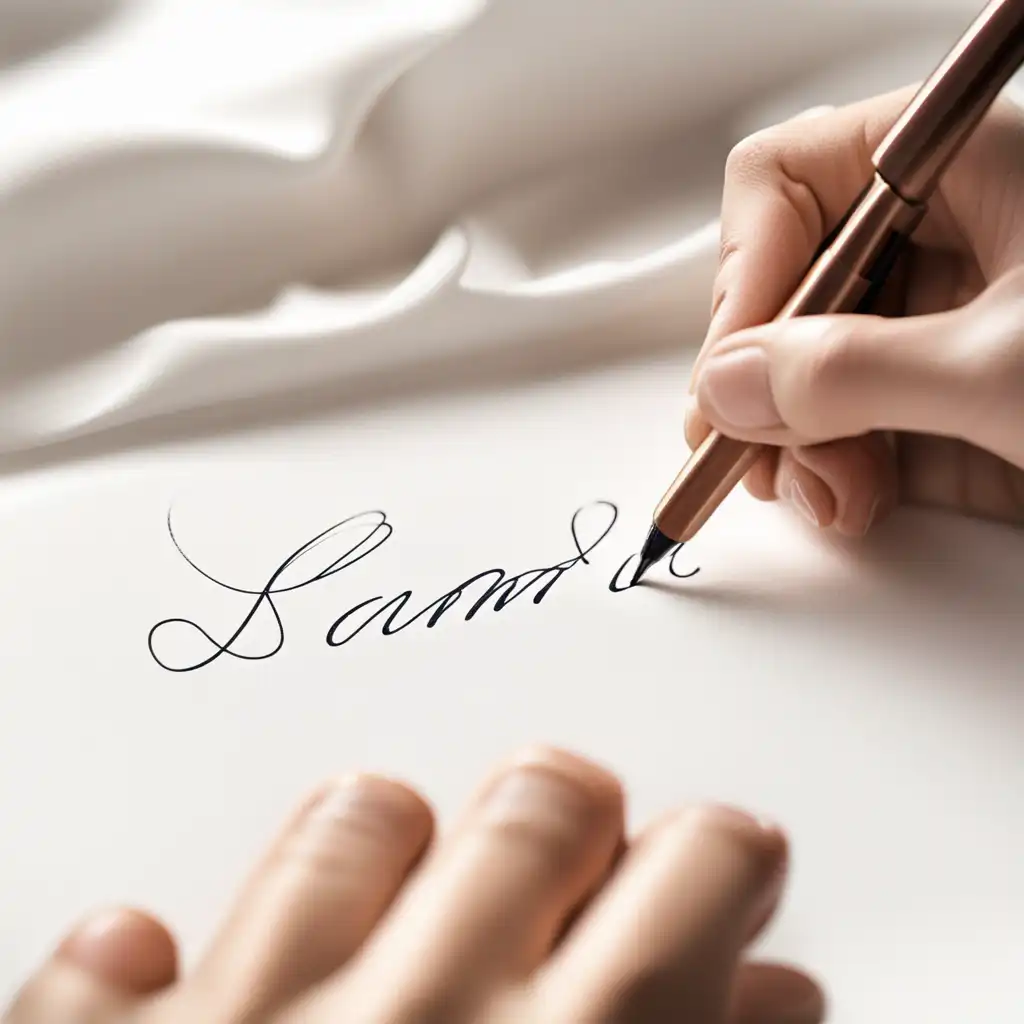
cursive
adjective cursive
ˈkɜːrsɪv
Relating to handwriting where the letters are joined together.
She wrote her name in neat cursive letters.
cursive
ˈkɜːrsɪv
読み込み中…
ˈkɜːrsɪv
Relating to handwriting where the letters are joined together.
She wrote her name in neat cursive letters.

ˈkɜːrsɪv
Handwriting where the letters are joined together.
Learning cursive is a part of elementary school curriculum.
音声を読み込めませんでした。しばらくしてからもう一度お試しください。
Cursive is a style of handwriting where the letters in a word are joined together in a flowing and cursive-like manner. It is commonly used in written communication, such as letters, notes, and documents. In some schools, cursive is taught to students to help them write more quickly and efficiently. While it is not always necessary to use cursive when writing, it can be a useful skill to have. If you are unsure about whether or not to use cursive, it is always best to check with a teacher or native English speaker.
Calligraphy and cursive are both related to handwriting, but they are not the same.
Calligraphy is a decorative art form of writing where the letters are carefully and beautifully designed using special pens or brushes.
Calligraphy is a form of decorative writing, while cursive is a style of handwriting that is functional for everyday use.
単語を開く: Calligraphy →Cursive refers to a specific style of writing where the letters are connected together in a flowing manner, while handwriting is just the act of writing by hand.
Cursive is typically used when writing in a more formal setting, like a letter or a document, while handwriting can be used in any situation where writing by hand is needed.
単語を開く: Handwriting →Cursive and italic are both forms of handwriting, but they are different. Cursive is a style of writing where each letter is joined to the next letter, and it is often used for handwriting practice and signature writing.
Italic is a slanted form of writing, where each letter is separate, and it is often used to emphasize or highlight certain words in printed materials like books or newspapers.
Cursive is used more for handwriting, whereas italic is used more for printed materials.
単語を開く: Italic →Cursive and longhand both refer to handwriting styles. Cursive refers to a style of handwriting where the letters are joined together in a flowing manner, while longhand simply refers to regular handwriting where the letters are separate.
Cursive can be useful for quickly writing in a smooth and connected manner, while longhand may be preferred for more formal writing such as essays or letter writing.
単語を開く: Longhand →Penmanship refers to the skill or art of writing neatly and beautifully with a pen or pencil whether in cursive or print.
It is generally used for more formal purposes such as letter writing or calligraphy. Simply put, cursive is a type of handwriting while penmanship is the quality or style of handwriting regardless of the script used.
単語を開く: Penmanship →Cursive and script both refer to handwriting styles, but there is a subtle difference between them.
Script refers to any style of handwriting that is artistic or decorative.
Script is often used in artistic contexts, such as calligraphy or handwriting on invitations, greeting cards, and other decorative items.
Cursive is a functional handwriting style that is used for everyday writing, while script is a decorative and artistic style of handwriting that is used to enhance visual appeal.
単語を開く: Script →3 ways to create a space...
YouTube で見る ↗Cursive writing does not mean what I think it does.
Ancient Egypt 101 %\PIPE%...
YouTube で見る ↗There was a mission: To match the cover of 'Extraordinary' to the cover of the paperback 'Impossible,' which was commercially successful. Consider the outdoor natural setting, the single girl in motion with her hair blowing, and the cursive font used for the title; both covers have these in common.
I got to take classes in writing with a fountain pen, and actually, something you make is your own textbook. So, while you're learning about something, you have to write essays on it, and then you handwrite in cursive, in fountain pen, your essays out on beautiful paper and you bind it together into a book that you hand in at the end of the course.
No one looks at your hands to see how much they shake when you are interviewed to be a surgeon. The physical skills required are no greater than for writing cursive script. If an operation requires so much skill only a few surgeons can do it, you modify the operation to make it simpler.
For some reason when I write in cursive, it's easier and flows better for me to read that when I print.
I'm really interested in making a mark on a paper and letting that be cursive shorthand for an idea - that's the origin of cartooning.
I went to an all-girls' Catholic school for, like, six years during the time when kids actually had handwriting class. I've always had a propensity for getting the cursive down pretty well.
Penmanship means a lot to me. I don't have cursive penmanship, though. I've created my own penmanship. It's very clear. Everyone can read it. I write things down all day long.
I've always had a propensity for getting the cursive down pretty well. What it evolved into was my pseudo-waitressing job when I was auditioning. I didn't wait tables. I did calligraphy for the invitations for, like, Robin Thicke and Paula Patton's wedding.