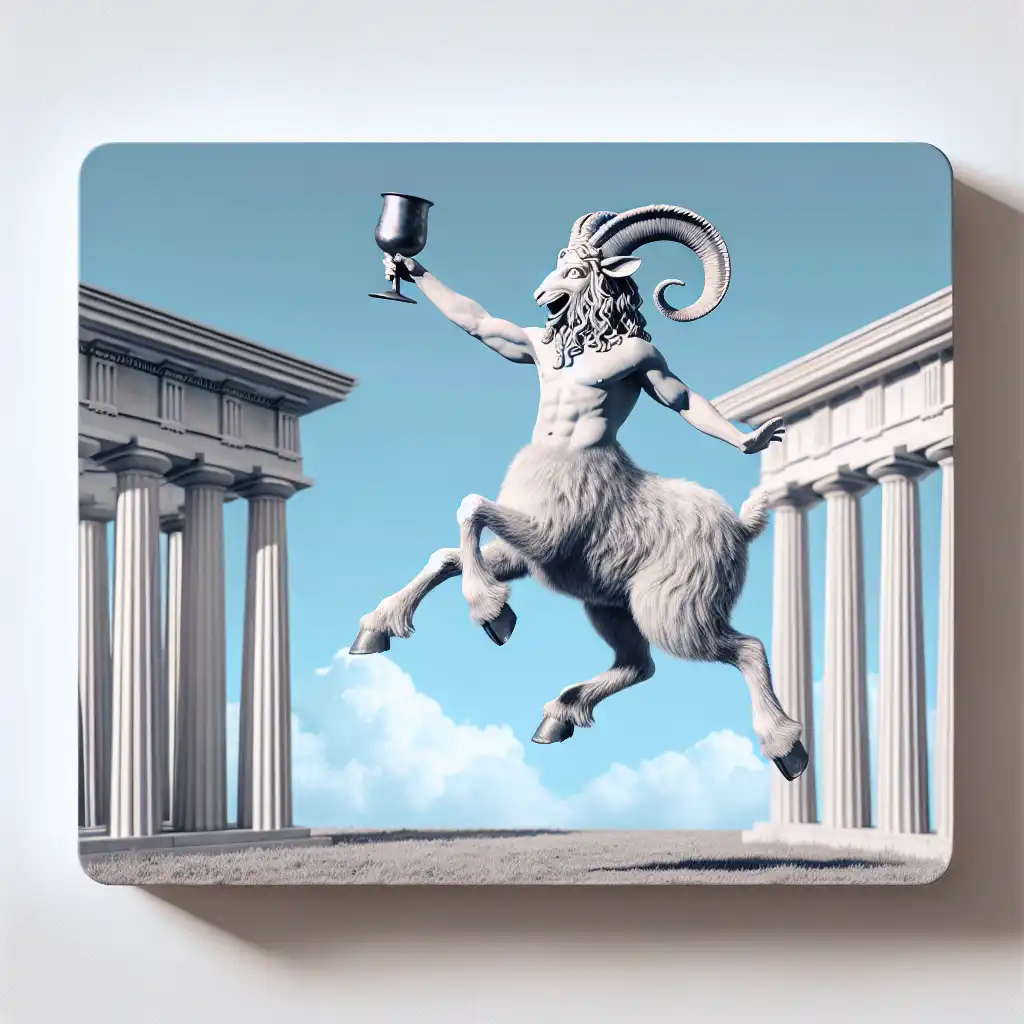
A creature from ancient Greek stories that is half man and half goat, represents wild and drunken behavior, and has a strong interest in women and wine
The statue depicted a satyr leaping joyously with a goblet of wine in his hand.
Impossible de charger l’audio. Réessayez plus tard.
Comment l’utiliser
A satyr is a mythical creature from Greek mythology that has the upper body of a man and the lower body of a goat. They were often depicted as mischievous and lusting after women. The word satyr can also refer to a man who behaves in a similar way, being very interested in sex and pleasure. It is not a word that is commonly used in everyday conversation, but it may be encountered in literature, art, or discussions about mythology or folklore.
Centaur and satyr are both mythological creatures, but they have significant differences.
A centaur is a creature with the upper body of a human and the lower body of a horse. They are typically depicted as strong and powerful, often associated with archery and hunting.
Centaurs are usually depicted in a positive light in mythology and are considered noble creatures.
In popular culture, centaurs are often seen in fantasy and fiction works, while satyrs are more commonly found in classical literature and art.
Both faun and satyr refer to mythical creatures that are part human and part animal, specifically goat-like.
- Fauns are usually depicted as gentle, peaceful forest creatures in Greek mythology. They are often shown as being playful and mischievous, but not necessarily lustful or aggressive.
In terms of modern usage, faun tends to be used more broadly to describe any mythical creature that is part human and part animal, while satyr specifically connotes a more debauched or rowdy creature.
A lecher is someone who is excessively interested in sex and constantly thinks about sexual things. This term usually describes a man who behaves in a lustful and inappropriate way towards women.
Both words can describe men who have a strong sexual desire, but lecher is a more straightforward and commonly used term, while satyr is more of a metaphorical or poetic term.
A minotaur is a mythical creature with the head of a bull and the body of a man. It is known for being a ferocious monster and is often associated with Greek mythology.
The minotaur is often portrayed as a dangerous antagonist, while the satyr is more of a playful and comedic figure.
Pan refers to a Greek god who was half-man and half-goat, often portrayed playing a flute. Satyr refers to a creature from Greek mythology who was also half-man and half-goat, but generally depicted as mischievous and lustful.
In modern usage, pan can also refer to a cooking vessel with sloping sides, while satyr is generally only used in the context of mythology or literature.
Pan is more commonly associated with Greek mythology and cooking, while satyr is primarily associated with mythology and literary works.
Puck refers to a mischievous fairy or sprite in English folklore.
It is often associated with the character of Puck in the play "A Midsummer Night's Dream" by William Shakespeare.
Puck refers to a mischievous fairy or a small, hard rubber disk used in ice hockey, while satyr refers to a mythological creature with a human upper body and a goat lower body.
Both satyr and sylvan are words used to describe creatures or spirits from Greek mythology.
On the other hand, sylvans are nature spirits who are typically associated with woodland areas. They are often depicted as being half-human and half-animal, with the lower body of a horse, deer, or goat.
Sylvans were believed to protect the forest and its inhabitants and were associated with the god of nature, Pan.
In short, satyrs are associated with wine, music, and lust, while sylvans are associated with nature and the protection of woodland areas.