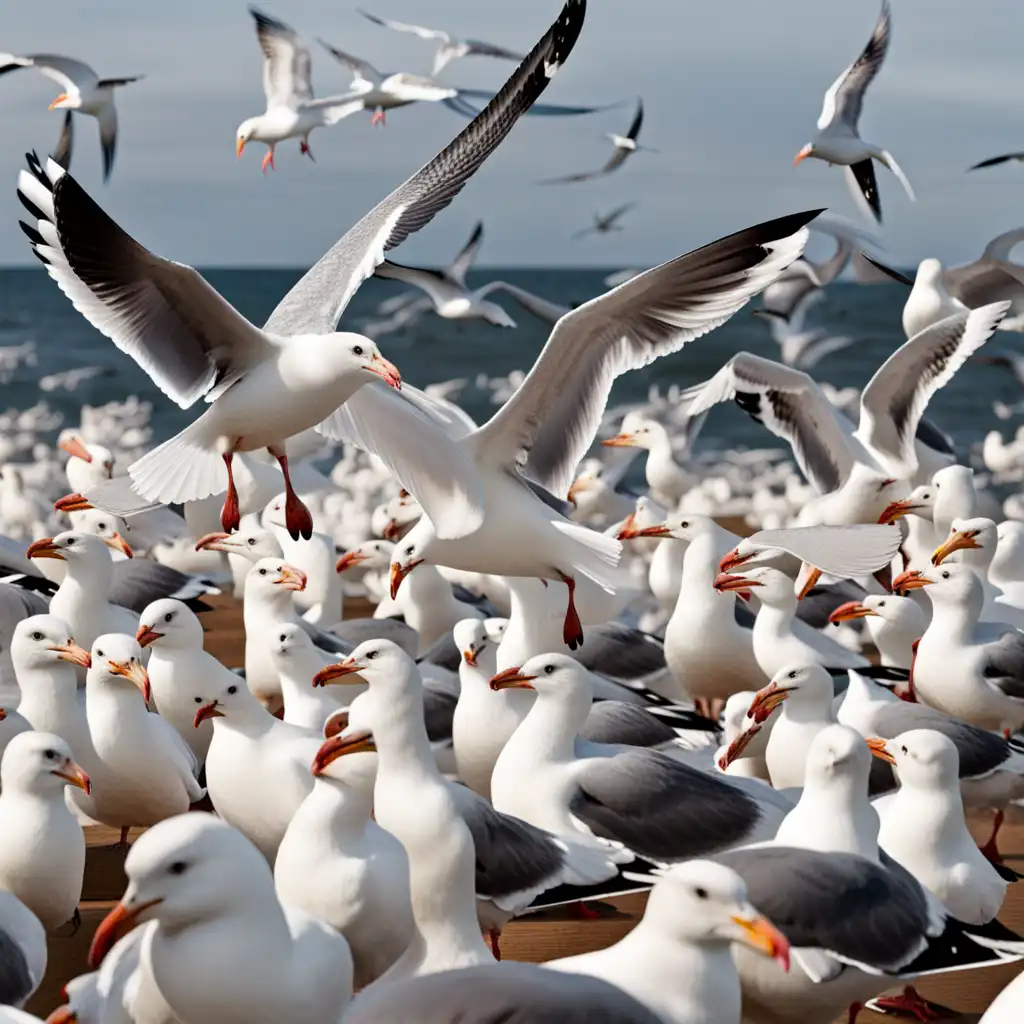
gull
noun gull
ɡʌl
A seabird with a heavy body, long wings, and a curved beak especially common to the North Atlantic
He watched a group of gulls fighting over a piece of bread.
gull
ɡʌl
Loading…
ɡʌl
A seabird with a heavy body, long wings, and a curved beak especially common to the North Atlantic
He watched a group of gulls fighting over a piece of bread.

ɡʌl
To trick or deceive someone
He was gulled into buying a useless piece of machinery.
Audio could not be loaded. Please try again later.
The word 'gull' is used to refer to a type of sea bird that is often seen near the coast. It has a grey or white body, webbed feet, and a sharp beak. People also use the word 'gull' as a verb to describe someone who has been tricked or deceived by someone else. For example, if someone convinces you to do something that is not good for you, you might say that they 'gulled' you.
Albatross and gull are both birds, but they are different from one another. Albatross is a large sea bird that spends most of its life in the open ocean, while gull is a smaller sea bird that can be found near coasts and over bodies of water like lakes and rivers.
Albatrosses have long wings and are well suited for flying long distances across the ocean. They are often seen gliding effortlessly over the waves, feeding on fish and other small marine creatures.
Albatross is a large oceanic bird that lives and feeds in the open ocean, while gull is a smaller sea bird that can be found near coasts and over bodies of water, and is an opportunistic feeder.
Open word: Albatross →A cormorant is a type of bird that is known for its diving and fishing abilities. They have long necks and hooked bills that help them catch fish underwater.
Cormorants are primarily found near bodies of water, such as lakes or oceans. They can be seen sitting on rocks or tree branches with their wings spread out to dry.
In summary, cormorants are diving birds that fish underwater, while gulls are scavengers with a distinct shape and flying style.
Open word: Cormorant →Gannets and gulls are both types of seabirds, but there are some key differences between them.
Gannets are larger birds with long wings and a pointed beak. They are usually white with black tips on their wings, and they are known for their spectacular diving ability.
Gannets dive straight into the water at high speeds to catch fish. They are found in coastal areas all over the world.
In summary, gannets are larger, white birds that dive into the water to catch fish, while gulls are smaller, more colorful birds that scavenge for food near the shore.
Open word: Gannet →Gulls and petrels are both types of seabirds, but they have some differences. Gulls are usually larger and have heavier beaks, while petrels are smaller and have more streamlined bodies.
Gulls are often seen near coastlines or beaches, where they scavenge for food and may even steal food from people. Petrels are usually found far out at sea, where they feed on fish and other marine life.
The term gull is applicable when referring to a large seabird commonly seen near coastlines or beaches, while petrel is applicable when referring to a smaller seabird found in open ocean areas.
Open word: Petrel →Gulls and shearwaters are both types of seabirds, but they have some differences. Gulls are typically smaller and have shorter wings, while shearwaters are larger and have longer wings.
Shearwaters are pelagic birds that spend most of their lives at sea. They are adapted for long-distance flight and are able to travel vast distances without touching land.
In summary, gulls are smaller, have shorter wings, and are adaptable to various environments, while shearwaters are larger, have longer wings, and are mainly found at sea in large colonies.
Open word: Shearwater →Gulls and skuas are both birds found in coastal areas, but they have some differences.
On the other hand, skuas are larger and mainly feed on other seabirds or their eggs. They have a powerful build, sharp talons, and hooked beaks that allow them to attack other birds.
In summary, gulls are scavengers that feed on a variety of things, including fish, while skuas are predators that primarily feed on other seabirds or their eggs.
Open word: Skua →Gulls and terns are both types of seabirds, but there are some differences between the two.
Gulls are usually larger and heavier than terns, with a more robust body structure. They have a broad beak and are often scavengers, feeding on things like fish, insects, and garbage.
Terns are smaller and more streamlined than gulls. They have a long, slender beak and are known for their graceful flight.
Terns typically feed on small fish and other aquatic animals and are often found in coastal or oceanic habitats.
In summary, gulls are larger and more heavy-set birds that scavenger for food, while terns are smaller, more streamlined birds that catch their prey in the water.
Open word: Tern →on your doorstep is the largest lizard in the world and they probably think it's as normal as a seagull on the beach here in England. But to answer the question do they eat people? Is not really the case.
Watch on YouTube ↗Strangers he gulls, but friends make fun of him.
You hear the gentle lap of waves, the distant cawing of a seagull. But then an annoying whine interrupts the peace,
Watch on YouTube ↗Devon holds a special place in my heart. As a child, I normally went on holiday to Bantham and have lots of happy memories from my time there. I used to catch sand eels in the early morning and go fishing for bass throughout the day. I remember a gull taking my bait.
is that ems spend most of their life in virtual reality. This is what you might look like if you were using virtual reality. And this is what you might sunlight glinting off of water you might hear gulls flying above,
Watch on YouTube ↗In fact, to gull a fool seems to me an exploit worthy of a witty man.
beautiful young girl from Wellfleet her her hair was the color of corn silk in her eyes or as blue as the deeps of gull pond these were some of the things that I remember as a kid and reading about
Watch on YouTube ↗I'd be interested to read Gull's paper on it, and I wish Alan would put it in somewhere. It gives him a relevance to our times, which he doesn't otherwise have. Gull, I mean, not Alan.
to help find out the team asked the cat owners to take photos of any prey their cats bring home i could have things in three or four times a week in the summer or the spring he's brought in a seagull a rat a vole mice
Watch on YouTube ↗Now and then, when I grow nostalgic about my ocean childhood - the wauling of gulls and the smell of salt, somebody solicitous will bundle me into a car and drive me to the nearest briny horizon.
Herring gulls and wood turtles also sometimes drum their feet on the earth to summon worms. So then why does this behavior persist? Scientists think it’s beneficial for a prey species to maintain its adaptations against a more frequent predator, even if it makes it more vulnerable to a rarer one.
Watch on YouTube ↗- So that's nature at its best. - I've never seen anything like that. To see the little gulls! It's so funny to watch them like who is this? - Yeah. - It's just-- but I just-- I don't know what it is. It's just communing with another life form. - Yeah.
Watch on YouTube ↗and all the damaging features that can happen from that environment. So they're all hunkered down there. Then also there's a safety in numbers thing because it also helps you keep away the predators, because if say a seagull wants to pick you up and eat you,
Watch on YouTube ↗again you won't find polar bears there you won't find little locks there you won't find ivory gulls there it's important to preserve it because it is an entire intact ecosystem that's not duplicated anywhere on this planet and for all we know anywhere in the universe
Watch on YouTube ↗Other fish-eaters profit from their daring. Herons and gulls follow every hunt.
Watch on YouTube ↗