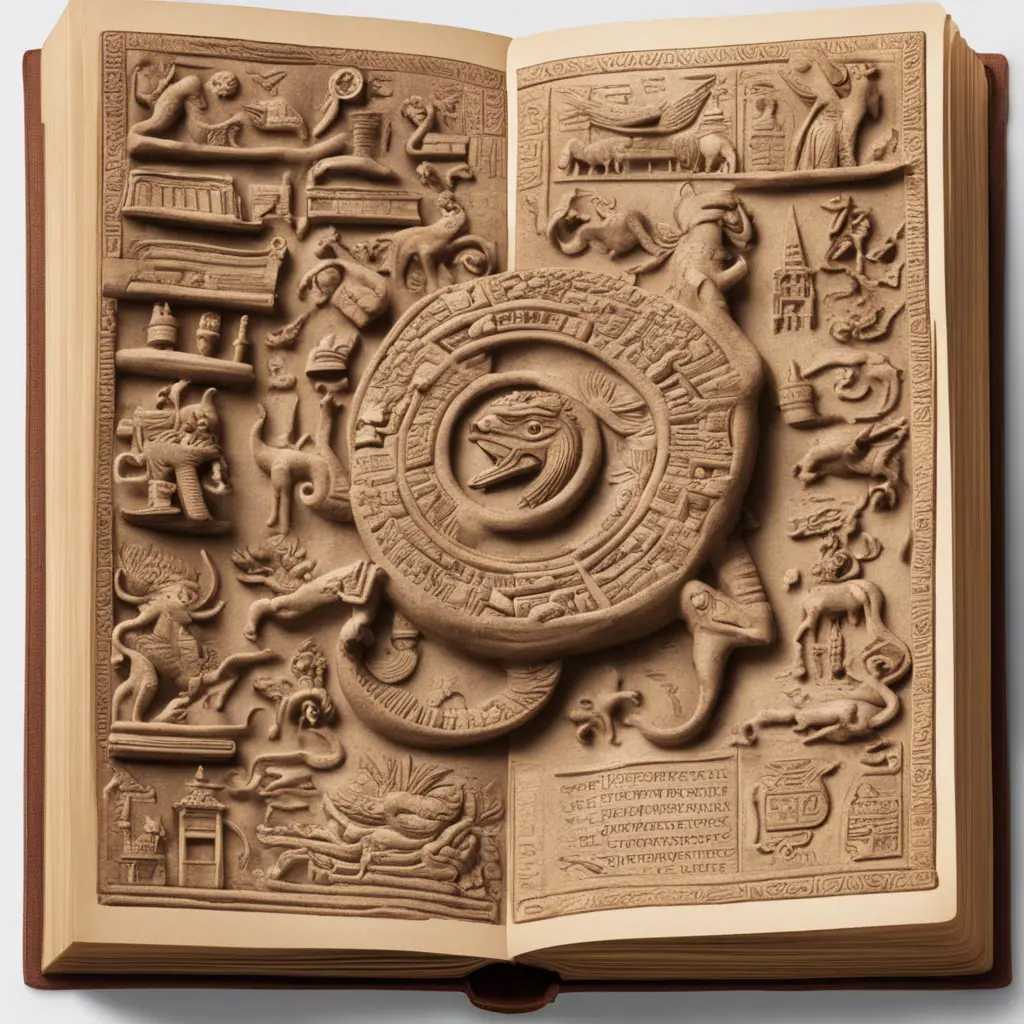
Mythology refers to the collection of stories, rituals, beliefs, and traditions of a particular culture or civilization. These stories usually involve gods, goddesses, heroes, and other supernatural beings. Mythology can be used to understand the cultural and historical background of a particular place and its people. For example, Greek mythology includes famous stories such as the Trojan War and the adventures of Perseus and Medusa. The ancient Egyptians had their own mythology with stories of their gods and goddesses like Ra and Isis. Mythology can also refer to popular beliefs or misconceptions that are not necessarily true, such as the myth that carrots improve your eyesight.
A fable is a short story that uses animals or plants to convey moral lessons or instructive truths. These tales are often set in an imaginary world and are intended to teach a moral lesson.
Fables are usually more straightforward and focused on a specific moral lesson, while mythology is often more complex and diverse, reflecting the broader traditions and cultural beliefs of a society.
In applications, fables are often used in children's literature and education, while mythology is often studied in academic contexts and as a means of exploring cultural history and belief systems.
Folklore refers to the beliefs, customs, stories, and traditions passed down from generation to generation within a particular culture or society.
It often includes legends, superstitions, and sayings that are unique to a specific group. For example, folklore of the Native American tribes includes stories about spirits, animals, and nature.
Folklore refers to the traditions and stories of a culture or society, while mythology is more specific and focused on the stories and beliefs related to a particular group of gods or goddesses.
A legend is a story that is typically based on historical events, but may have been exaggerated over time. It usually involves real people or places and is often passed down through oral tradition.
Legends are often used to explain or interpret historical events, and may contain moral or ethical lessons.
Both legends and mythology are used to explain events or beliefs, but legends are usually based on real people or events, while mythology is often more fantastical and involves supernatural beings.
Legends are applicable in history, culture and heritage while mythology is applicable in religion, literature and art.
Superstition refers to a belief or practice that is not based on reason or scientific evidence. Superstitions often involve ideas about luck, fate, or supernatural forces.
They may include things like avoiding certain actions or objects, performing rituals or using lucky charms. Unlike mythology, superstitions are not usually considered to be part of a formal belief system.
Mythology is a collection of stories that explain the world and its phenomena, while superstition is a belief or practice that is not based on reason or evidence.
Mythology is applicable in the contexts of literature and history, while superstitions are often associated with everyday life beliefs and common practices.
teach us that mythology and science are actually two sides of the same coin. Both are rooted in explaining and understanding the world. The key difference is that where mythology uses gods monsters and magic, science uses measurements records and experiments.
And every culture comes up with its own understanding of life, its own customized version of mythology. Culture is a reaction to nature, and this understanding of our ancestors is transmitted generation from generation
mean by that is that if you've been raised on a diet of mythology that said that you were the exceptional nation the essential nation that you were the at the pinnacle of societal and democratic achievement that somehow another your inheritance
I don't look at it as writing a book in a videogame universe. I look at it as writing for 'Halo', which for me, transcends being just a great video game. It's evolving into a whole new mythology.
that would literally let me copy all of their homework math science mythology I literally had help with all of it and I remember it was my second senior year or my second because I skipped so much school the first year I couldn't pass
The idea of science fiction, mythology, and creating a world is my favourite thing. I do love the reality of dramas and playing that, but being able to start from scratch, to completely build the character and this world, I love that.
It's not the absurdity of bureaucracy alone, but the irony of the character's circular reasoning in reaction to it that is emblematic of Kafka's writing. His tragicomic stories act as a form of mythology for the modern industrial age, employing dream logic to explore the relationships
and speaks her cultural language. It might also be said that the history of what we call art is a conversation that continues on, as our contemporary present passes into what will be some future generation's classical past. It's a conversation that reflects the ideologies mythologies belief systems and taboos
I've always loved shows that combine both approaches - that have a mythology and a set of characters, whose stories develop and change, and where the relationships evolve and fracture.
If you read folklore and mythology, any kind of myths any kind of tall tales, running is always associated with freedom and vitality and youthfulness and eternal vigor. It's only in our lifetime that running has become associated with fear and pain.
but left instead to the dark depths of our imagination. Lovecraft’s dozens of short stories novellas and poems often take place in the same fictional continuity, with recurring characters locations and mythologies. At first glance,
Comic-book movies are mythology, in a way, and there are a lot more parallels in them with what's going on in the real world than people want to discuss.
So there's this profound mythology around whistleblowers which says first of all they're all crazy. But what I've found going around the world and talking to whistleblowers is actually,
one of the things that really sort of seeped into my pores, that I sort of lived my whole life is process. And it's the process of learning things. One of the great things was that my father was an avid golfer but he was lefty. And he had a real passion for golf, and he also created this whole mythology