gulch
noun gulch
ɡʌltʃ
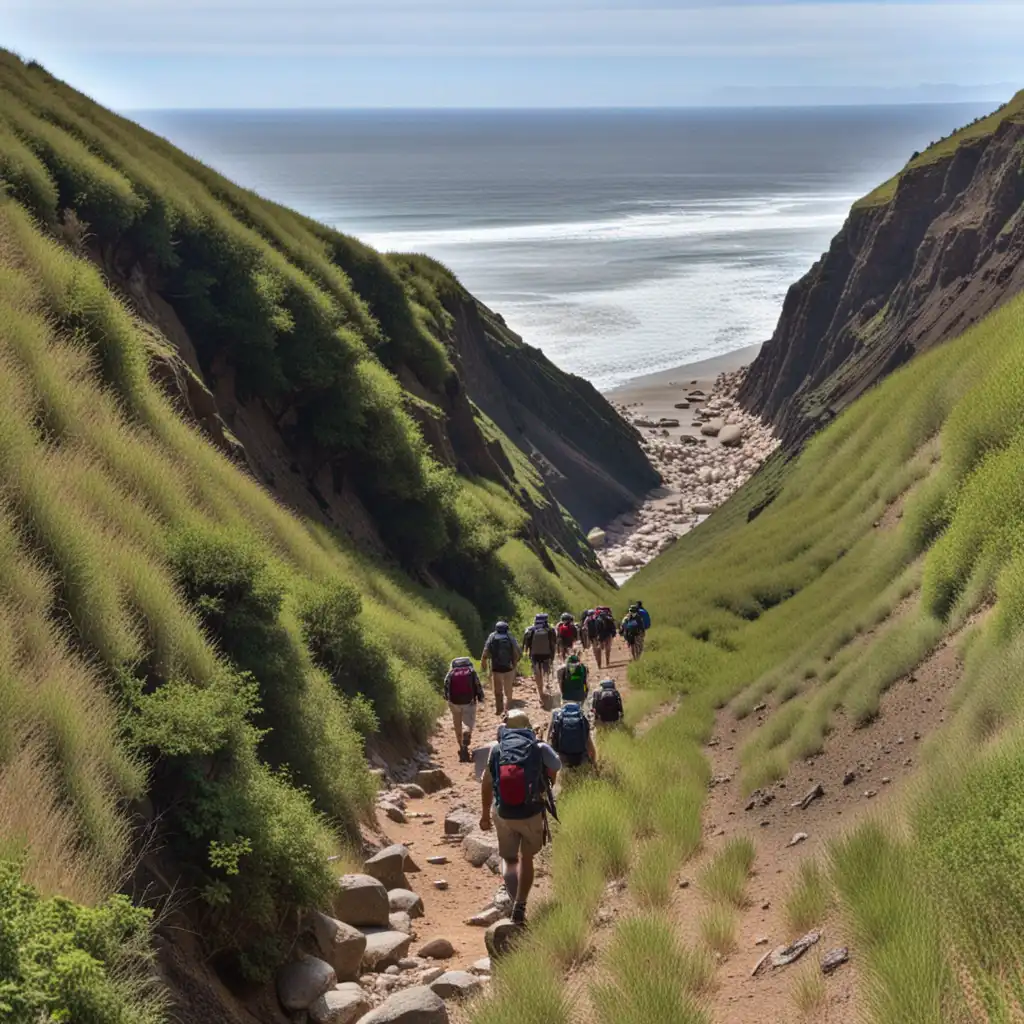
A narrow and steep-sided ravine marking the course of a fast stream.
We hiked down the gulch to reach the beaches.
gulch
ɡʌltʃ
불러오는 중…
ɡʌltʃ
A narrow and steep-sided ravine marking the course of a fast stream.
We hiked down the gulch to reach the beaches.
오디오를 불러오지 못했어요. 잠시 후 다시 시도해 주세요.
The word 'gulch' is used to describe a deep narrow valley or channel, usually with steep sides that have been formed by water erosion. You might hear someone say "I hiked through a rocky gulch on my camping trip." It's often used to describe a rugged, wild landscape, typically found in mountainous or desert regions. You could also use the word 'gulch' to describe a stream or river with a rocky bed that has carved out a narrow and steep-sided channel over time.
A canyon is a deep valley with steep sides, often formed by a river or erosion over time. Canyons are typically much larger and deeper than gulches, and may include rock formations, formations, and wildlife.
A gulch is a narrower, smaller, and shallower version of a canyon. It is formed by water flowing in a narrow channel, often in a dry or semi-dry region.
Essentially, a canyon is a large and deep valley formed through a long, slow process, while a gulch is a smaller and shallower channel formed more quickly by water or erosion.
Canyons are often viewed as natural wonders and popular tourist attractions, while gulches are less grand and typically used for hiking or outdoor activities.
단어 열기: Canyon →A chasm refers to a deep, narrow opening or gap that separates two areas.
It is typically long and narrow and can be difficult to cross without the aid of a bridge or other means. Examples of chasms include the Grand Canyon and the Mariana Trench.
A gulch refers to a steep-sided ravine, typically formed by water erosion. It is generally shorter and narrower than a chasm and can be crossed with relative ease.
A chasm is a long and narrow opening or gap, while a gulch is a shorter and narrower steep-sided ravine.
단어 열기: Chasm →Both cleft and gulch refer to a narrow and steep valley or gap.
Cleft usually refers to a narrow opening or a split in a rock or a material.
It can also refer to a fissure or a deep indentation in the surface of something. For example, a cleft chin is a prominent indentation between the lower lip and the chin.
In terms of geography, a cleft can refer to a deep, narrow valley or a gorge that is formed by erosion or tectonic activity.
Gulches are typically smaller and less deep than clefts and can be found in areas with a dry climate, such as deserts or canyons.
Cleft refers to a narrow opening or a deep indentation while gulch refers to a narrow, rocky valley or a dry channel.
단어 열기: Cleft →A crevice is a narrow crack or opening in a surface, often found in rocks, walls, or other hard materials.
It is usually small and can be difficult to see or navigate through. Crevice is applicable to natural features like rocks or cliffs, as well as man-made structures like walls or buildings.
It is typically larger than a crevice and can be recognized by its distinct U-shaped drainage pattern, often found in desert areas.
A crevice is a narrow opening or crack, while a gulch is a larger steep-sided ravine or small canyon formed by waterways.
단어 열기: Crevice →A fissure is a narrow opening or crack in something, usually a rock, while a gulch is a narrow and steep-sided ravine created by erosion.
Fissures are commonly found in geology or earth science, and they can be deep or shallow, depending on the magnitude of the geological force that created them.
Both words could be applicable to a scenario where there is a narrow opening or passage, but fissures are generally more relevant to geology, while gulches are commonly associated with topography and geography.
단어 열기: Fissure →Gorge refers to a long and narrow valley with steep sides, typically formed by a river cutting through hard rock.
Gorge describes larger valleys while gulch describes smaller valleys with steep sides.
단어 열기: Gorge →Both gulch and ravine refer to a narrow and steep-sided valley with a stream or river at the bottom.
However, gulch usually refers to a smaller, shallower and narrower stream while a ravine is larger and deeper.
A gulch is often found in dry areas or deserts and can be formed by flash floods while a ravine is usually found in wetter areas with more vegetation.
단어 열기: Ravine →A rift is a much larger and deeper crack or fissure in the Earth's surface.
A rift can be found on land or under the ocean and can even separate continents.
In summary, gulches are small, steep-sided ravines that are formed by erosion, while rifts are large cracks or fissures in the Earth's surface that are formed by tectonic activity.
Gulches are typically found in arid or desert areas, while rifts can be found on land or under the ocean and can even separate continents.
단어 열기: Rift →Aaron Huey: America's...
YouTube에서 보기 ↗The Water Crisis %\PIPE%...
YouTube에서 보기 ↗America's native...
YouTube에서 보기 ↗