Audio could not be loaded. Please try again later.
How to use
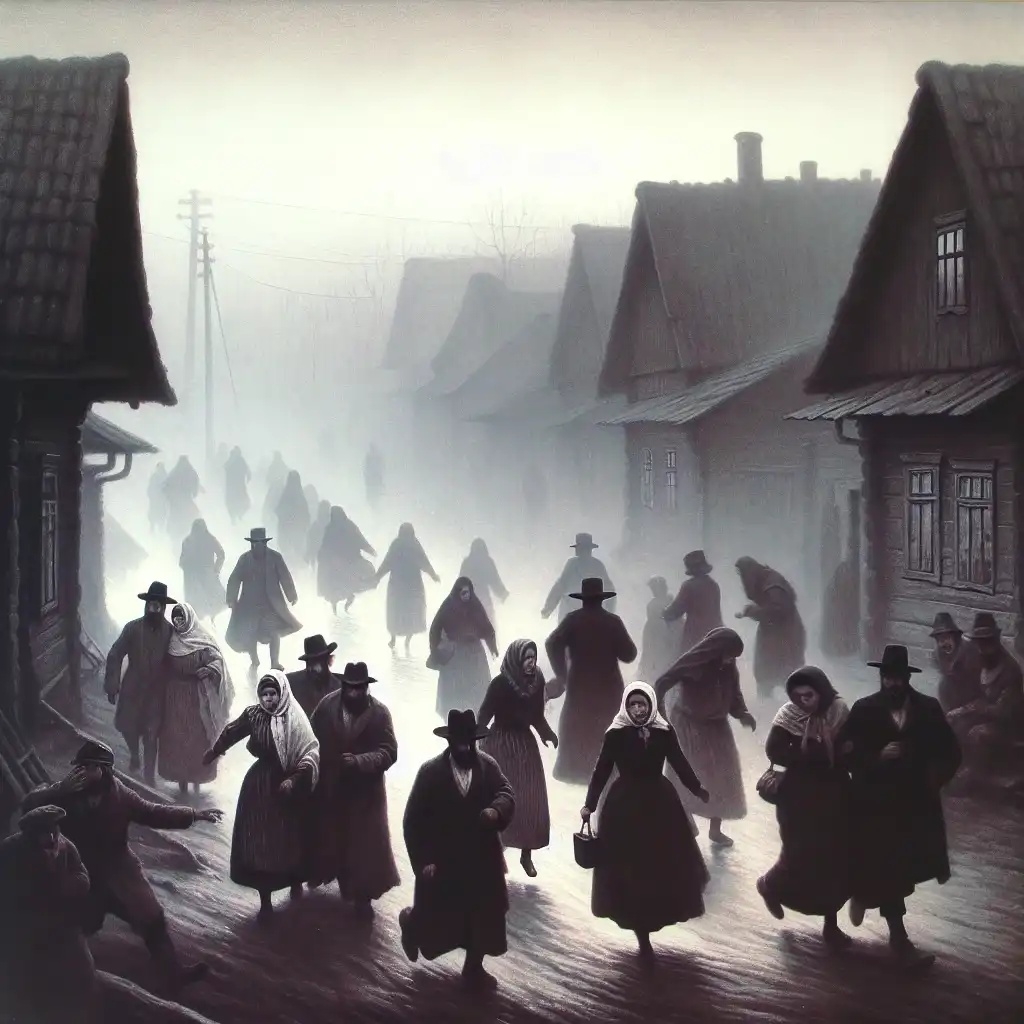
The word 'pogrom' is used to describe a violent attack on a specific group of people, usually based on their religion or ethnicity. It has typically been used to describe violent attacks against Jewish people in Eastern Europe during the late 19th and early 20th centuries. It can also be used more broadly to refer to any organized and violent attack on a particular group of people.
Carnage refers to a large-scale, violent and bloody killing of people or animals.
Pogroms can occur both on a smaller scale, for example, a mob attacking a single family, or on a larger scale. While carnage is more general and can apply to many different situations, a pogrom is specifically associated with attacks against a particular group.
Decimate means to reduce something by one-tenth or to destroy a large portion of something. It is commonly used to describe something that has been severely damaged or lost a significant number of members.
For example, if a disease decimates a population, it means that a large portion of that population has died.
Decimate describes a loss of a significant portion of something, whereas pogrom describes violent attacks against a particular group of people.
Exterminate means to completely destroy or kill a group of people or animals.
In simpler terms, exterminate means to kill off completely, while pogrom refers to a violent attack on a specific group of people based on hate or prejudice.
Genocide is a deliberate act of killing a large group of people from a particular race, ethnicity, or nationality. It is a systematic and organized killing of a group of people with an intention to completely wipe them off from the face of earth.
For example, the Holocaust under the Nazi regime in Germany during World War II is an example of genocide.
Genocide is a systematic killing of an entire group or community with the intention of wiping them out, while pogrom is a violent attack on a particular group or community aimed at causing harm and destruction.
Holocaust describes a systematic and organized mass killing of a large number of people, typically referring to the genocide of Jews by Nazi Germany during World War II.
Holocaust refers to a large-scale, systematic, and organized mass killing, while pogrom refers to a violent mob attack targeting a minority group.
Both pogrom and slaughter refer to violent acts, but there is a difference in their meaning and usage.
Slaughter refers to the killing of a large number of people or animals, often in a brutal or violent manner.
So, while both words describe violent acts, a pogrom is a specific type of violent attack aimed at a particular ethnic or religious group, while slaughter is a general term used to describe the killing of a large number of people or animals.
My family kept its history to itself. On the plus side, I didn't have to hear nightmarish stories about the Holocaust, the pogroms, terrible illnesses, painful deaths. My elderly parents never even spoke about their ailments.
The members of my people who took part in the pogrom in Kielce after the end of World War II expelled themselves from the Polish people. That is my deep personal conviction.
I have never found out that there was in my family an artist or anyone interested in the arts or sciences, and I have never been sufficiently interested in my 'family tree' to bother. My father and mother had come to America on one of those great waves of immigration that followed persecution and pogroms in Czarist Russia and Poland.
One could reasonably argue that the Turkish pogrom against the Armenians during World War I qualifies as a crime against humanity, as does the United States' ethnic cleansing of Native Americans.
My father's father fled a pogrom in Russia in the early 20th century and was welcomed to the United States. So was my stepmother, who escaped as a young girl from Communist Hungary in 1950.
The search for a Jewish national home came about due to centuries of anti-Semitic pogroms, expulsions, discrimination and hate. The Holocaust was simply the evil culmination of all that came before it.
So an autobiography about death should include, in my case, an account of European Jewry and of Russian and Jewish events - pogroms and flights and murders and the revolution that drove my mother to come here.
At age 14, my paternal grandfather fled Poland to escape the pogroms that killed tens of thousands of European Jews. He worked full-time for a cobbler in Boston, making his way to California and eventually starting his own business in Taft - the Goldman Oil Supply Company.
Jews survived all the defeats, expulsions, persecutions and pogroms, the centuries in which they were regarded as a pariah people, even the Holocaust itself, because they never gave up the faith that one day they would be free to live as Jews without fear.