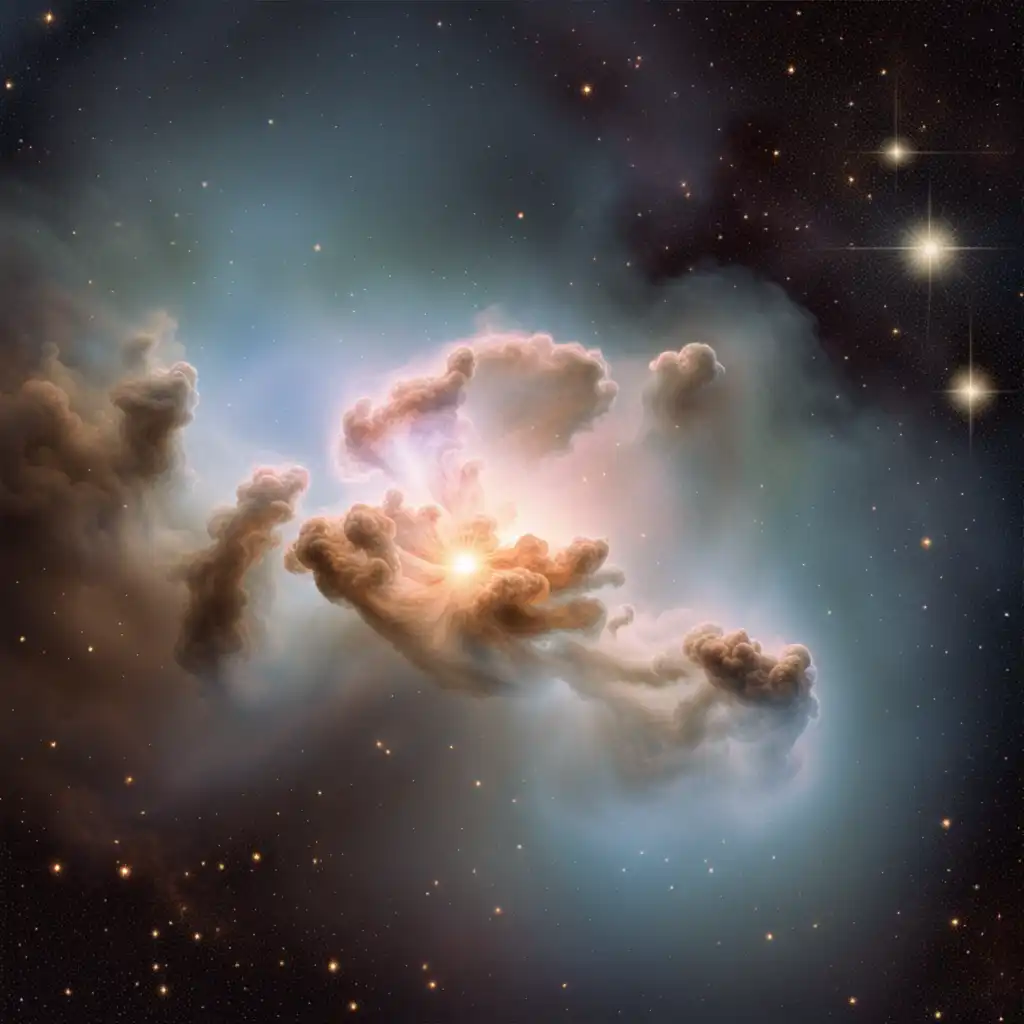
nebula
noun nebula
ˈnebjələ
A cloud of gas and dust in outer space, often visible to us as a hazy spot of light
Astronomers discover a new nebula in the Milky Way galaxy.
nebula
ˈnebjələ
Chargement…
ˈnebjələ
A cloud of gas and dust in outer space, often visible to us as a hazy spot of light
Astronomers discover a new nebula in the Milky Way galaxy.
ˈnebjələ
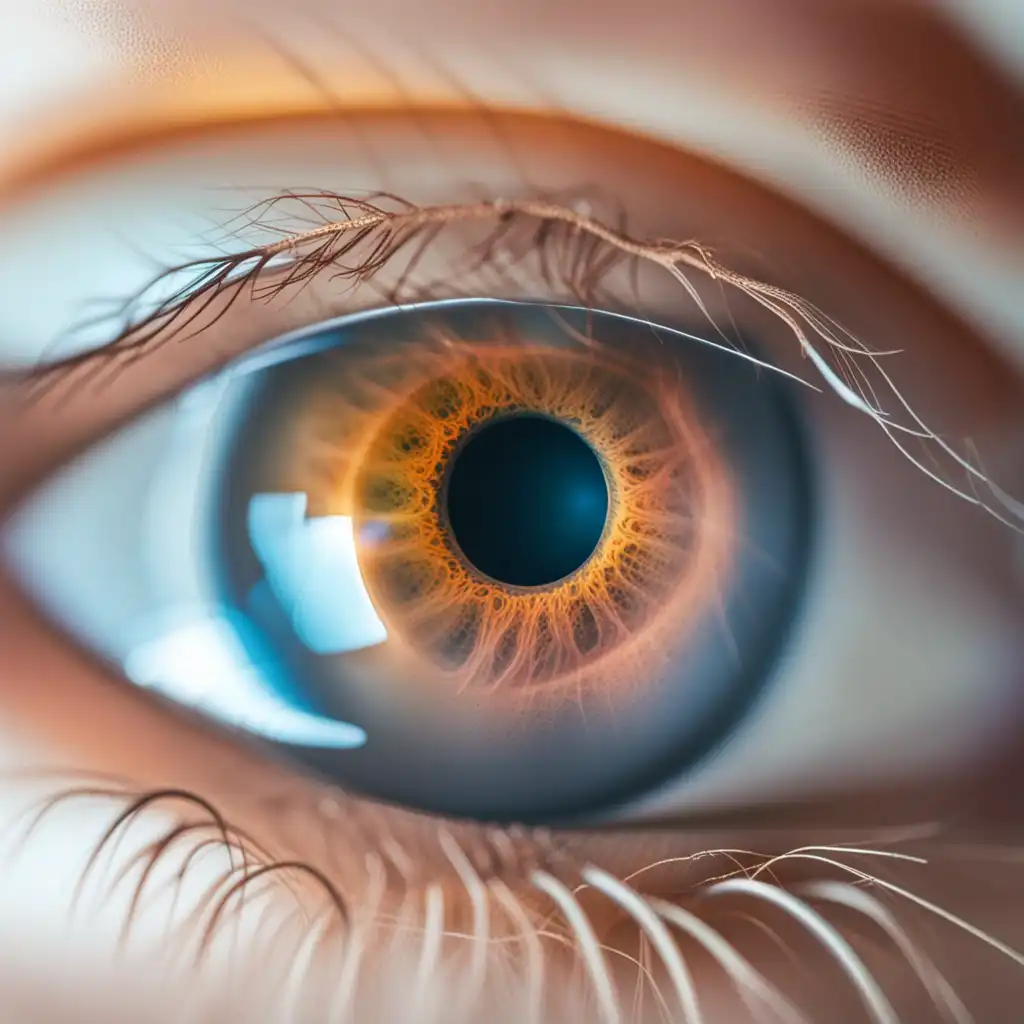
A thin cloud in the eye, causing blurred vision
The doctor diagnosed him with a corneal nebula.
Impossible de charger l’audio. Réessayez plus tard.
A nebula is a cloud-like patch of gas and dust in space. It can be seen through a telescope and often has a beautiful and colorful appearance. Scientists study nebulae to learn about how stars and galaxies are formed. The word "nebula" can be used when talking about astronomy or space. For example, "The Orion Nebula is one of the most famous nebulae visible from Earth."
Both cloud and nebula refer to large, diffuse masses of materials in space.
A cloud usually refers to a smaller and more localized mass of gas or dust, commonly found within our solar system. For example, a cloud could be the dust found in a comet's tail or the gas around a planet.
A nebula is a much larger and more distant interstellar cloud of gas and dust. These can span across many light-years and are often sites of active star formation.
In summary, while both terms refer to masses of gas and dust in space, a cloud is generally smaller and closer to home while a nebula is much larger and usually found further out in the galaxy.
Ouvrir le mot: Cloud →Fog refers to a cloud that forms close to the ground. It's created when warm air meets cooler air, and the moisture in the warm air condenses into tiny droplets.
Fog is often seen in the early morning or at night, and it can make it difficult to see.
Fog is a cloud that forms near the ground and makes it hard to see, while a nebula is a cloud of gas and dust in space that's visible through a telescope.
Ouvrir le mot: Fog →A galaxy refers to a large system of billions of stars, dust, and gas held together by gravity.
It can be thought of as a city of stars, and our own Milky Way galaxy is an example. Galaxies come in different shapes, such as spiral or elliptical.
A galaxy is a large system of stars, while a nebula is a cloud of gas and dust.
Galaxies can be identified by their shape and are known to contain immense numbers of stars, while nebulae can signal the birthplace of new stars.
Ouvrir le mot: Galaxy →Haze describes a situation where there is a lot of smoke, dust, or moisture in the air, making it difficult to see things clearly.
Haze describes a situation here on Earth where visibility is reduced due to particles in the air, while nebula describes clouds of gas and dust that are seen in space.
Ouvrir le mot: Haze →Mist refers to water droplets that are suspended in the air, usually close to the ground. It often occurs in cool and humid conditions and is commonly seen in the morning or at night.
Mist can be created by the condensation of water vapour.
Nebula refers to a cloud of dust and gas in space. It is much larger than mist and may extend over many light-years in size.
Mist is a weather condition that happens on Earth, while nebula is a phenomenon that occurs in space. Mist is applicable to daily activities like driving or walking, while nebulae are studied by astronomers using telescopes.
Ouvrir le mot: Mist →Smog is a type of air pollution caused by the release of harmful gases and particles from human activities, such as factory emissions, vehicles, and burning fossil fuels.
In summary, nebulae are natural clouds of gas and dust in outer space, while smog is a man-made type of air pollution caused by human activities.
Ouvrir le mot: Smog →It is often visible as a colorful cloud or glow surrounding stars. Steam is the gas that is produced when water is heated to a high temperature.
Steam is applicable in everyday life, where it is used for cooking, heating, and powering machines.
The key difference is that nebula is a term used in astronomy to describe phenomena in space, while steam is a term used to describe a physical state of water.
Ouvrir le mot: Steam →It is usually visible as a brightly glowing area in the night sky. Vapour is a gaseous form of a substance that is typically found at room temperature.
Vapour can be applied in various contexts, such as in the form of steam from a boiling kettle, or in the form of water droplets suspended in the air as mist or fog.
In essence, while both nebula and vapour refer to gaseous substances, the former is applicable in the context of outer space, while the latter can be applied in a wide range of contexts.
Ouvrir le mot: Vapour →A whirlpool is a swirling mass of water or air in which an object or entity can become trapped and drawn downward. Whirlpools are typically found in oceans, rivers, or even in your bathtub.
In summary, nebulae are found in space and are related to the formation of new stars, while whirlpools are found in bodies of water and can be dangerous to living things that are caught in their currents.
Ouvrir le mot: Whirlpool →in a sample of rock that's undergone radioactive decay, geologists have estimated the Earth's birthday, when it first formed from a solar nebula, to be 4.6 billion years ago. But just how long is that really? Here's some analogies that might help you understand.
Voir sur YouTube ↗That is the exploration that awaits you! Not mapping stars and studying nebula, but charting the unknown possibilities of existence.
disagree with you i'm not going to disagree because people people are from all over the world they hire nebula for climbing a thousand meter peak right of course so mingle g work for other expeditions and eventually he built his own successful guiding business but there was one thing that still
Voir sur YouTube ↗A revolution resembles the death of a fading star, an exhilarating Technicolor explosion that gives way not to an ordered new galaxy but to a nebula, a formless cloud of shifting energy.
Which meant that Andromeda was not a nebula in our own galaxy, but a whole other galaxy, out there in the cold dark nothingness. Suddenly the universe was a garden blooming with galaxies, with ours but a single bloom.
Voir sur YouTube ↗A beam of light takes about two million years to reach from us to the Andromeda nebula. But my thought covers this distance in a few seconds. Perhaps some day some intermediate form of body and mind may permit us to say that we actually can travel faster than light.
Nebula you can see behind me but in astronomy in biology in particle physics we're collecting data a lot faster and faster all the time and some people say that we're in a data deluge with drowning in data but we're not we need to embrace data we need to learn how to handle it and one way to do that is mass
Voir sur YouTube ↗leads to more questions and more enemies was his mother's death really an accident will he uncover the missing formula who can he trust the one thing crews knows for sure nebula is still out to get him making his mission more important and more dangerous than ever
Voir sur YouTube ↗The solar system came into being about 4.5 billion years ago when a cloud of interstellar gas and dust collapsed, resulting in a solar nebula a swirling disc of material that collided to form the solar system. The solar system is located
Voir sur YouTube ↗It was born when a cloud of dust and gas known as a solar nebula Collapsed and in the middle of this formation matter condensed into a burning ball of gas that became our Sun
Voir sur YouTube ↗such as our sun release their stellar material into space leaving behind a white dwarf surrounded by a planetary nebula. More massive stars instead blast matter into space in a bright supernova leaving behind an extremely dense body called a neutron star.
Voir sur YouTube ↗sour nebula began to collapse under its own gravity and spin faster a dense clump of matter formed in the center
Voir sur YouTube ↗You see every star hits periods of hardship, It takes a brighter light to inspire them through the darkness. If we go back to when he was born in a nebula, We know that he never was thought of as regular, Because he had a flair about him, To say the Midas touch is wrong But all he went near seemed to turn a little bronze,
Voir sur YouTube ↗