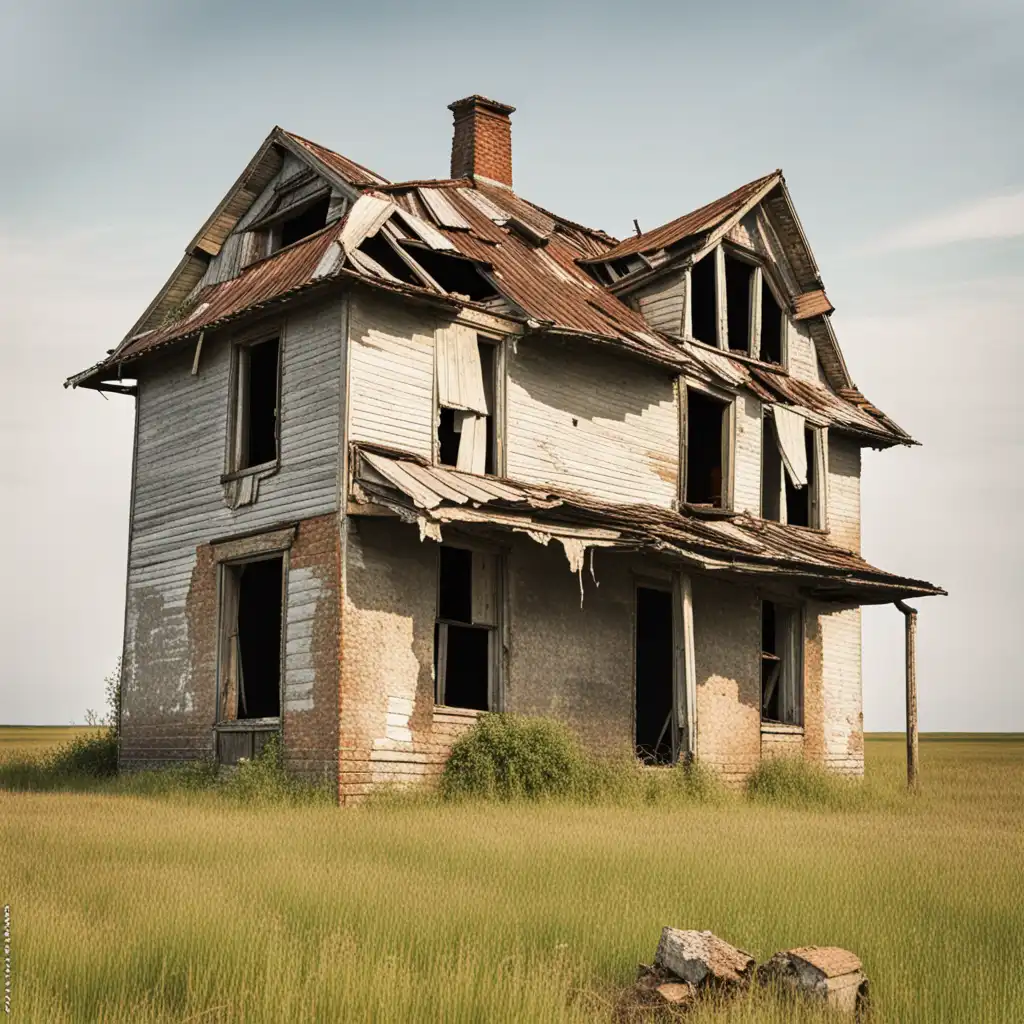
tumbledown
adjective tumbledown
ˈtʌmbldaʊn
Falling apart or in bad condition because of being old or not properly cared for.
The farmer's house was a tumbledown shack in desperate need of repair.
tumbledown
ˈtʌmbldaʊn
Đang tải…
ˈtʌmbldaʊn
Falling apart or in bad condition because of being old or not properly cared for.
The farmer's house was a tumbledown shack in desperate need of repair.
Không tải được âm thanh. Vui lòng thử lại sau.
'Tumbledown' is an adjective used to describe a building or structure that is in a state of disrepair, decay, or ruin. For example, if a house has a roof that is falling apart, walls that are crumbling, and floors that are caving in, we might describe it as 'tumbledown'. This word is often used to convey a sense of neglect or abandonment, and can be used to describe anything from an old barn in the countryside to a run-down house in the city. So, if you see a building that looks like it's about to fall apart, you can use the word 'tumbledown' to describe it.
Both words, broken-down and tumbledown, mean something that is in a state of disrepair or decay.
Broken-down describes something that is no longer working or functional, such as a car, machine, or appliance.
Tumbledown describes something that is falling apart or collapsing, such as an old house, barn, or fence. In simpler terms, broken-down refers to something that doesn't work anymore, while tumbledown refers to something that is falling apart.
Crumble means to break or fall apart into small pieces or crumbs. This is typically used to describe something that is still standing but is starting to fall apart due to decay or damage.
For example, a old building may be crumbling due to years of neglect.
Crumble describes something that is starting to fall apart, whereas tumbledown describes something that has already completely fallen apart.
Mở từ: Crumble →Decay refers to the process of gradually rotting or breaking down over time, often due to neglect or lack of upkeep. It is applicable to things like food, plants, buildings, and infrastructure.
Decay refers to the gradual breaking down of something over time, while tumbledown refers to something that has already reached a state of disrepair and disintegration.
Mở từ: Decay →Deteriorate means to become gradually worse in condition over time.
It is typically used to describe things that are breaking down or deteriorating due to age or neglect, such as a building or road.
So, while both words describe things that are not in good condition, deteriorate implies a slower, more gradual decline, while tumbledown implies a more sudden and severe state of disrepair.
Mở từ: Deteriorate →Dilapidated refers to something that is in a state of disrepair, and usually implies that it was once in good condition, but has fallen into a state of ruin or neglect.
Dilapidated suggests a state of disrepair, while tumbledown suggests a total collapse or complete failure of a structure or object.
Mở từ: Dilapidated →Disintegrate means to break apart into small pieces or to completely crumble into nothing. This typically happens over a period of time due to decay, erosion, or other natural factors.
Mở từ: Disintegrate →Ramshackle and tumbledown both describe buildings or structures that are in a state of disrepair, but there is a slight difference in their usage.
Ramshackle implies that the building or structure is poorly constructed or in need of serious repairs. It suggests that the building is unstable and could collapse at any moment.
Both words can be used interchangeably to describe a building or structure that is in a state of disrepair, but in general, ramshackle describes buildings that are still standing and tumbledown describes buildings that have partially or completely fallen down.
Mở từ: Ramshackle →Back when I was 16, when I should have been doing normal high school things, I availed myself of my brand new driver's license to spend as much time as possible in Milwaukee's Renaissance Book Shop, a tumbledown five-story warehouse that the city was finally able to close down in 2011 for safety reasons. It was my teenage paradise.