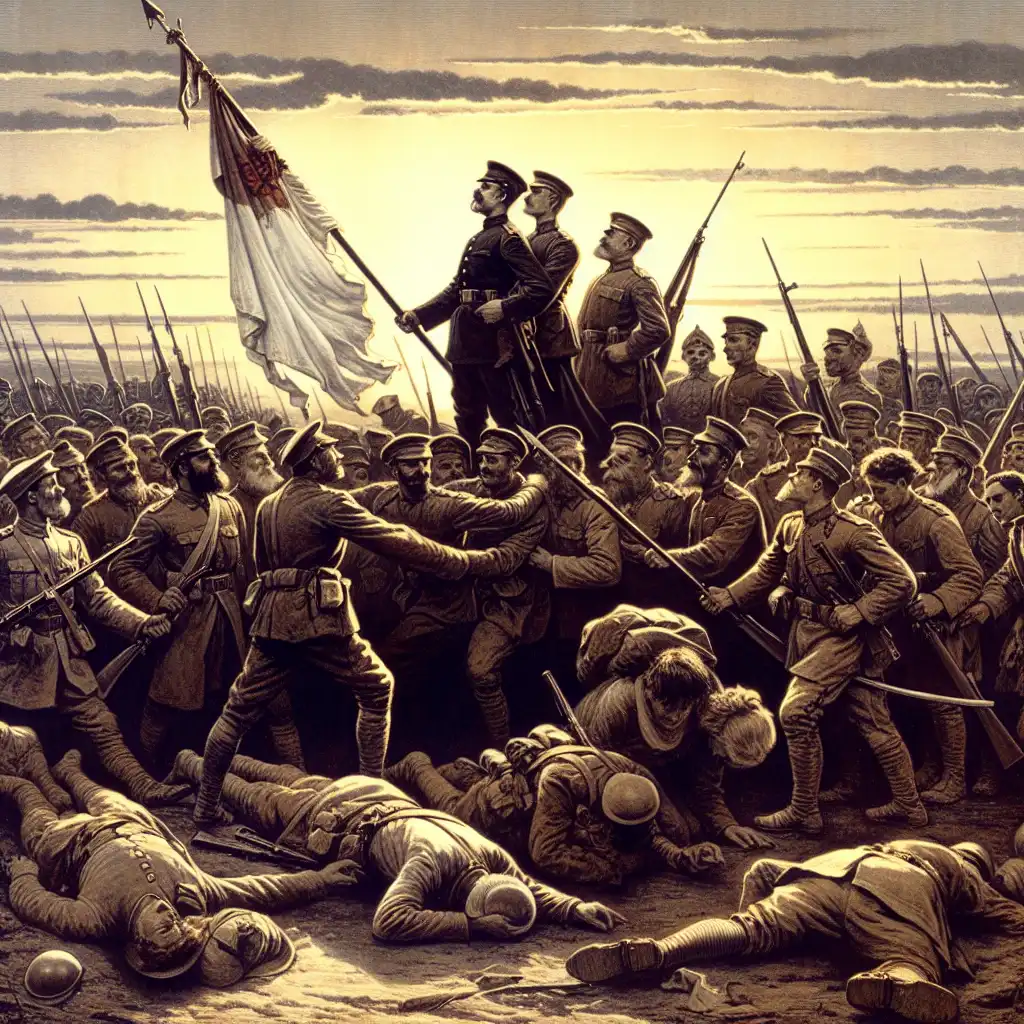
capitulate
verb capitulate
kəˈpɪtʃuleɪt
To stop fighting an enemy or opponent; to admit that they have won.
After heavy losses, the troops were forced to capitulate.
capitulate
kəˈpɪtʃuleɪt
Chargement…
kəˈpɪtʃuleɪt
To stop fighting an enemy or opponent; to admit that they have won.
After heavy losses, the troops were forced to capitulate.

kəˈpɪtʃuleɪt
To accept something reluctantly but without protest.
She finally capitulated and agreed to do the task.
Impossible de charger l’audio. Réessayez plus tard.
Capitulate means to surrender or give up. You might use this word in a military context when one side of a conflict gives up and agrees to the terms of the other. In other situations, it can mean giving in or relinquishing control. For example, a company might capitulate to the demands of a powerful union or a parent might capitulate to their child's requests for a new toy.
Both acquiesce and capitulate refer to submitting or surrendering something, but there is a subtle difference between them.
Acquiesce means to agree or comply with something reluctantly, without expressing approval or enthusiasm for it. For example, if your parents insist that you clean your room, you may acquiesce even though you don't want to.
In essence, acquiesce suggests a grudging acceptance of something, while capitulate implies a more complete and final surrender.
Ouvrir le mot: Acquiesce →Bow means to lower your head or body as a sign of respect or submission.
It is often used to show politeness or humility. For example, you might bow to your teacher to show respect or bow your head when you say a prayer as a sign of reverence.
Bow is a gesture of respect or humility, while capitulate is a decision to surrender or give up in a conflict.
Ouvrir le mot: Bow →Both words can mean to give up or surrender, but capitulate suggests more of an agreement or negotiation, while cave in implies a sudden collapse or defeat.
For example, a country might capitulate to the demands of another country after negotiations and compromises. A weakened building might cave in under the pressure of a strong storm.
In other words, capitulate is often used in contexts of surrendering power, authority or control, whereas cave in is used more in situations where there is a physical collapse or giving way.
Ouvrir le mot: Cave in →Concede means to acknowledge or admit defeat, typically in a less formal setting.
If a country surrenders to another country in a war, they are said to have capitulated. If a friend admits they were wrong in an argument, they have conceded.
Ouvrir le mot: Concede →Capitulate means to surrender or give up completely, often under certain conditions. It is applicable in situations where one party has no other option but to surrender to the other party's demands.
An example could be a country surrendering to another during a war.
Give in means to yield or concede, usually after a struggle or argument. It is applicable in situations where two parties are negotiating and one party is willing to give up some of their demands in order to reach an agreement.
An example could be a parent giving in to a child's request after a long argument.
Ouvrir le mot: Give in →Submit means to yield or comply with something, often in a more voluntary or cooperative way. This can refer to following rules, accepting feedback, or accommodating others' wishes.
For example, a student may submit an essay to their teacher for grading, or a group may submit to the authority of a leader.
Capitulate implies a defeat or concession, while submit implies a willingness to work with others or respect certain standards.
Ouvrir le mot: Submit →Both capitulate and succumb mean to give in or surrender.
Succumb is used when someone is overcome or overwhelmed by a situation or emotion, and is unable to resist or overcome it.
For example, a person may succumb to an illness or temptation, while a military force may capitulate to an opposing force.
Ouvrir le mot: Succumb →Capitulate means to give in or agree to something under certain conditions. It suggests that the surrender is more conditional or strategic, rather than a complete and total defeat.
Surrender means to give up completely and without conditions. It suggests a complete and total defeat.
Capitulate is more applicable in situations where there is negotiation or a compromise is sought, while surrender is applicable in situations where a complete defeat is accepted.
Ouvrir le mot: Surrender →Yield means to give in or submit to something without necessarily putting up a fight.
Capitulate implies a more dramatic and formal surrender after a long struggle, while yield implies a more passive giving in without necessarily putting up a fight.
Ouvrir le mot: Yield →Philip Howard: Four ways...
Voir sur YouTube ↗I'm very disappointed in Obama. I was very much in support of him in the beginning, but I cannot support war. I cannot support droning. I cannot support capitulating to the banks.
I allow myself to feel fear without always capitulating to it... You don't have to live your life by fear.
The fact that some things are mysterious or that they touch on mystery isn't in some way a capitulation, and one should realize that there are some things that we may never understand and, to that extent, should be humbled by that.
I will be conquered; I will not capitulate.
I have self-doubt. I have insecurity. I have fear of failure. I have nights when I show up at the arena and I'm like, 'My back hurts, my feet hurt, my knees hurt. I don't have it. I just want to chill.' We all have self-doubt. You don't deny it, but you also don't capitulate to it. You embrace it.
After May 1940, the good times were few and far between; first there was the war, then the capitulation, and then the arrival of the Germans, which is when the trouble started for the Jews.
A noble heart will always capitulate to reason.
Negotiations are a euphemism for capitulation if the shadow of power is not cast across the bargaining table.
If you want to capitulate to what commercial needs are, you can always be commercially valuable, but I'm not interested in being that.
I'm too much of a Libra. I too often see the other person's point of view and capitulate, even though I have strong political convictions. It's just my liability. Maybe I'm too empathetic. That's the actor in me.