juggernaut
noun juggernaut
ˈdʒʌɡərnɔːt
A large, powerful force or organization that cannot be stopped.
The company has grown into a juggernaut in the entertainment industry.
juggernaut
ˈdʒʌɡərnɔːt
Loading…
ˈdʒʌɡərnɔːt
A large, powerful force or organization that cannot be stopped.
The company has grown into a juggernaut in the entertainment industry.

ˈdʒʌɡərnɔːt
A large, heavy vehicle, especially a lorry or truck.
A juggernaut of a truck barreled down the road.
ˈdʒʌɡərnɔːt
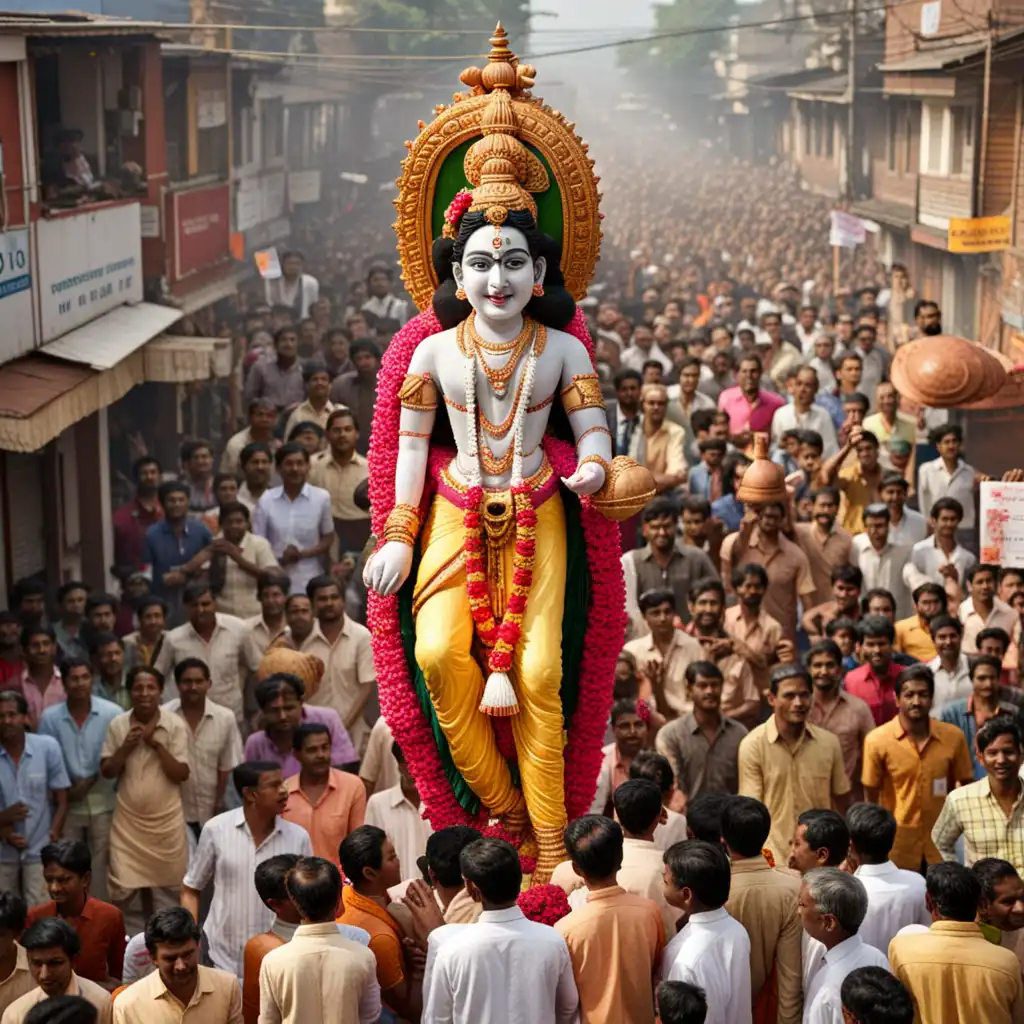
In Hinduism, a title of Krishna, under which he is worshipped in the form of a large wooden image at Puri in Odisha, India.
The procession of the Juggernaut in Puri is a major religious event.
Audio could not be loaded. Please try again later.
The word 'juggernaut' is used to describe a powerful force, often in a negative way. It is commonly used to describe a large and inflexible institution or organization that is difficult to stop, like a massive corporation, government or political party. It can also refer to a person, idea or trend that is so powerful or dominating that it seems impossible to resist or control. For example, "The tech company became a juggernaut in the industry, driving out competition and dominating the market."
Behemoth: This word refers to something that is extremely huge and powerful, often used to describe an animal or a thing.
It suggests immense size and strength. For example, a dinosaur or a giant elephant can be called behemoth.
Behemoth describes something that is immense in size and power, while juggernaut refers to something that has an unstoppable force or momentum.
Open word: Behemoth →Both colossus and juggernaut generally refer to something huge, powerful, and unstoppable.
However, colossus carries more of a connotation of sheer size and grandeur, while juggernaut suggests more of an overwhelming force or influence.
For example, you might describe a towering building or statue as a colossus, emphasizing its massive size and impressive appearance.
Colossus tends to describe physical objects or structures, while juggernaut conveys a sense of unstoppable momentum or power, even if the subject isn't necessarily tangible.
Open word: Colossus →Giant refers to something that is unusually large in size, while juggernaut refers to something that is massive and unstoppable, often used in reference to an organization or force.
Giant can describe anything big, such as a giant elephant or a giant cake.
Giant describes size, while juggernaut describes power and influence.
Open word: Giant →Leviathan refers to something that is extremely large and powerful, often used to describe a sea monster or a large sea creature.
Juggernaut describes an uncontrollable force or organization, while leviathan describes something that is large and imposing.
Open word: Leviathan →Juggernaut and mammoth are both used to describe things that are large and powerful, but they have different connotations and applications.
Mammoth usually refers to something that is large and impressive in size, without the connotation of unstoppable power.
Juggernaut implies unstoppable force or influence, while mammoth simply implies massive size.
Open word: Mammoth →Juggernaut and monster are both terms used to describe something that is large and powerful, but they differ in their connotations and applications.
A monster is generally used to describe something that is perceived as being evil or frightening, but not necessarily unstoppable.
Monsters can come in many forms, such as mythical creatures, villains in stories, or even large animals that are considered dangerous.
For example, the Loch Ness Monster is a famous example of a monster because it is a large, mysterious creature that is said to dwell in Scotland's Loch Ness.
In short, while both juggernaut and monster can describe something that is large and powerful, a juggernaut is associated with something that is seemingly unstoppable, while a monster is perceived as being frightening or evil.
Open word: Monster →Ogre refers to a monstrous creature often portrayed as a large, ugly, and terrifying humanoid.
Juggernaut refers to an unstoppable force or entity that can cause destruction, while ogre refers to a fictional monstrous creature with a savage nature.
Open word: Ogre →Both juggernaut and titan are words used to describe something or someone that is powerful and dominant.
Titan typically refers to an individual or entity that is simply incredibly powerful, often in a positive or awe-inspiring way.
For example, a skilled athlete might be described as a titan in their sport, or a towering mountain might be called a titan of the natural world.
A juggernaut is an unstoppable force or organization, whereas a titan is a powerful and awe-inspiring individual or entity.
Open word: Titan →Being Steve Jobs %\PIPE%...
Watch on YouTube ↗It's fairly easy to know when you've succeeded because you're kind of hanging on for dear life. It's such an unstoppable juggernaut; you're trying to stay with your head above water because things are moving so fast.
Uber's plan to get more...
Watch on YouTube ↗This fame is a juggernaut: It slaps you in the face, and you don't know what you're doing. You don't know who has your back, who is your support system.
I have a yearning someday to do one of these huge juggernauts.
I am an entertainment juggernaut.
It's a juggernaut, yeah... but I'm not phased by making movies.
Facebook is not an unstoppable juggernaut. There are a lot of other things people can do on the web.
When I started on 'Roseanne,' it was a great achievement for me at the time. But I wasn't a part of building it; I wasn't a carpenter in creating that juggernaut.
American Idol' became a juggernaut of epic proportions, but to me it was always like home.
I've seen a lot of athletic juggernauts throughout high school, college, even the NFL who can't play the game.
The one time I was an actor, it happened to be in a globally dominant juggernaut. That was lucky.