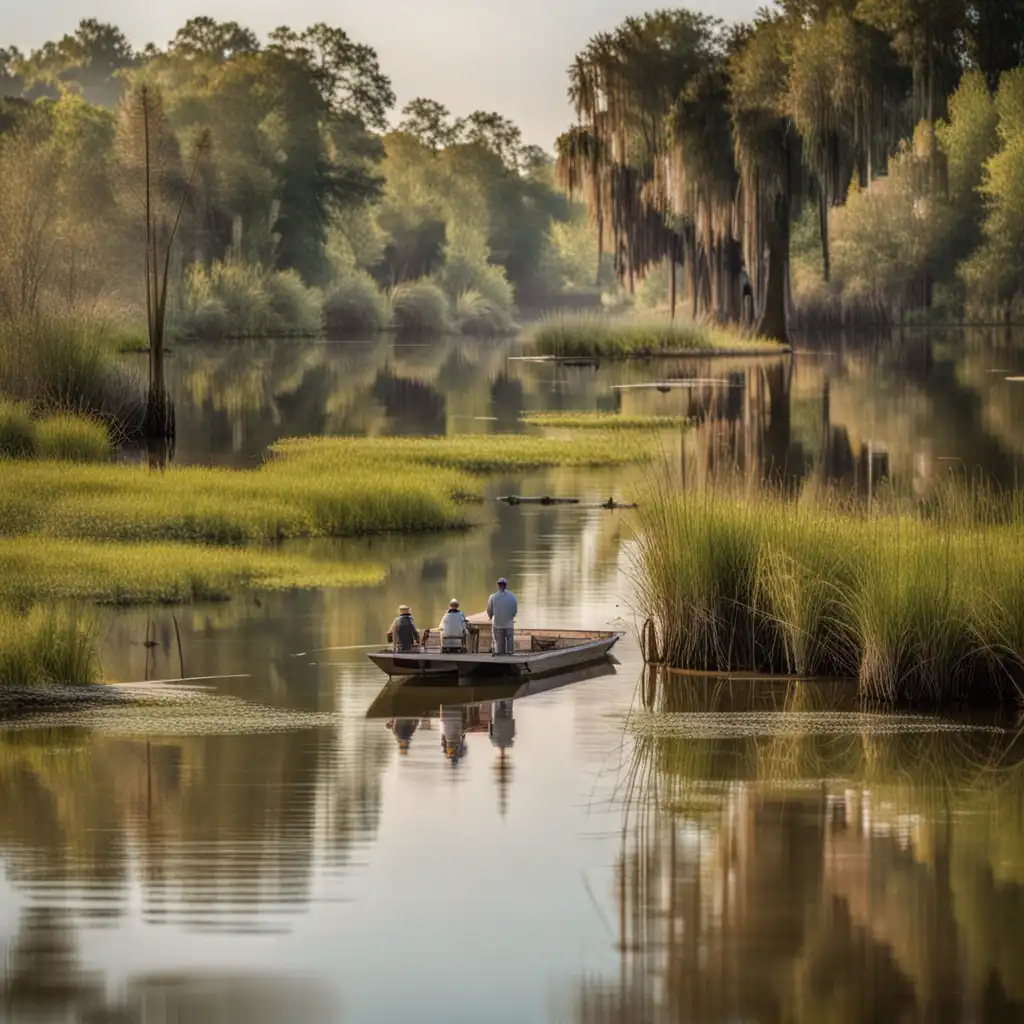
Bayou is a word used to describe a small, slow-moving river or stream that runs through marshy or swampy areas. They are common in the southern United States, especially in Louisiana. You might hear people use the word "bayou" when talking about Cajun or Creole culture, because these groups have long histories in the bayou areas. You might also hear the word used in music, like in the song "Proud Mary" by Creedence Clearwater Revival, which includes the lyric "rollin' on the river down to New Orleans on a bayou." Now, you know how and where the word "bayou" is used!
A bog is a wetland area that is composed primarily of decaying plant matter, typically mosses or grasses. Bogs are found all over the world and are often characterized by being acidic and having a low nutrient content.
A bayou is a type of waterway found in the southern United States, while a bog is a type of wetland area found all over the world.
A delta is a landform that forms at the mouth of a river where it flows into an ocean or a larger body of water. Deltas are formed by the accumulation of sediment carried by the river over time.
A bayou is a small, sluggish stream found in swamps or marshlands, while a delta is a landform created at the mouth of a river where it meets the ocean or larger body of water.
An estuary is a partially enclosed body of water where freshwater from rivers meets and mixes with saltwater from the ocean.
Estuaries are typically found where rivers flow into the ocean and can be home to a diverse array of fish and bird species.
Unlike bayous, estuaries are typically subject to tides and other oceanic influences.
A bayou is a slow-moving body of water found in flat areas near rivers and lakes, while an estuary is a partially enclosed body of water where freshwater from rivers mixes with saltwater from the ocean.
A bayou is a slow-moving stream or river found in the southeastern United States, typically with a swampy or marshy surrounding.
A marsh is a wetland area characterized by having shallow water and containing vegetation such as grasses and reeds.
It is typically found near the coast, where saltwater and freshwater meet. Marshes are important habitats for wildlife and can also provide natural flood control.
The main difference between the two is that a bayou is a type of river with a swampy or marshy surrounding, while a marsh is a distinct wetland area with its own specific vegetation and characteristics.
A swamp is an area of land that is saturated with water. Swamps are usually found in low-lying areas, and they are characterized by the presence of trees and other woody plants.
In summary, while both bayous and swamps are characterized by water and plant life, a bayou is typically a slow-moving stream or river that flows into a larger body of water, while a swamp is a saturated area of land that is often characterized by the presence of trees.
A bayou is a type of wetland that is characterized by slow-moving, meandering waterways or channels. Wetlands are areas of land where the soil is saturated with water for at least part of the year.
Wetlands, meanwhile, can take many different forms, from marshes and swamps to bogs and fens. They are found all around the world, and play important roles in regulating water flow, filtering pollutants, and storing carbon.
Overall, while bayous are a specific type of wetland, wetlands encompass a much broader range of ecosystems and habitats.
at one of the fastest rates on the planet. Disappearance is what my bayou community has in common with other coastal communities. Erasure is what communities around the globe are fighting as we get real about the impacts of climate change.
We can't afford to lose anymore land. CHIEF These bayou communities stick out like fingers. It used to be all land. But now they're just these little strips.
When you get into Louisiana, it really is like a different country in a lot of ways. The plants you see are a little different, like the weeping willows and the cypress trees that come up out of the bayou. And it's steamy hot.