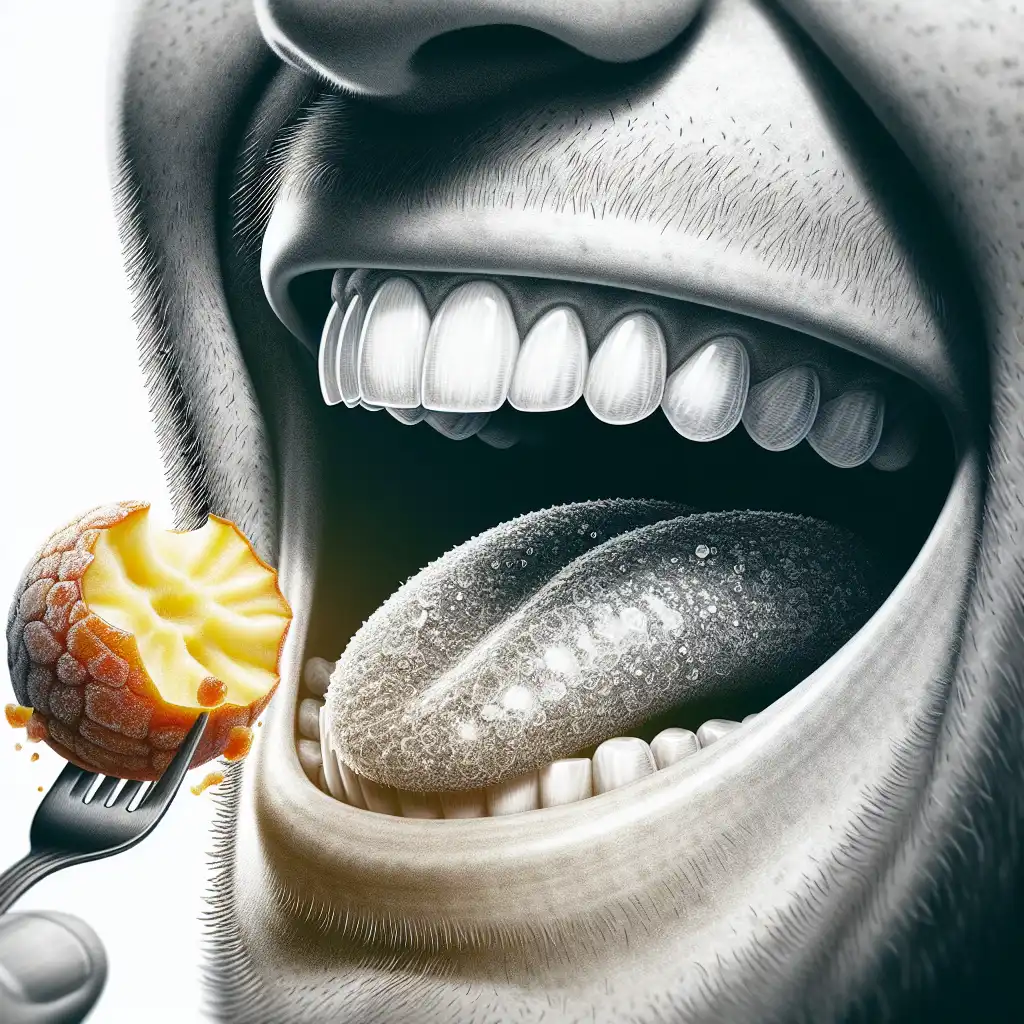
saliva
noun saliva
səˈlaɪvə
A clear liquid produced by the glands in your mouth
When you eat food, your saliva helps to break it down.
saliva
səˈlaɪvə
Chargement…
səˈlaɪvə
A clear liquid produced by the glands in your mouth
When you eat food, your saliva helps to break it down.
Impossible de charger l’audio. Réessayez plus tard.
Saliva is a liquid that is produced in your mouth to help you chew and swallow your food. It also helps to keep your mouth moist and clean. You can use the word "saliva" when talking about things like brushing your teeth, eating food, or visiting the dentist. For example, "I need to brush my teeth to get rid of any leftover saliva after eating breakfast."
Drool refers to the excess saliva that comes out of your mouth unintentionally, typically when you are sleeping or when your mouth is open.
Saliva is typically a healthy and necessary bodily fluid while drool can be seen as an involuntary action.
Ouvrir le mot: Drool →Expectorate refers to the act of coughing up phlegm or mucus from the respiratory tract, while saliva refers to the watery fluid produced in the mouth that helps with digestion.
In simpler terms, expectorate is associated with coughing up mucus or phlegm from the lungs, while saliva is the liquidly material that is often associated with the act of drooling or spitting.
Expectorate is applicable when someone has a respiratory illness, while saliva is produced constantly to aid in the chewing and swallowing of food.
Ouvrir le mot: Expectorate →Froth is a mass of small bubbles that forms on the surface of a liquid, such as soap bubbles or the foam on top of a cappuccino.
Saliva is the liquid that is produced in our mouths to help us eat and digest food, and it is not typically bubbly like froth.
Froth is applicable in situations where a liquid is agitated or whipped to create bubbles, such as in making a latte or the bubbles in a bubble bath.
Froth is bubbly foam that forms on the surface of a liquid, while saliva is a liquid produced by our body to help with digestion, and they are applicable in different contexts.
Ouvrir le mot: Froth →Gibber refers to speech or language that is unclear or nonsensical, often characterized by rapid, meaningless chatter.
Gibber refers to confusing speech, while saliva refers to a bodily fluid.
Ouvrir le mot: Gibber →Saliva and slobber are both fluids that come from our mouths, but they have different meanings and are used in different contexts.
Slobber is a thick and sticky fluid that comes from our mouths when we drool, or when we have an excessive flow of saliva.
Slobber is often associated with animals, such as dogs who slobber when they are excited or hungry.
So, in short, saliva is a natural fluid that helps us digest food while slobber is a thicker and less pleasant looking fluid that is associated with drooling or excessive salivation.
Ouvrir le mot: Slobber →Saliva and spit are both terms used to describe the watery liquid in our mouths that helps us to digest our food. The difference between the two is that saliva is the medical term used to describe the mixture of water, enzymes, and other chemicals that our mouths produce, while spit is the more informal term that people use in everyday conversation.
Saliva is a more formal term used in the medical field, while the word spit is a more common term that is used in everyday conversation.
For example, a doctor would use the term saliva when discussing the chemical makeup of the liquid in our mouths, while a friend might use the term spit when talking about someone who is drooling or spitting while talking.
Ouvrir le mot: Spit →Sputum is a thick secretion that comes from the lungs and is usually coughed up when a person has certain respiratory illnesses such as bronchitis or pneumonia.
So, while saliva is primarily used for digestion and maintaining oral health, sputum is a sign of respiratory illness and is used for diagnosis and treatment.
Ouvrir le mot: Sputum →saliva samples showed an increase in testosterone in those who had smelled a shirt worn by an ovulating woman. Such a testosterone boost may give a man the nudge to pursue a woman he might not have otherwise noticed. A woman's nose is particularly attuned
Voir sur YouTube ↗The first kiss I had was the most disgusting thing in my life. The girl injected about a pound of saliva into my mouth, and when I walked away I had to spit it all out.
And at the moment of death he shared its pain. He rubs its saliva into his own legs to relieve the agony of his burning muscles. And he gives thanks for the life he has taken,
Voir sur YouTube ↗Rumors of sneezing, kissing, tears, sweat, and saliva spreading AIDS caused people to panic.
to hide all the time saliva actually helps it a lot of people don't get to do stuff like this anymore everybody used to do this everybody used to work on hides that was just normal
Voir sur YouTube ↗Saliva has antibacterial properties. It also has things called nerve growth factor, skin growth factor, histatins which help with wound closure. So when you see an animal licking a wound or even a mom kissing a child's boo-boo, there's some, there's some good science behind why one might do this.
Exosomes are important biomarkers that provide an early-warning system for the development of cancer. And because they're abundantly present in just about every bodily fluid, including blood urine and saliva, they're extremely attractive for noninvasive liquid biopsies.
Voir sur YouTube ↗Death is caused by swallowing small amounts of saliva over a long period of time.
gut how does it end up at a saliva gland where it actually becomes infectious to give you a view of a parasite site how a parasite feels when it goes through an insect cut here is a very short clip this is the giant fly this is the proboscis this is the actual pump that
Voir sur YouTube ↗The perception of juiciness involves a complex jumble of things, including how quickly juices are squeezed out of meat fibers by our teeth, how much saliva we produce, and the ratio of liquid fat to water-based liquid.
including our own. There are actually thousands of species of mosquitos in the world, but they all share one insidious they suck blood, and they're really really good at sucking blood. Here's how they do it. After landing a mosquito will slather some saliva onto the victim's skin which works like an antiseptic,
Voir sur YouTube ↗I love fat people. Every fat person says it's not their fault, that they have gland trouble. You know which gland? The saliva gland.
If she is killed the entire colony will die out. She must be protected, so termites start to isolate her from the fighting by building a wall of mud mixed with saliva that will harden like concrete. There's not much time.
Voir sur YouTube ↗We're involved in a very large study that's federally funded and being done with Kaiser Permanente, and saliva is a very non-invasive way to get cells from the body.
but vampire bats can be a great help to humans. A chemical known as desmoteplase found in vampire bat saliva helps break down blood clots, and is being tested by recovering stroke victims.
Voir sur YouTube ↗All across Africa, the Pacific and the Americas, we find cultures that didn't know about mouth kissing until their first contact with European explorers. And the attraction was not always immediately apparent. Most considered the act of exchanging saliva revolting.
Fortunately while Ebola is highly virulent, several factors limit its contagiousness. Unlike viruses that proliferate through small airborne particles, Ebola only exists in bodily fluids, such as saliva, blood, mucus, vomit, or feces. In order to spread,
Voir sur YouTube ↗Edible substances evoke the secretion of thick, concentrated saliva. Why? The answer, obviously, is that this enables the mass of food to pass smoothly through the tube leading from the mouth into the stomach.
razor-sharp teeth and germ-laden saliva can inflict life-threatening wounds but water monitors rarely bite humans the reaction to these latter day
Voir sur YouTube ↗Saliva has testosterone and estrogen. When you kiss, you're having a chemical experience.