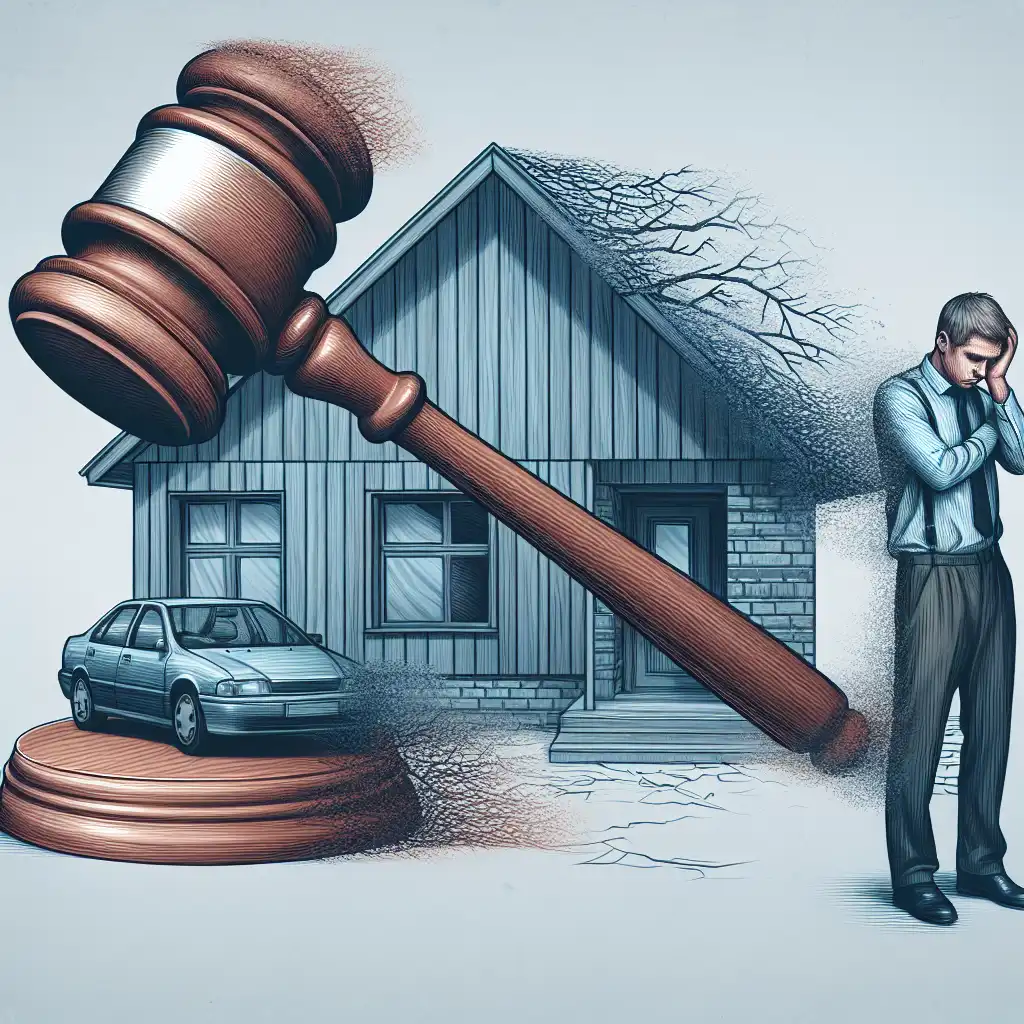
'Forfeiture' refers to the act of giving up something that you own or possess as a penalty or punishment for breaking a rule or law. It can also refer to the thing that is given up in this way. For example, if you are caught driving under the influence of alcohol, your car might be taken as a forfeiture, meaning you lose ownership of it. Another example could be a criminal who has their assets seized as a forfeiture for their crime. In essence, forfeiture means surrendering something valuable as a result of wrongdoing or legal action.
Confiscate and forfeiture both mean taking something away from someone, but there is a difference in their application.
Confiscate means taking something away as a punishment or penalty for breaking a law or rule. For example, if someone is caught smuggling drugs, the drugs can be confiscated by the authorities as a punishment.
Confiscate is taking something away as a punishment for breaking a law or rule, while forfeiture is taking something away that was obtained illegally or used in illegal activities.
Dispossession and forfeiture are two different terms that can be used in legal contexts.
Dispossession refers to the act of being forcibly removed from one's property or land. This can happen in situations where someone has not paid rent or mortgage payments, or in cases where the property has been illegally occupied.
Dispossession relates to the physical act of being evicted from property, while forfeiture refers to the legal consequences of breaking a law or agreement.
Forfeiture and loss both refer to a situation where something is no longer available.
However, the key difference between the two is that forfeiture typically involves something being intentionally given up or taken away as a punishment or penalty, while loss refers to something that is unintentionally or unexpectedly gone.
If someone misplaces their wallet and cannot find it, they have experienced a loss.
Forfeiture implies a sense of intentional sacrifice or consequences, while loss suggests a lack of control or unforeseen circumstances.
Penalty refers to a punishment for breaking a rule or law that is typically monetary in nature. This means that the person who has done something wrong may be required to pay a fine or fee as a penalty.
For example, if someone is caught speeding, they may be given a penalty in the form of a ticket and a fine.
Forfeiture is the loss of property or assets as a punishment, while a penalty is a monetary punishment. Both terms are used in the legal system to assign consequences for breaking rules or laws, but they are applied in different situations.
Renunciation refers to the act of giving up or formally denying a claim, right, or association. For example, a person can renounce their citizenship if they no longer wish to be a citizen of a particular country.
In simpler terms, forfeiture is when something is taken away as a punishment, while renunciation is when someone gives up something voluntarily.
Forfeiture refers to giving up something as a penalty or punishment for breaking a rule or law, while sacrifice is giving up something willingly for a greater purpose or cause.
If someone gives up their time or resources to help others or achieve a larger goal, that is a sacrifice.
Forfeiture is generally associated with negative consequences or punishment, while sacrifice is more often seen as a positive, selfless act.
Forfeiture and seizure are both legal terms used to describe actions taken by law enforcement or government authorities in relation to property or assets.
Seizure simply means the act of taking possession of something by legal authority.
Seizure can be temporary or permanent and is often used as a means to protect public safety or to enforce the law.
Forfeiture and seizure are both legal actions that involve the loss or taking of property or assets, but forfeiture is usually permanent and tied to a violation of the law, while seizure can be temporary and used for a variety of reasons.
Surrender means giving up control or power over something or someone voluntarily in order to avoid conflict or harm.
If a country surrendered during a war, they would give up control of their land and resources to the victors in order to avoid further fighting and bloodshed.
Forfeiture is usually a consequence of breaking rules, while surrender is a choice made in order to avoid further harm or conflict.
I have sacrificed not only my favorite scheme of life, but the softer affections of the heart, and my prospects of domestic happiness, and I am ready to sacrifice my life also, with cheerfulness, if that forfeiture could restore peace and good will among mankind.
This system of encouragement proves serviceable as a preventive of punishment, the attainment of the tickets being a reward, the forfeiture of them the reverse; and, as such, boys seem often more affected by their loss than by coercion.
My dad was a plumber. That's hard work. He never missed a day of work. I will never disrespect him by not showing up for an athletic competition that has a maximum duration of 25 minutes. There should be forfeiture if you have to pull out of a fight. If you don't show up, it should be a loss on your record.
They say that it were great reproof to the king to take again what he has given, so that they will not suffer him to have his own good, nor land, nor forfeiture, nor any other good but they ask it from him, or else they take bribes of others to get it for him.
I am a nonparticipant of social media. I'm not much attracted to anything that involves the willing forfeiture of privacy and the foregrounding of insignificance.
One of the most offensive actions by the IRS is its continued unlawful seizures of money and assets of innocent Americans, called civil asset forfeiture.
As it happens, Cumberland was on the verge of bankruptcy and had to give up football. But the villainous Heisman made it play a game that had been scheduled when Cumberland still had a team, or Heisman threatened to demand a $3,000 forfeiture fee that could well have put the school out of existence.