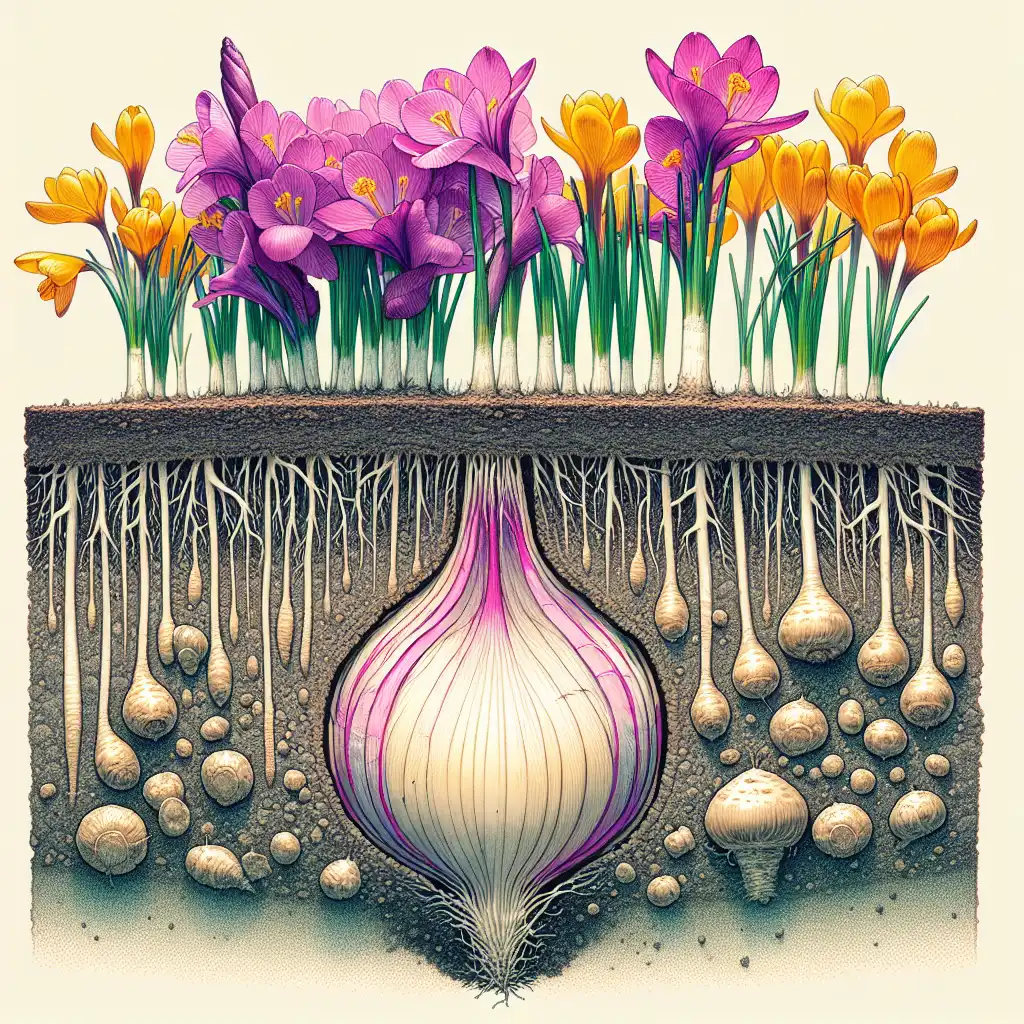
corm
noun corm
kɔːrm
A bulb-shaped stem base of some plants that stores food
Gladioli and crocuses grow from corms.
corm
kɔːrm
Loading…
kɔːrm
A bulb-shaped stem base of some plants that stores food
Gladioli and crocuses grow from corms.
Audio could not be loaded. Please try again later.
Corm is a word used to describe a part of a plant. It is a bulb-like structure that grows underground and is used by the plant to store nutrients. Corms are often found in plants such as crocuses, gladiolus, and taro. They can be used for planting to grow more plants or may also be used for food, such as with taro, which is a root vegetable widely used in many cultures.
Bulbs and corms are both underground storage structures that plants use to survive in adverse conditions.
A bulb is a swollen underground root structure that stores food and nutrients for the plant. It has layers of fleshy leaves called scales, which are attached to a basal plate.
Examples of bulbs are onion, garlic, daffodil, and tulip.
A corm is similar to a bulb in that it also stores nutrients, but it is a solid, swollen stem base rather than a layered structure.
Corms also have a basal plate, but they do not have scales like bulbs do. Examples of corms are crocus and gladiolus.
In summary, bulbs and corms are both storage structures used by plants.
A bulb is a swollen underground root structure with scales, while a corm is a swollen stem base without scales.
The choice of using bulbs or corms depends on the plant species and their needs.
Open word: Bulb →Both corms and rhizomes are types of plant structures that store nutrients and energy for the plant's growth and survival.
A rhizome is also an underground stem, but it grows horizontally instead of vertically. It has nodes where roots grow downwards and leaves and stems grow upwards.
Rhizomes store energy and nutrients like corms, but they also help the plant spread and clone itself. Examples of plants with rhizomes are ginger, bamboo, and lilies.
Rhizomes are applicable for plants that need to spread and propagate themselves by producing more stems and roots.
Open word: Rhizome →Both corms and tubers are types of plant structures that are used for storage. The main difference between them is the part of the plant from which they develop.
Tubers are enlarged portions of the plant's underground stems, known as rhizomes. They are often irregularly shaped and have a rough and bumpy exterior.
Tubers are used by plants like potatoes, sweet potatoes, and yams to store energy and nutrients to fuel new growth during the next growing season.
In summary, corms develop from the base of the plant stem and are used for storage in plants like crocus and gladiolus, while tubers develop from underground stems and are used for storage in plants like potatoes and sweet potatoes.
Open word: Tuber →