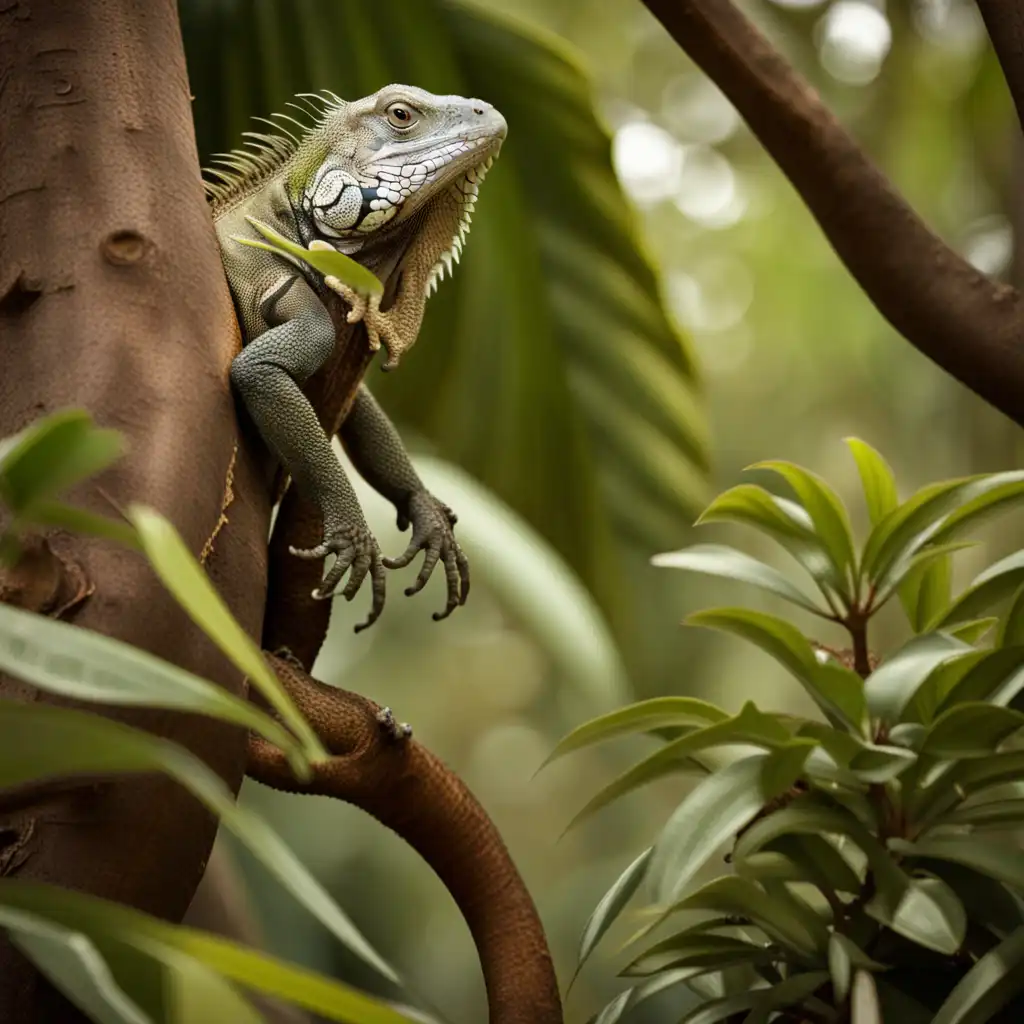
iguana
noun iguana
ɪˈɡwɑːnə
A large lizard that lives in Central and South America and the Caribbean
In my trip to Panama, I saw an iguana climbing a tree.
iguana
ɪˈɡwɑːnə
Loading…
ɪˈɡwɑːnə
A large lizard that lives in Central and South America and the Caribbean
In my trip to Panama, I saw an iguana climbing a tree.
Audio could not be loaded. Please try again later.
An iguana is a type of lizard that is found in warm climates like South and Central America. You might see an iguana at a zoo or in someone's backyard if they keep them as pets. The word iguana can be used in a sentence like "I saw a huge iguana sunbathing on a rock."
A chameleon is a small lizard that can change its colors to blend into its surroundings. It is commonly found in forests and rainforests.
Chameleons are popular as pets and are known for their unique color-changing ability.
Some iguanas can also change color, but not to the extent of a chameleon.
In summary, chameleons are small lizards that change color to blend into their surroundings and are found in forests and rainforests.
Open word: Chameleon →Gecko and iguana are two different types of lizards.
Geckos are typically smaller in size and have a distinctive appearance with sticky toes that allow them to climb walls and ceilings.
They are found in warm climates and are often kept as pets. Geckos are harmless to humans and mainly eat insects.
The main difference between geckos and iguanas lies in their size, appearance, habitat, and behavior. Geckos are smaller and have sticky toes for climbing, while iguanas are larger and are known for their ability to swim and climb trees.
Open word: Gecko →Iguana is a specific type of lizard that is larger in size and has a crest of spiky scales down its back. Lizard is a broader term that refers to a diverse group of reptiles with different physical characteristics such as size, shape, and color.
Iguanas are found in tropical areas throughout Central and South America, while lizards are found all over the world in different habitats.
Essentially, all iguanas are lizards, but not all lizards are iguanas.
Open word: Lizard →Iguana is a specific type of reptile that belongs to the family Iguanidae. They have a distinct appearance with long tails, sharp claws, and a crest of spines along their backs.
Reptile is a broader term that includes all cold-blooded animals that are covered in scales, including snakes, turtles, crocodiles, and lizards like iguanas.
An iguana is a type of reptile, but not all reptiles are iguanas. You would use the term iguana when specifically referring to that type of lizard, and reptile when talking about any type of cold-blooded animal that has scales.
Open word: Reptile →An iguana is a type of lizard that is mainly found in warm areas of the Americas, while a salamander is a type of amphibian that can be found all over the world.
On the other hand, salamanders have a soft, moist skin and are often found near water sources. They range in size from only a few centimeters to up to a meter long.
An iguana is a type of reptile, while a salamander is an amphibian. Iguanas are usually found in the Americas and live in trees, while salamanders can be found all over the world and are often found near water sources.
Open word: Salamander →Saurian is a more general term that refers to all reptiles related to lizards and snakes. This includes not only iguanas but also crocodiles, alligators, and a variety of other species.
Therefore, while iguanas are technically saurians, not all saurians are necessarily iguanas.
Iguana refers specifically to a type of lizard in the Iguanidae family, while saurian is a more general term that encompasses all reptiles related to lizards and snakes.
Open word: Saurian →Iguanas and skinks are both types of reptiles, but there are some differences between them.
Skinks are smaller and have smooth, shiny skin with no noticeable spines or crests. They have shorter tails and a pointed nose.
In terms of where each is applicable, iguanas are often kept as pets and can be seen in zoos, while skinks are less commonly kept as pets and are more likely to be seen in their natural habitats.
Open word: Skink →elsewhere he's a marine iguana the only lizard in the world that gets its food from the sea
Watch on YouTube ↗We were playing a fair, and a few people were handing me stuffed animals and flowers, but one person handed me a paper sack. So I took all the stuff back to the bus. I put the sack in my lap and opened it, and a live iguana jumped out of the sack and onto my shirt. I screamed like a little girl!
the centipede advances on the iguana the iguana retreats the iguana scoots the centipede crawls scoot crawl scoot crawl
Watch on YouTube ↗I grew up with a pet iguana named Willy. We had a very contentious relationship. It turns out that iguanas are not meant to live in suburban homes.
Now as a politician myself standing in front of you, or indeed meeting any stranger anywhere in the world, when I eventually reveal the nature of my profession, they look at me as though I'm somewhere between a snake a monkey and an iguana,
Watch on YouTube ↗I have a lot of mice, I have a kitten named 'Girr,' I have an iguana named 'Invader Zim,' I have some fish, a whole buncha water snails, and a tarantula named 'Sweet Pea.
standing in front of you are indeed meeting any stranger anywhere in the world when I eventually revealed the nature of my profession they look at me as though I'm somewhere between a snake a monkey and an iguana and through all
Watch on YouTube ↗My favorite animal on the Galapagos is the Galapagos Marine Iguana. The first rule of iguana-dom is that iguanas hate the water, yet somehow, these poor iguanas landed there and had to figure it out.
centipede is slower persistent hungry and strategic the centipede advances on the iguana iguana retreats the iguana scoots the centipede crawls scoot crawl scoot crawl
Watch on YouTube ↗fast twitchy highly mobile and impulsive the centipede is slower persistent hungry and strategic the centipede advances on the iguana the iguana retreats the
Watch on YouTube ↗its old skin just isn't good enough it's after a baby green iguana the iguana is fast twitchy highly mobile and impulsive the centipede is slower persistent hungry and strategic the centipede advances on
Watch on YouTube ↗iguana on their on their shoulder for an instagram picture if you can educate that person and stop that from happening then you've done your bit spreading awareness to stop wildlife trafficking might sound like wishful thinking but it actually works remember that thousand pounds of manta
Watch on YouTube ↗very often um and uh yeah i mean this is like a huge huge iguana that uh was was living in one of the trees that i set up cameras in and it's funny because the cameras are they're um they have an infrared motion sensor so usually it's something that is warm that
Watch on YouTube ↗this is so good to see you how are you did you get any good pictures I said yeah well I said can you show me so I was sitting down with the computer showing him this this land iguana with this galapagos mockingbird talking about
Watch on YouTube ↗