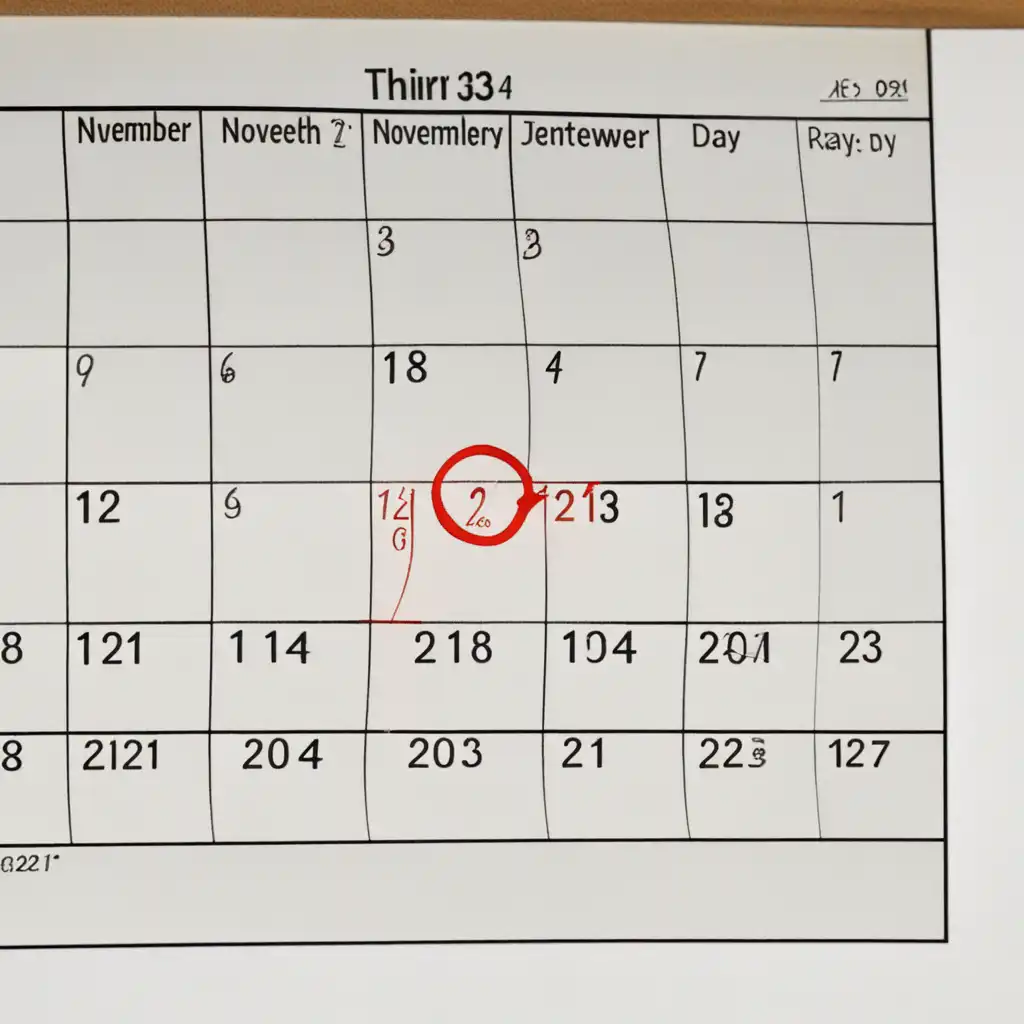
thirteenth
adjective thirteenth
ˌθɜːrˈtiːnθ
The ordinal form of the number thirteen, coming after the twelfth and before the fourteenth.
Today is the thirteenth of November.
thirteenth
ˌθɜːrˈtiːnθ
Loading…
ˌθɜːrˈtiːnθ
The ordinal form of the number thirteen, coming after the twelfth and before the fourteenth.
Today is the thirteenth of November.

ˌθɜːrˈtiːnθ
A person or thing in the position or rank of number thirteen in a sequence.
He finished the race in thirteenth place.

ˌθɜːrˈtiːnθ
In music, the thirteenth is the note thirteen steps away from the root note in a musical scale.
He played a chord that included the thirteenth.
Audio could not be loaded. Please try again later.
'Thirteenth' is used to describe something that comes after the number twelve. For example, if there are 12 people in a group and another person joins, then there are 13 people in the group. So, the new person is the thirteenth person in the group. You can also use 'thirteenth' to describe the 13th day of the month or the 13th floor of a building. It is important to remember that 'thirteenth' only applies to the number 13 and not to any other number.
Division refers to a process of splitting or separating something into smaller parts or sections. This can be used in various contexts, such as dividing a pizza into slices or dividing a country into states.
Division describes a process of splitting or separating, while thirteenth describes a numerical value in a sequence.
Open word: Division →Fraction is a mathematical term that describes a part of a whole number or a ratio between two numbers, represented as a numerical value with a numerator and a denominator.
In summary, while fraction refers to a numerical value that represents a part or ratio of a whole number, thirteenth denotes a specific position in a sequence of numbers or objects.
Open word: Fraction →Fractional refers to a part of a whole number or amount, such as one-half or three-fourths.
Fractional is a broader term that refers to any part of a whole, while thirteenth specifically refers to dividing something into 13 equal parts.
Open word: Fractional →A portion refers to a part or share of something, like a serving of food or a fraction of a whole amount.
It can be used in everyday language to describe a piece of a larger whole, like a portion of a pie or a portion of a paycheck.
Portion refers to any part or share of something, while thirteenth specifically refers to a fraction representing one out of thirteen equal parts.
Open word: Portion →Rank refers to a position or level in a hierarchy or classification system.
It is used to indicate the order of importance, popularity, or achievement. For example, one can say that a student ranked first in their class, or a sports team is ranked third in the league.
Rank is used to indicate a position or level in a hierarchy, while thirteenth is used to indicate the position of something in a series or sequence.
Open word: Rank →A sequence refers to a particular order or arrangement of things, events, or numbers. For example, the sequence of the alphabet is A, B, C, D, and so on.
Thirteenth refers specifically to the number 13 in a series or sequence of numbers. For example, if you were counting from 1 to 20, the thirteenth number would be 13.
A sequence is a general term used for any order or arrangement, while thirteenth is a specific term used for the 13th position in a numbered sequence.
Open word: Sequence →Subset refers to a part of a larger set or group. For example, the set of all fruits may have a subset of only red fruits.
Subset describes a part of a group and thirteenth describes a position in a sequence.
Open word: Subset →eventually expanded into thirteen being an unlucky number in general. Now this fear of the number thirteen called triskaidekaphobia, is so common that many buildings around the world skip the thirteenth floor,
Watch on YouTube ↗You know, sometimes if you work - if you do a lot of takes and you work long hours, for me, at least, there is a delirium that starts kicking in on the fifteenth hour, and that can help. Below the just thirteenth hour is where I have a concern, because everybody's so tired.
and find the diminutive characters I promised we'd try and introduce to you in the meantime let us go across to the dried Sydney macaw see and find out what his plans are for this the thirteenth episode of Safari lives a very very good afternoon and welcome to the beginning
Watch on YouTube ↗I was in my thirteenth year when I heard a voice from God to help me govern my conduct. And the first time I was very much afraid.
But this characteristic rhythm pattern comes from Africa. In the ninth century you could find it in the brothels of Persia, and in the thirteenth,
Watch on YouTube ↗In the Constitution of the United States, Negroes are referred to as fellows although the word 'slave' is carefully avoided before the thirteenth amendment.
It was not till toward the end of the thirteenth century that the prose romances began to appear.
Years ago, when I was in Siena for the first time, I saw the works of Duccio, whose deeply emotional painting from the thirteenth century has never left me.
I am presently in my thirteenth year of teaching a graduate course at the University of Southern California.
Between their rise in the thirteenth century and their sudden fall in the seventeenth, when the line abruptly ended, the Medicis produced three popes, two queens, and many Florentine rulers, and they supported the work of Galileo, Michelangelo, Leonardo, and Botticelli - a veritable parade of geniuses.
It takes only one drink to get me drunk. The trouble is, I can't remember if it's the thirteenth or the fourteenth.
The rise of the dramas in the thirteenth century, and the rise of the great novels in a later period, together with their frank glorification of love and the joys of life, may be called the Third Renaissance.
An attempt by the Mongols to introduce paper money in Persia in the twelfth and thirteenth centuries flopped because no one would accept it. The public had no confidence in the paper money despite the awesomely coercive decrees that always marked Mongol rule.