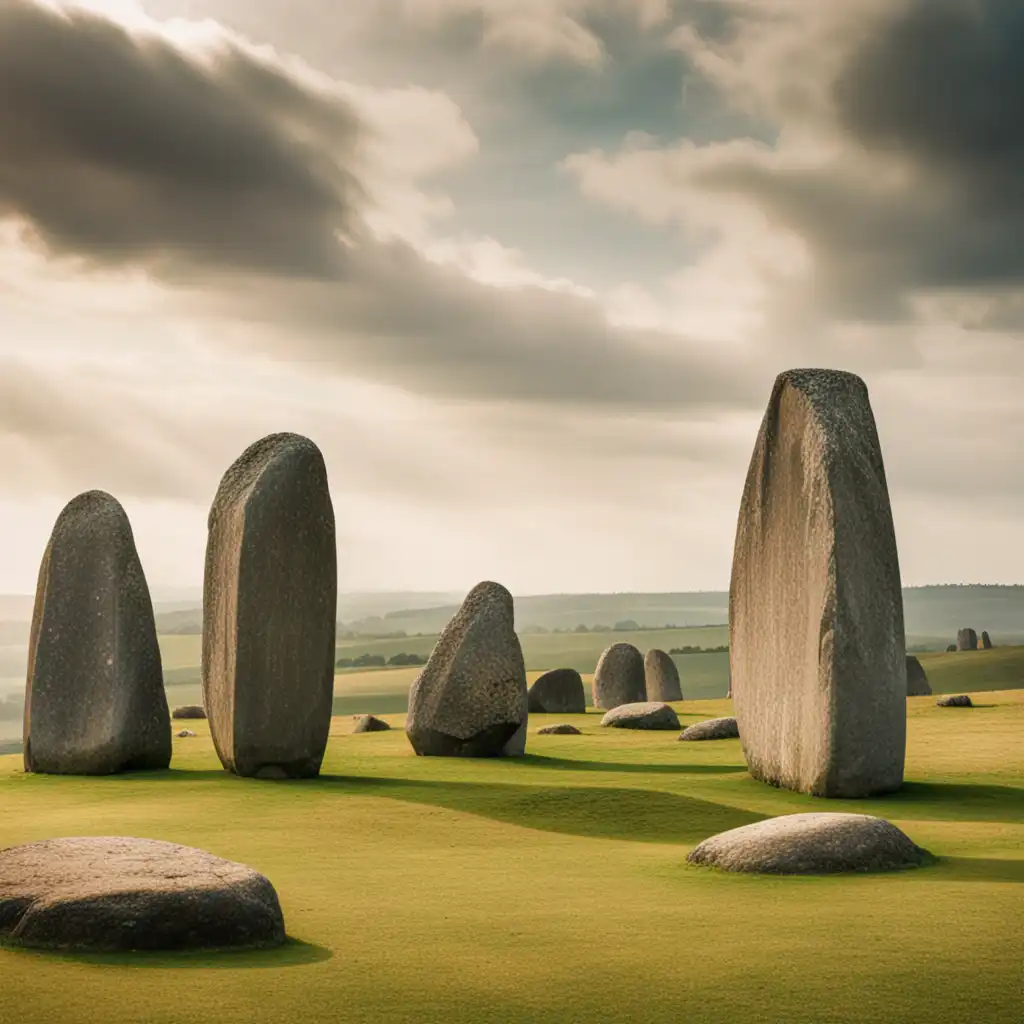
cromlech
noun cromlech
ˈkrɑːmlek
A prehistoric monument made up of large stones arranged in a circle or flat on the ground.
We visited the cromlech in the local countryside, a fascinating piece of ancient history.
cromlech
ˈkrɑːmlek
Đang tải…
ˈkrɑːmlek
A prehistoric monument made up of large stones arranged in a circle or flat on the ground.
We visited the cromlech in the local countryside, a fascinating piece of ancient history.
Không tải được âm thanh. Vui lòng thử lại sau.
A cromlech is a megalithic structure made up of large stones that are arranged in a circular or horseshoe shape. It is typically found in prehistoric or ancient sites, such as Stonehenge in England. The word cromlech is usually used to describe these types of structures. So, for example, if someone is talking about Stonehenge or another ancient site with these large stone structures, they may use the word cromlech to describe them.
A barrow is a type of burial mound or tumulus made of earth and stones, often with a tomb or burial chamber inside. Barrows were typically constructed during the Bronze Age and Iron Age in Europe and can be found throughout the continent.
A barrow is an earth and stone burial mound while a cromlech is a stone monument. Barrows are typically found throughout Europe while cromlechs are more specific to the British Isles.
Mở từ: Barrow →A cairn is a mound of stones that is often used to mark a trail or summit of a mountain.
It can be used to guide hikers or to commemorate someone or something. Cairns are typically found in mountainous or rocky areas.
In summary, while both cairns and cromlechs involve rocks and stones, a cairn is a marker while a cromlech is a megalithic monument for burial or ceremony.
Cairns are found in mountainous areas while cromlechs are found in ancient burial or ceremonial sites.
Mở từ: Cairn →Both cromlech and dolmen refer to types of ancient megalithic structures, but they have some differences.
A dolmen is a type of tomb or burial structure made up of large upright stones (the "orthostats") supporting a capstone.
So, in short: cromlechs are circular arrangements of standing stones, while dolmens are tomb-like structures made up of upright stones and capstones.
Mở từ: Dolmen →A cromlech and megalith are both types of prehistoric stone structures, but they have different meanings.
A megalith is a large, single standing stone, often used for marking territory or as part of a larger structure such as a cromlech or stone circle.
Megaliths can also be found standing alone or in rows. A cromlech is a type of stone circle with a capstone, while a megalith is a single standing stone that can be found in many different contexts.
Mở từ: Megalith →Both cromlech and menhir are terms used to describe prehistoric standing stones found in various parts of the world.
A menhir is a tall upright stone that stands alone. They were also used for ritual and ceremonial purposes, and can often be found in fields or other open spaces.
The primary difference between cromlechs and menhirs is that cromlechs consist of multiple stones, while menhirs are single standing stones.
Both were used for similar purposes, but cromlechs were primarily used as burial sites or for religious ceremonies, while menhirs were often used as landmarks or boundary markers.
Mở từ: Menhir →A tumulus is a mound of earth and stones that covers a burial site. Tumuli were often created by ancient people as a way of burying their most important leaders and nobles.
The main difference between the two is that a cromlech is a type of standing stone structure, while a tumulus is a type of burial site.
Mở từ: Tumulus →