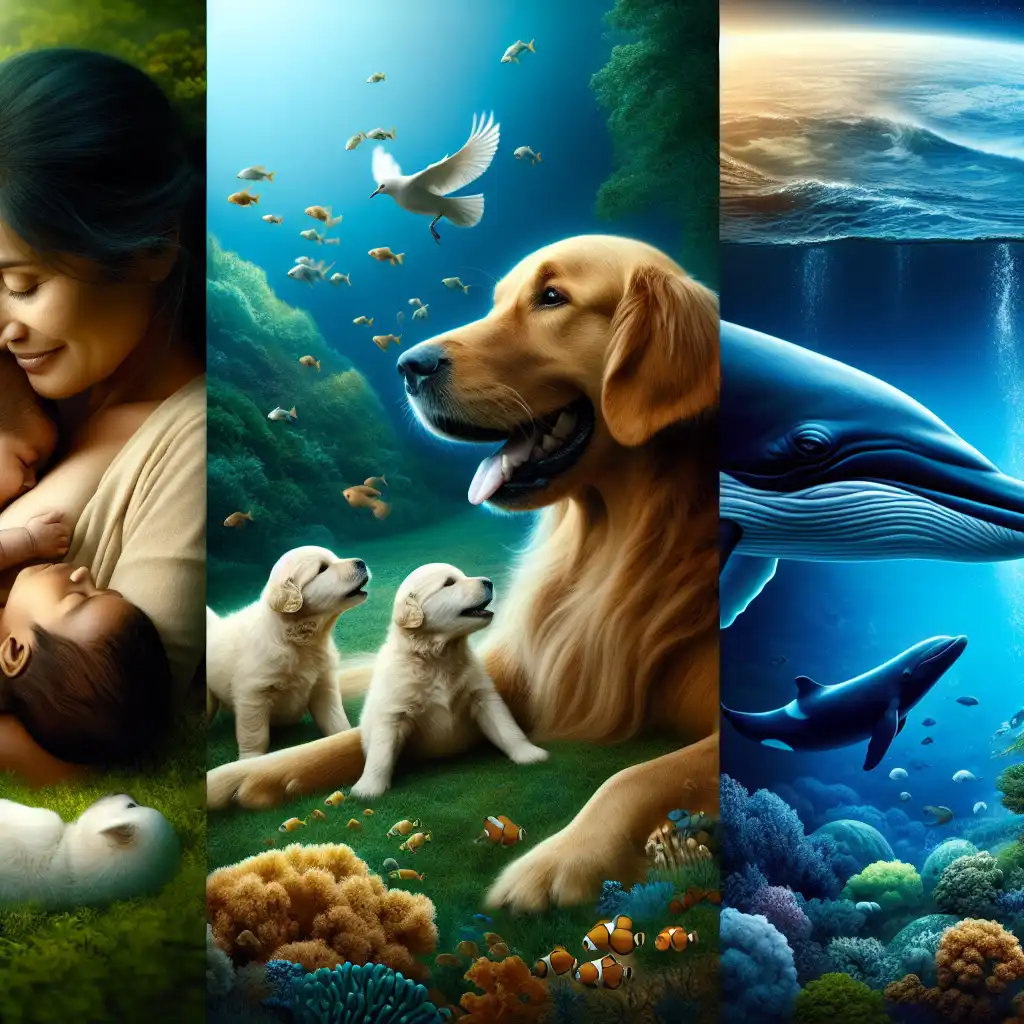
mammal
noun mammal
ˈmæml
An animal that gives birth to live young, not eggs, and feeds them with milk.
Humans, dogs, and whales are examples of mammals.
mammal
ˈmæml
불러오는 중…
ˈmæml
An animal that gives birth to live young, not eggs, and feeds them with milk.
Humans, dogs, and whales are examples of mammals.
오디오를 불러오지 못했어요. 잠시 후 다시 시도해 주세요.
A mammal is an animal that usually has fur or hair on its body and gives birth to live babies (instead of laying eggs). Mammals also produce milk to feed their babies. Examples of mammals include dogs, cats, horses, humans, and whales. You can use the word 'mammal' when talking about different types of animals that fit this definition.
Animal refers to any living organism that is not a plant or a human being. It includes a wide range of creatures such as insects, birds, fish, reptiles, and mammals.
The word mammal refers specifically to a group of animals that have certain characteristics in common, such as having hair or fur, producing milk for their young, and being warm-blooded.
So, basically, all mammals are animals, but not all animals are mammals. The term animal is more broad and general, while mammal is more specific and refers to a subset of animals with certain distinguishing features.
단어 열기: Animal →Beast is a term used to describe any animal that is wild, dangerous, or harmful to humans like lions or bears.
So, while all beasts are animals, not all animals are beasts. Mammal is a more specific classification of animals based on specific biological characteristics.
단어 열기: Beast →Brute typically refers to an animal that is seen as fierce, savage, or cruel.
Brute is a term used to describe wild, aggressive animals, while mammal is a scientific classification that refers to a diverse group of animals that share certain traits.
단어 열기: Brute →A creature is a general term used to refer to any living thing or organism, both living and non-living, that has life or spirit.
It can include animals, plants, bacteria, and even mythical creatures like dragons.
A mammal is a specific type of creature, that is characterized by having fur or hair, giving birth to live young, and feeding them with milk from mammary glands.
The term creature can refer to any living thing or organism, while mammal specifically refers to a certain class of animals with distinctive features.
단어 열기: Creature →Fauna refers to all the animal species, both vertebrates and invertebrates, found in a particular region or time period.
In simpler terms, fauna is a broader term that includes all animals in a given area, while mammal is a specific type of animal with certain characteristics.
For example, the fauna of a forest might include mammals like bears, deer, and raccoons, as well as birds, insects, and reptiles.
But within that fauna, mammals are a specific group of animals with fur or hair, which nurse their young, and have a specific type of heart.
단어 열기: Fauna →Livestock refers to animals that are kept by humans for the purpose of producing food, fiber or labor. Examples include cows, pigs, chickens, and sheep.
Mammals are a group of animals characterized by the presence of mammary glands and hair or fur. This includes many animals that are not livestock, such as whales, dolphins, elephants, and monkeys.
Livestock refers to specific animals that are raised for human use, while mammals is a broader category that includes any animal with mammary glands and hair or fur.
단어 열기: Livestock →Quadruped refers to any animal that has four legs or four feet for mobility.
While all mammals are quadrupeds, not all quadrupeds are mammals. For example, dogs and cats are both mammals and quadrupeds, while lizards and frogs are quadrupeds but are not mammals.
Therefore, we use the term mammal when referring to specific characteristics of certain animals, while we use quadruped when referring to the number of legs/feet an animal has.
단어 열기: Quadruped →Mammals and vertebrates are two different classifications of animals.
Mammals are a group of vertebrates that have certain characteristics in common. All mammals have fur or hair, they produce milk to nurse their young, and they are warm-blooded.
Vertebrates are animals with backbones. This includes not only mammals, but also fish, birds, reptiles, and amphibians.
Vertebrates have many different characteristics depending on the group, but aside from having a backbone, they also tend to have a head, a tail, and four limbs (or wings in the case of birds).
In summary, all mammals are vertebrates, but not all vertebrates are mammals. Mammals have specific characteristics such as hair/fur and milk production, while vertebrates simply have a backbone.
단어 열기: Vertebrate →and are evolutionarily linked to the rest of the class. Whether placental, marsupial, or monotreme, each of these creatures and its unique birthing methods however bizarre, have succeeded for many millennia in bringing new life and diversity into the mammal kingdom.
YouTube에서 보기 ↗Humans, the supremely social mammals, are ethical and intellectual sponges. We unconsciously absorb, for good or ill, the influences that surround us.
When baby mammals are hand-reared, you have to do everything that mum does, and that includes encouraging them to wee and poop. In the wild they can't do this on their own, so mum helps by licking their behind.
YouTube에서 보기 ↗To me it seems that the warm blooded dinosaurs replaced advanced mammal ancestors that were warm blooded, also.
So it's not at all unusual for example to hear people to say humans are the only animals that laugh. Nietzsche thought that humans are the only animals that laugh. In fact you find laughter throughout the mammals. It's been well-described and well-observed in primates, but you also see it in rats, and wherever you find it --
YouTube에서 보기 ↗Play begins as a major feature of mammalian evolution and remains as a major method of becoming reconciled with our present universe.
the world's most trafficked mammal is one you may have never even heard of the pangolin
YouTube에서 보기 ↗The old age of lower mammals presents characters similar to those found in man.
ocean the killer whale is the most broadly distributed mammal in the world apart from us near shore off shore polar or tropical they occupy a singular position in the food web without concern of predation themselves fish seals penguins sharks great whales heck They ve been known to eat moose killer whales
YouTube에서 보기 ↗Hunger and sex still dominate the primitive mammalian side of human existence, but at the present time it looks as if humanity were within sight of their satisfaction. Permanent plenty, no longer a Utopian dream, awaits the arrival of permanent peace.
to help their young survive the harsh freezing climate. So how is milk made? In the uniquely mammalian process of lactation, a special class of milk-secreting cells known as mammocytes line up in a single layer around pear-shaped alveoli.
YouTube에서 보기 ↗I am really a sea creature. Just a mammal that lost its fins.
Out of these three only one prefers the blood of mammals, and even these bats mostly feed on cattle. Maybe that still doesn't seem so great, but vampire bats can be a great help to humans.
YouTube에서 보기 ↗Orcas are my spirit animal. That's my favorite mammal.
and fierce storms made life unpredictable. Dinosaurs flourished on land, pterosaurs roamed the skies, and giant marine reptiles and sharks swam in warm seas. Small mammals our ancestors lived quite literally in the shadow
YouTube에서 보기 ↗On fight night I feel alive and full of tingles. You feel your blood flow hot but that's how we like it. We're mammals, we're warm-blooded creatures.
Animals are clearly important to us, so it's equally important that we avoid causing them unnecessary pain. For animals that are similar to us like mammals, it's often obvious when they're hurting. But there's a lot that isn't obvious, like whether pain relievers that work on us also help them.
YouTube에서 보기 ↗Insects are living metaphors for me. They are so alien and so remote and so perfect, but also they are emotionless; they don't have any human or mammalian instincts. They'll eat their young at the drop of a hat; they can eat your house! There's no empathy - none.
and are far more common in infants that adults. Their explanation for this involves the uniquely mammalian activity of nursing. The ancient hiccup reflex may have been adapted by mammals to help remove air from the stomach as a sort of glorified burp.
YouTube에서 보기 ↗Mammals are very close to us, but bugs are strange. They're more mysterious and exotic.