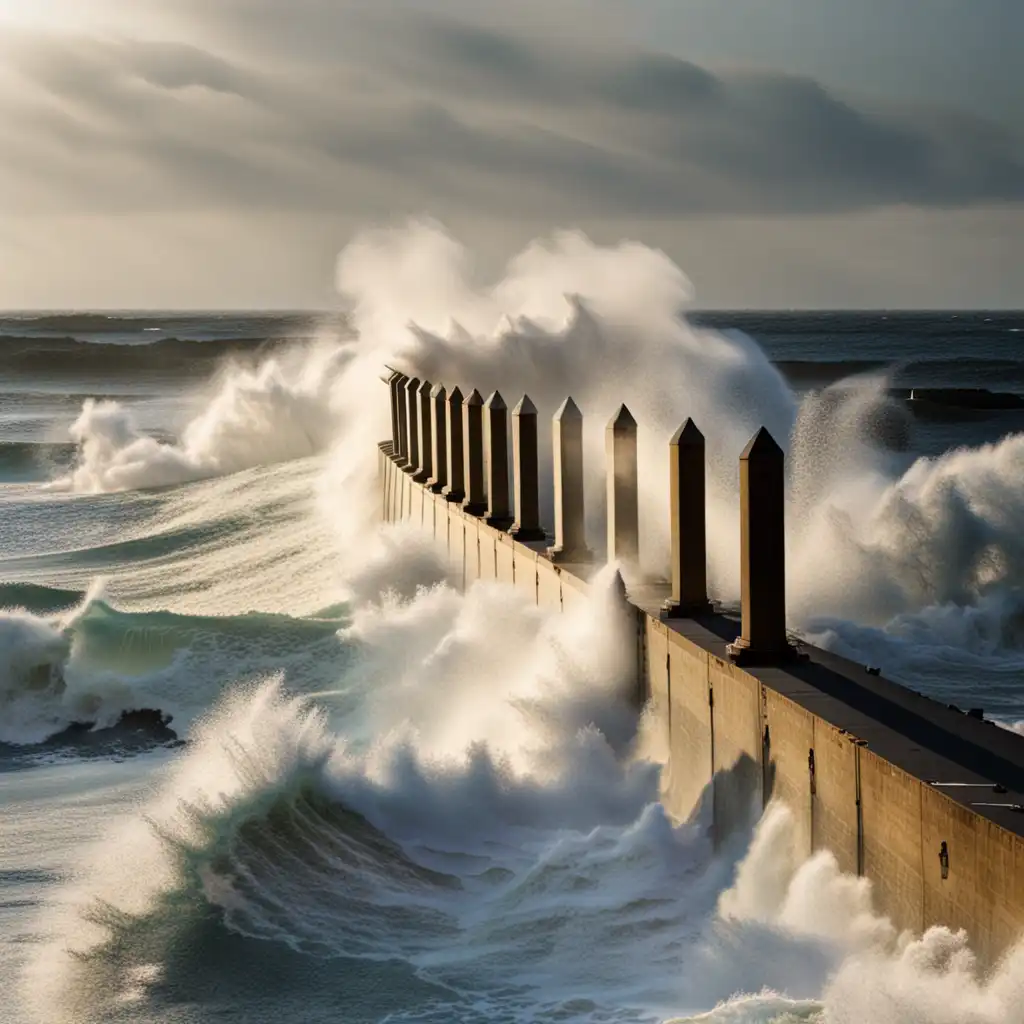
breakwater
noun breakwater
ˈbreɪkwɔːtər
A barrier that is built into the sea to protect a coast or harbor from the force of waves.
They built a breakwater to protect the harbors during storms.
breakwater
ˈbreɪkwɔːtər
Loading…
ˈbreɪkwɔːtər
A barrier that is built into the sea to protect a coast or harbor from the force of waves.
They built a breakwater to protect the harbors during storms.
Audio could not be loaded. Please try again later.
A breakwater is a barrier or structure that is built in the water at the edge of a shoreline or harbor to protect the area from waves and strong currents. It helps to calm the water and prevent erosion of the shore. Breakwaters are typically made of concrete or large rocks and can be found in areas where boats enter or leave a harbor, or where waves are strong enough to cause damage. They are common in coastal areas and can be seen along beaches or near ports.
A causeway is a raised road or pathway that connects two bodies of land or extends over a body of water. It's usually a long strip of land, built on an embankment, bridge or some other structure to allow transportation between two places.
A causeway often connects an island to the mainland or links two places separated by a water body.
A breakwater serves as a protective barrier from the waves, while a causeway connects two land areas or islands over a body of water.
Open word: Causeway →Breakwater and dyke both refer to structures built to protect against water but they are different in their form and location.
A dyke is a structure built on land to hold back water.
The primary difference between breakwater and dyke is their location and form.
A breakwater is located in a body of water and protects a coastline or a harbor from waves and storm surges while a dyke is located on land and holds back water to prevent flooding.
Open word: Dyke →An embankment is a raised structure built on land to prevent floods or the erosion of the surrounding area. They are typically made of soil or concrete and are usually placed between a body of water and the land it borders.
Embankments are commonly used near rivers, lakes or other bodies of water to prevent flooding or to create a barrier between the water and the surrounding areas.
A breakwater is a structure built offshore to protect a harbor or beach from waves and currents, while an embankment is a raised structure built on land to prevent floods or erosion.
Open word: Embankment →A groin is a structure that extends from the shore out into the water.
It is typically made of rocks or concrete and runs parallel to the shore. Groins are used to reduce beach erosion by trapping sand and sediment along the shore.
A breakwater is a structure that is built perpendicular to the shoreline to protect boats and vessels from waves and currents, and a groin is a structure that extends parallel to the shoreline to reduce beach erosion by trapping sand and sediment.
Open word: Groin →Both breakwater and groyne are structures built in coastal areas to protect the shore from erosion caused by waves and currents.
A groyne is a smaller structure built perpendicular to the coast, extending into the sea and designed to trap sand and prevent it from being carried away by longshore drift.
Groynes are made of wood, rock, or concrete and can be found on beaches. They help prevent beach erosion by creating areas of deposition and building up beaches.
A breakwater is a large structure designed to protect a harbor or marina by breaking the force of waves before they hit the shore, while a groyne is a smaller structure designed to trap sand and prevent erosion on beaches.
Open word: Groyne →A jetty is a long, narrow structure that extends into the water from the shore.
Jetties are often built at either end of a harbor entrance and serve to stabilize the entrance channel and protect against coastal erosion.
In summary, breakwaters are typically built offshore and act as a barrier to waves and currents to protect the shoreline, while jetties are usually built on the shore and serve to stabilize the entrance to a harbor and protect against coastal erosion.
Open word: Jetty →A pier is a raised structure that extends from the land out over the water.
Piers can be made of wood, concrete, or other materials and are typically built in areas with calm waters.
A breakwater is used to protect ships from waves and currents, while a pier is used as a platform for boats to dock or for recreational activities.
Open word: Pier →A quay is a platform or a structure that is built alongside a waterway, such as a river or a canal. It serves as a landing place for boats and ships to load and unload cargo, passengers, and materials.
Quays are usually made of concrete or stone, and they can be found in ports, harbors, and docks.
A breakwater protects the shore from waves, while a quay provides a landing place for boats and ships to load and unload cargo.
Open word: Quay →A wharf is a structure built along a shore or waterfront that is used as a berth for boats to load and unload cargo or passengers.
A breakwater is a protective wall built along the shore to create a sheltered area, while a wharf is a platform used for docking boats and loading/unloading cargo.
Open word: Wharf →Toby Shapshak: You don't...
Watch on YouTube ↗How can sculptures save...
Watch on YouTube ↗