
vitreous
adjective vitreous
ˈvɪtriəs
Something that is like glass or relates to glass.
His eyes had a vitreous sheen, like shiny glass marbles.
vitreous
ˈvɪtriəs
Loading…
ˈvɪtriəs
Something that is like glass or relates to glass.
His eyes had a vitreous sheen, like shiny glass marbles.
ˈvɪtriəs
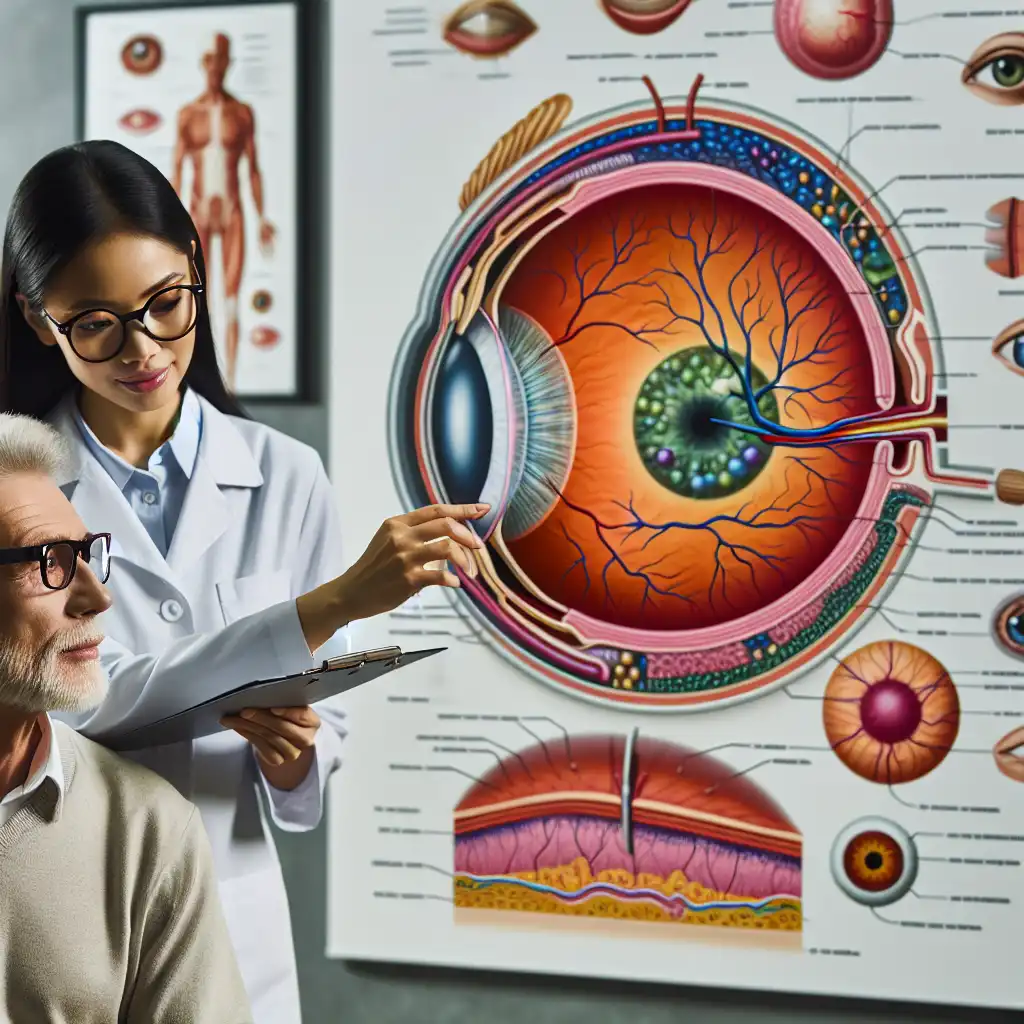
Referring to the vitreous humor, a jelly-like substance in the eye located between the lens and the retina.
The doctor explained the degeneration in the vitreous of his eye due to age.
Audio could not be loaded. Please try again later.
The word 'vitreous' is sometimes used to describe something that is glass-like or has a glassy appearance. For example, the vitreous humor in your eye is a clear, gel-like substance that helps maintain the shape of your eye. In the context of art or architecture, the term may refer to glass or glass-like materials used in construction. Overall, the word 'vitreous' is used to describe something that resembles or is related to glass in some way.
Bright typically refers to something that is highly reflective or emitting a lot of light. For example, a bright light bulb or a bright smile.
Bright is a more commonly used word that can be applied in a variety of contexts, while vitreous is a more technical term that is typically used in scientific or medical contexts.
Open word: Bright →Clear refers to something that is free from turbidity or cloudiness and is transparent.
Clear refers to transparency while vitreous relates to a glass-like quality.
Open word: Clear →Crystalline and vitreous are two different types of materials based on their atomic structure.
Crystalline refers to a material that has well-defined, structured patterns of atoms, with a repeating order. These materials have a specific internal arrangement of atoms, leading to the formation of crystal shapes like cubes, octahedrons, and spheres.
Crystalline materials are typically hard and have a defined melting point. Examples of crystalline materials include diamonds, salt, and quartz.
Both types of materials have their unique properties and applications. Crystalline materials are commonly used in electronics, construction, and jewelry due to their hardness, durability, and distinct shapes.
Open word: Crystalline →Both glassy and vitreous describe something that is like glass in appearance and texture.
However, glassy usually describes surfaces that are smooth and shiny, like glass. For example, you might describe a lake as glassy if it is still and reflective.
For example, you might describe a piece of jewelry made of glass as vitreous. Glassy describes the appearance of something, while vitreous describes its composition or material.
Open word: Glassy →Both glossy and vitreous describe a shiny or reflective surface, but glossy is generally used to describe something that is smooth, polished and shiny due to surface treatment such as varnish or wax.
In simple terms, shiny paint on a car would be described as glossy, while a shiny glass vase would be described as vitreous.
Open word: Glossy →Reflective refers to something that reflects light or other rays. An example would be a mirror, which reflects your image back at you.
Reflective and vitreous are not always interchangeable terms. While something may be both reflective and vitreous, they refer to different properties of a material.
Reflective describes how light behaves when it interacts with an object, while vitreous describes the physical properties of a material itself.
Open word: Reflective →Shiny and vitreous both refer to a surface quality, but they are used in different contexts.
Shiny refers to something that reflects light well, producing a bright and lustrous appearance.
It's a term we use to describe objects and surfaces that are smooth and polished. For example, we would describe a polished diamond or a freshly waxed car as shiny.
Vitreous refers to a glassy or shiny appearance that is more specific to minerals and rocks.
Shiny can describe anything that reflects light well, while vitreous is more specific to glassy surfaces found in minerals and rocks in the field of geology.
Open word: Shiny →Transparent refers to something that allows light to pass through without any obstruction or distortion. This could refer to glass or plastic that is clear, or water that you can see through.
Transparent describes something that is see-through, while vitreous describes something that has a glass-like quality.
Open word: Transparent →What are those floaty...
Watch on YouTube ↗The trouble with vitreous water is that vitrification should be impossible.